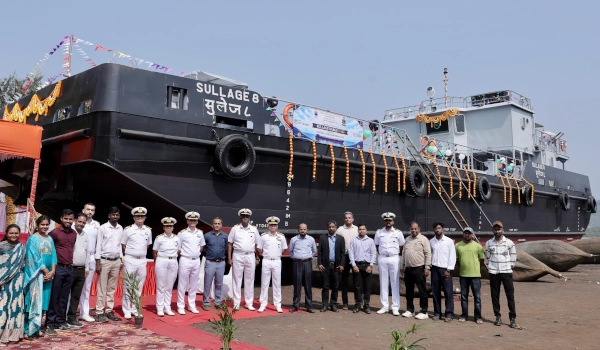
New Delhi, October 27, 2026: India’s indigenous naval shipbuilding programme achieved another milestone with the launch of the first 300-tonne Sullage Barge (Yard 142) and the keel laying of two additional naval barges at Suryadipta Projects Private Limited in Thane, Maharashtra, on October 26, 2026. The developments form part of the Indian Navy’s continuing efforts to strengthen its operational support infrastructure, improve maritime environmental management and encourage participation by domestic Micro, Small and Medium Enterprises (MSMEs) in defence shipbuilding.
The ceremony included the launch of Yard 142, the first vessel under a four-barge Sullage Barge programme, the keel laying of Yard 144, the third vessel in the same series, and the keel laying of Yard 148, the first Bottom Opening Dumb Barge under a separate three-vessel construction programme.
Rear Admiral Kapil Mehta, Assistant Controller of Warship Production and Acquisition (ACWP&A), attended the ceremony as the chief guest. The event marked progress in two indigenous naval auxiliary vessel programmes being executed by the Thane-based shipyard.
The Ministry of Defence stated that the vessels have been indigenously designed and built through collaboration between Suryadipta Projects, an Indian ship design firm and the Indian Register of Shipping (IRS).
Indian Navy Expands Indigenous Auxiliary Vessel Fleet
The Indian Navy’s maritime operations depend not only on major warships, submarines and aircraft but also on a network of auxiliary vessels that perform essential logistical, maintenance and harbour-support functions.
Naval barges form an important part of this infrastructure, supporting activities that enable larger naval platforms to remain operational and maintain readiness.
The latest construction milestones involve two categories of specialised barges developed to meet different operational requirements.
The four 300-tonne Sullage Barges are intended to support the collection and handling of liquid waste associated with maritime operations. Such vessels contribute to waste-management arrangements that allow naval platforms to comply with applicable marine pollution prevention requirements.
The three Bottom Opening Dumb Barges belong to a separate category of non-self-propelled vessels designed for transporting and discharging suitable materials through openings in their hull bottoms.
Together, the two programmes will add seven specialised barges to the Navy’s auxiliary support capabilities once construction, testing and delivery are completed.
First 300-Tonne Sullage Barge Launched at Thane
The launch of Yard 142 represents an important milestone in the Indian Navy’s programme for constructing four 300-tonne Sullage Barges.
The construction contract for these vessels was concluded with Suryadipta Projects Private Limited in November 2024.
Sullage barges are specialised vessels used in marine waste-management operations, particularly for collecting and transferring liquid waste from ships and other maritime facilities.
Modern naval vessels generate different categories of wastewater during routine operations. Appropriate collection, storage, transfer and disposal arrangements are necessary to prevent the uncontrolled discharge of pollutants into the marine environment.
Dedicated support barges can assist naval establishments in managing these requirements by providing facilities for the collection and movement of waste to appropriate shore-based reception or treatment systems.
The commissioning of new sullage barges could therefore strengthen the Navy’s ability to conduct harbour operations while maintaining environmental safeguards.
The launch of Yard 142 marks a construction milestone rather than its formal induction into naval service. The vessel will need to complete the remaining outfitting, testing, inspection and acceptance processes before operational deployment.
Keel Laid for Third Sullage Barge, Yard 144
The keel-laying ceremony for Yard 144, the third Sullage Barge in the programme, was conducted alongside the launch of Yard 142.
Keel laying is a significant stage in ship construction because it marks the formal commencement of the vessel’s principal hull-building phase.
The ceremony indicates the progress of the four-vessel construction programme at Suryadipta Projects.
Building multiple vessels under a common programme can allow shipyards to apply standardised design practices, utilise common components and improve manufacturing efficiency through repeated production.
Such advantages are particularly relevant for specialised auxiliary vessels, where consistent operational capabilities and maintainability are important considerations.
Once completed and inducted, the new sullage barges are expected to support the Navy’s growing requirements for maritime waste management and harbour services.
Construction Begins on First Bottom Opening Dumb Barge
Another important development was the keel laying of Yard 148, the first Bottom Opening Dumb Barge being constructed under a separate Indian Navy contract.
The Ministry of Defence awarded Suryadipta Projects a contract for three Bottom Opening Non-Propelled Barges on January 16, 2026.
According to the official contract announcement, the vessels are of 200-tonne capacity and are to be constructed under the classification rules of the Indian Register of Shipping.
A bottom-opening barge is designed with a mechanism that allows designated cargo or material to be discharged through openings in the bottom of the vessel.
Such barges are commonly associated with marine material-handling operations where controlled discharge is required.
The term dumb barge refers to a vessel without its own propulsion system. These barges generally require towing or another form of external assistance for movement.
The specific operational deployment of the Navy’s new bottom-opening barges will depend on its requirements and the vessels’ approved operating configurations.
The commencement of Yard 148’s construction marks the next phase in implementing the three-vessel programme.
Supporting Compliance with International Marine Pollution Regulations
An important objective of the new auxiliary vessel programmes is to support the Indian Navy’s compliance with applicable international marine pollution prevention standards.
The Ministry of Defence specifically identified the International Convention for the Prevention of Pollution from Ships, commonly known as MARPOL, as a relevant framework for the vessels.
MARPOL is the principal international convention addressing pollution from ships arising from both routine operations and accidental incidents.
The convention contains provisions covering several categories of ship-generated pollution, including oil, sewage, garbage and harmful substances.
Effective compliance requires suitable onboard systems, operational procedures and shore-support infrastructure for handling waste materials.
Specialised barges can contribute to this infrastructure by facilitating the collection and movement of designated waste streams.
The addition of new sullage barges is particularly relevant because naval vessels operating from ports and dockyards require reliable arrangements for managing wastewater and related liquid waste.
By strengthening these capabilities, the Indian Navy can improve environmental support arrangements associated with its maritime operations.
The construction of these vessels also reflects the increasing importance of environmental considerations in naval infrastructure development.
Suryadipta Projects Strengthens Its Role in Naval Shipbuilding
The latest milestones further demonstrate the participation of Indian MSME shipyards in meeting the Navy’s specialised vessel requirements.
Suryadipta Projects Private Limited, based in Thane, has previously undertaken construction projects involving ammunition, torpedo and missile transportation barges for the Indian Navy.
In March 2021, the Ministry of Defence concluded a contract with the company for the construction and delivery of 11 Ammunition Cum Torpedo Cum Missile (ACTCM) Barges.
These vessels were designed to support the transportation, loading and unloading of ammunition and related stores for naval platforms operating alongside jetties and at outer harbours.
The eleventh barge under that programme, LSAM 25 (Yard 135), was inducted at Naval Dockyard, Mumbai, on October 17, 2025, marking the completion of an important indigenous auxiliary vessel project.
The award of subsequent contracts for sullage barges and bottom-opening barges reflects the shipyard’s continued involvement in naval construction activities.
The Indian Navy’s procurement of vessels from MSME shipyards also supports the development of a broader domestic maritime manufacturing network.
Smaller shipyards can contribute to defence production by undertaking specialised projects while larger naval construction facilities concentrate on major surface combatants and other complex platforms.
This division of manufacturing responsibilities can help expand the overall capacity of India’s shipbuilding industry.
Indian Design and Classification Expertise Support Construction
The new barges are being developed through cooperation between the shipyard, an Indian ship design organisation and the Indian Register of Shipping.
The involvement of domestic design expertise is an important aspect of indigenous shipbuilding because vessel development requires specialised engineering knowledge concerning structural integrity, stability, operational safety and intended maritime functions.
The Indian Register of Shipping provides classification services involving the assessment of ships and marine structures against applicable technical rules and standards.
Classification requirements play an important role in ensuring that vessels are designed and constructed according to prescribed structural and safety criteria.
The participation of Indian design and classification organisations contributes to the development of technical capabilities within the domestic maritime sector.
Such collaborations also provide opportunities for shipyards to strengthen their experience in specialised vessel construction and integrate locally developed engineering solutions.
Make in India and Aatmanirbhar Bharat in Naval Support Infrastructure
The construction of indigenous naval auxiliary vessels forms part of India’s wider efforts to develop a self-reliant defence manufacturing ecosystem.
While major naval platforms often receive greater public attention, auxiliary vessels remain essential for sustaining routine naval operations.
The availability of domestically constructed support vessels can reduce dependence on foreign suppliers for specialised maritime requirements while creating opportunities for Indian shipyards, equipment manufacturers and technical service providers.
The Sullage Barge and Bottom Opening Dumb Barge programmes are aligned with the Government of India’s Make in India and Aatmanirbhar Bharat initiatives.
They also demonstrate how defence procurement can support industrial development beyond large public-sector shipyards by enabling MSMEs to participate in naval manufacturing.
The latest milestones at Thane highlight the continued expansion of indigenous production capabilities in specialised areas of maritime engineering.
Once delivered and inducted, the new barges are expected to strengthen the Indian Navy’s operational support infrastructure while contributing to improved environmental management and harbour operations.
The launch of Yard 142 and keel laying of Yards 144 and 148 therefore represent significant progress in India’s efforts to build a more capable, sustainable and domestically supported naval fleet.
References
- Ministry of Defence, Government of India. “Launch of Yard 142, and Keel Laying of Yard 144 and 148.” Press Information Bureau, 27 October 2026.
- Ministry of Defence, Government of India. “Indian Navy Signs Contract for Three ‘Bottom Opening Non-Propelled Barges’ with M/s Suryadipta Projects Private Limited, Thane.” Press Information Bureau, 19 January 2026. https://www.pib.gov.in/PressReleasePage.aspx?PRID=2216216
- Ministry of Defence, Government of India. “Delivery of Eleventh Ammunition Cum Torpedo Cum Missile (ACTCM) Barge, LSAM 25 (Yard 135).” Press Information Bureau, 17 October 2025. https://www.pib.gov.in/PressReleseDetailm.aspx?PRID=2180602
- Ministry of Defence, Government of India. “Delivery of Yard 133 (LSAM 23).” Press Information Bureau, 12 March 2025. https://www.pib.gov.in/PressReleseDetailm.aspx?PRID=2110906
You may also like
-
Indian Navy’s First Training Squadron Arrives in Colombo to Strengthen Maritime Cooperation
-
Indian Navy’s Next Generation Offshore Patrol Vessel Srishti Launched at Goa Shipyard
-
Rajnath Singh to Lead Indian Delegation at ASEAN Defence Summit in Philippines, Strengthening Indo-Pacific Security Cooperation
-
Bengaluru Startup Paar Autonomy Develops AI-Powered Drone Systems for GPS-Denied Environments
-
Sigma Advanced Systems Secures Fresh ₹973 Crore NATO Artillery Ammunition Order
