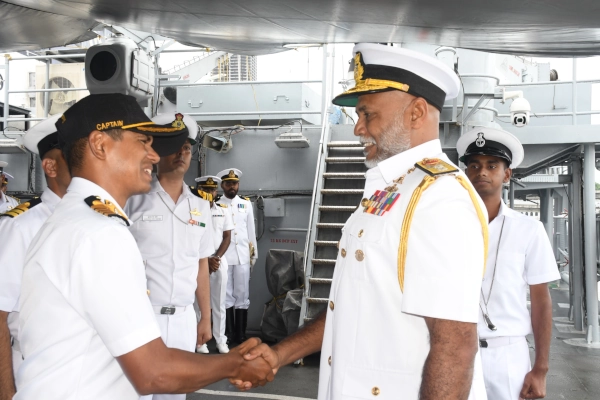
New Delhi, October 27, 2026: Three ships belonging to the Indian Navy’s First Training Squadron (1TS), comprising INS Tir, INS Sujata and Indian Coast Guard Ship (ICGS) Sarathi, arrived at Colombo, Sri Lanka, on October 26, 2026, as part of a training deployment aimed at strengthening maritime cooperation, professional exchanges and naval ties between India and Sri Lanka.
The ships received a ceremonial welcome from the Sri Lanka Navy, accompanied by a naval band, marking the beginning of their official port call. The visit provides an opportunity for Indian naval trainees to interact with their Sri Lankan counterparts while gaining practical exposure to international maritime cooperation and naval operational procedures.
The deployment forms part of the Indian Navy’s ongoing efforts to provide comprehensive sea training to personnel while strengthening professional relationships with friendly maritime nations in the Indian Ocean Region.
Indian Naval Training Ships Receive Ceremonial Welcome in Colombo
The arrival of INS Tir, INS Sujata and ICGS Sarathi at Colombo highlights the continuing maritime engagement between the Indian Navy, Indian Coast Guard and Sri Lankan naval authorities.
The Sri Lanka Navy formally welcomed the visiting ships, reflecting the established tradition of cooperation between the maritime forces of the two neighbouring countries.
Following their arrival, the Director General of Naval Training and the Commander of the Eastern Naval Area of the Sri Lanka Navy interacted with sea trainees aboard the visiting vessels.
The engagement provided an opportunity for the trainees to exchange perspectives on professional naval training and understand the operational practices followed by Sri Lankan naval personnel.
Such interactions are an important component of international naval training deployments, enabling young officers and sailors to gain exposure to the working environments, organisational cultures and professional practices of friendly maritime forces.
The port call also provides an opportunity for the participating ships’ crews to strengthen institutional relationships and develop greater familiarity with their Sri Lankan counterparts.
First Training Squadron Plays a Key Role in Naval Education
The Indian Navy’s First Training Squadron is responsible for providing practical sea training to naval personnel, forming an essential component of professional development within the service.
Sea training enables personnel to apply theoretical knowledge acquired at naval training establishments in real maritime operating conditions.
The training environment aboard naval ships exposes trainees to navigation, seamanship, ship handling, communication procedures, watchkeeping responsibilities and the coordination required for sustained operations at sea.
Training deployments also help personnel understand the importance of teamwork, discipline and operational awareness while functioning within the demanding environment of a naval vessel.
The presence of INS Tir and INS Sujata, along with Indian Coast Guard Ship Sarathi, provides opportunities for trainees to observe and participate in shipboard activities associated with different maritime roles.
International port visits further enrich these programmes by introducing trainees to foreign naval establishments and encouraging an understanding of maritime cooperation beyond national waters.
The Colombo visit is therefore both a training engagement and an opportunity to develop professional relationships with one of India’s closest maritime neighbours.
Cross-Training Visits and Professional Exchanges Planned
During the Colombo port call, personnel from the Indian and Sri Lankan navies will participate in a series of professional and training activities designed to promote the exchange of maritime knowledge.
The engagements will include cross-training visits, allowing personnel to familiarise themselves with the ships, equipment, operating procedures and training practices of their counterparts.
Cross-training activities provide useful exposure to different approaches to navigation, shipboard organisation, seamanship and maritime operations.
For young naval trainees, these interactions offer opportunities to observe how other maritime forces organise their professional responsibilities and maintain operational standards.
The exchanges can also encourage discussions on training methodologies, safety practices and operational coordination.
Such engagements are particularly relevant for neighbouring maritime nations whose naval forces frequently operate in adjoining sea areas and share an interest in maintaining a secure maritime environment.
The interactions are expected to contribute to greater professional understanding and reinforce the longstanding institutional relationship between the Indian Navy and Sri Lanka Navy.
Passage Exercise to Improve Naval Coordination
A significant component of the visit will be a Passage Exercise, commonly known as PASSEX, involving personnel and ships from the two navies.
Passage Exercises are conducted to strengthen coordination and familiarity between naval forces operating together at sea.
Depending on the participating vessels and operational requirements, such exercises can involve communication drills, coordinated manoeuvring, formation procedures and other basic seamanship activities.
These exercises allow ship crews to practise cooperation under real maritime conditions while developing an understanding of each other’s operational procedures.
The planned PASSEX during the Colombo visit will provide an opportunity for Indian and Sri Lankan naval personnel to strengthen their professional coordination.
For trainees embarked aboard the First Training Squadron, participation in or observation of such activities can provide valuable exposure to the practical requirements of multinational maritime operations.
The Ministry of Defence has confirmed that a Passage Exercise is planned as part of the port call. The detailed exercise programme and its outcomes have not yet been announced.
Community Outreach and Public Ship Visits
Beyond professional naval engagements, the visiting Indian ships will participate in community outreach activities during their stay in Colombo.
The programme includes opportunities for members of the public to visit the ships and interact with naval personnel.
Public ship visits allow visitors to gain a better understanding of naval life, maritime training and the responsibilities performed by personnel serving aboard Indian maritime vessels.
These activities can also encourage greater awareness of the role played by naval forces in maritime security, humanitarian assistance and regional cooperation.
Community engagement has traditionally been an important aspect of Indian naval visits to foreign ports, helping establish relationships beyond formal defence and military interactions.
The planned activities in Colombo will provide opportunities for direct contact between Indian naval personnel and the Sri Lankan community, reinforcing the broader people-to-people connections between the two countries.
India and Sri Lanka Share a Strategic Maritime Relationship
India and Sri Lanka occupy strategically significant positions in the Indian Ocean Region, with their maritime interests closely connected by geography, commercial shipping and regional security considerations.
The waters surrounding Sri Lanka lie near some of the Indian Ocean’s important international shipping routes, making maritime stability and coordination particularly relevant for both countries.
India and Sri Lanka have maintained cooperation in areas such as maritime surveillance, naval training, search and rescue, humanitarian assistance and maritime security.
The two countries also participate in bilateral naval engagements intended to strengthen operational understanding and cooperation between their maritime forces.
The India–Sri Lanka bilateral naval exercise SLINEX represents one of the established mechanisms through which the two navies undertake professional exchanges and maritime exercises.
Regular ship visits and training engagements complement such exercises by maintaining continuous interaction between naval personnel at different levels.
The deployment of the First Training Squadron to Colombo therefore contributes to a broader framework of defence and maritime cooperation between the two neighbouring countries.
Indian Coast Guard Participation Highlights Maritime Cooperation
The inclusion of ICGS Sarathi alongside the Indian Navy’s training ships reflects the contribution of different Indian maritime security organisations to regional engagement.
The Indian Coast Guard performs a range of responsibilities associated with maritime law enforcement, search and rescue, marine environmental protection and the protection of India’s maritime interests.
Its vessels operate in coordination with other maritime agencies, including the Indian Navy, while carrying out their assigned duties.
Participation in international deployments and professional interactions can help strengthen familiarity between maritime security organisations and support greater cooperation in areas of shared responsibility.
ICGS Sarathi’s presence in Colombo provides an additional dimension to the training deployment, demonstrating the involvement of both naval and coast guard platforms in India’s maritime outreach.
The combined visit also highlights the importance of coordinated maritime capabilities in addressing security and humanitarian requirements across the Indian Ocean Region.
Colombo Deployment Supports India’s MAHASAGAR Vision
The Ministry of Defence has linked the First Training Squadron’s Colombo visit to India’s MAHASAGAR vision, which stands for Mutual and Holistic Advancement for Security and Growth Across Regions.
The vision emphasises cooperation, shared security and inclusive development through engagement with regional and international partners.
In the maritime context, such cooperation includes professional exchanges, capacity-building initiatives, joint training and collaborative efforts to strengthen maritime stability.
Sri Lanka occupies an important place in India’s regional maritime engagement because of its geographical proximity and its location along major Indian Ocean shipping routes.
The First Training Squadron’s visit provides a practical example of cooperation through professional training, ship visits and planned operational interactions.
By promoting familiarity between personnel and strengthening institutional relationships, these activities can contribute to the broader objective of maintaining a stable and cooperative maritime environment.
Strengthening Naval Training and Regional Maritime Security
The arrival of INS Tir, INS Sujata and ICGS Sarathi in Colombo represents another step in the continuing maritime partnership between India and Sri Lanka.
The deployment combines practical training for Indian naval personnel with professional exchanges, planned maritime exercises and community engagement activities.
For the sea trainees, the visit provides exposure to international naval practices and the operational requirements of cooperating with friendly maritime forces.
For the Indian and Sri Lankan navies, it offers an opportunity to reinforce professional relationships and strengthen coordination through direct interaction.
The planned cross-training engagements and Passage Exercise are expected to contribute to mutual understanding and operational familiarity between the participating personnel.
As India continues to expand maritime cooperation across the Indian Ocean Region, training deployments involving neighbouring countries remain an important instrument of professional engagement and maritime diplomacy.
The First Training Squadron’s Colombo visit reflects this approach, combining naval education with India’s wider commitment to regional maritime security, cooperation and shared prosperity.
References
- Ministry of Defence, Government of India. “First Training Squadron of the Indian Navy Arrives at Colombo, Sri Lanka.” Press Information Bureau, 27 October 2026.
- Indian Navy, Government of India. Official information on the First Training Squadron, naval training deployments and international maritime cooperation. https://indiannavy.nic.in/
- Ministry of Defence, Government of India. Official releases concerning India–Sri Lanka naval cooperation and bilateral maritime exercises. https://pib.gov.in/
- Ministry of External Affairs, Government of India. Official information on India–Sri Lanka bilateral relations and maritime cooperation. https://www.mea.gov.in/
You may also like
-
India and Liechtenstein Explore Deeper Cooperation in Technology, Innovation and Advanced Manufacturing
-
India–Chile Free Trade Negotiations Near Conclusion as Talks with Canada Progress
-
Indian Navy Launches First Indigenous Sullage Barge, Begins Construction of Two More Vessels in Thane
-
Indian Navy’s Next Generation Offshore Patrol Vessel Srishti Launched at Goa Shipyard
-
Rajnath Singh to Lead Indian Delegation at ASEAN Defence Summit in Philippines, Strengthening Indo-Pacific Security Cooperation
