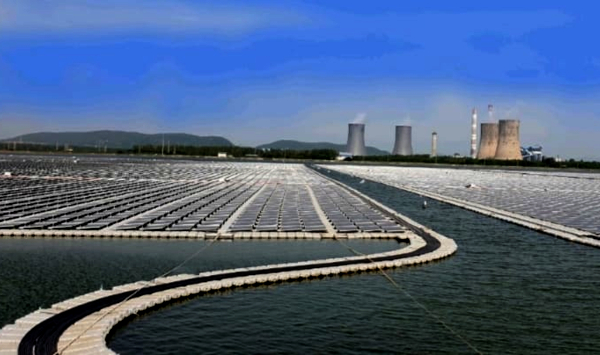
Indian climate-tech company Quantsolar Technologies is bringing indigenous floating-solar engineering into the international spotlight at the BRICS Bharat Innovates Exposition in New Delhi, where advanced floating photovoltaic technology is among the deep-tech innovations being showcased on September 11–12, 2026.
Contemporary coverage of the exposition specifically identifies an advanced floating solar PV platform for complex water bodies among the technologies on display at Bharat Mandapam. Bharat Innovates identifies Quantsolar Technologies as the Indian venture behind a platform matching that description.
The company’s technology is designed to place solar-generation systems on reservoirs, dams and industrial water bodies where conventional floating-solar installations can face difficult conditions including changing water levels, wind loads and complex hydrodynamics.
Solar Power Without Competing for Land
Floating photovoltaic systems address one of the constraints facing large solar developments: the amount of land required for utility-scale installations.
Instead of occupying agricultural or other terrestrial land, floating solar arrays place photovoltaic modules on buoyant structures over existing water bodies.
Quantsolar’s Bharat Innovates profile describes its system as a fully integrated floating-solar platform covering design, manufacturing, engineering, procurement, construction and long-term operation and maintenance.
The company’s own portfolio includes installations on reservoirs, dams, ponds and industrial water bodies across India. Its website says it has executed more than 20 floating-solar projects, including what it describes as India’s first megawatt-scale floating-solar installation at Visakhapatnam.
Proprietary Anchoring for Difficult Water Bodies
The more distinctive element of Quantsolar’s technology lies beneath the solar panels.
Floating-solar arrays must remain stable as water levels change and must withstand wind, waves and movement of the floating platform. The mooring and anchoring system therefore becomes a critical part of the installation.
Bharat Innovates says Quantsolar has developed proprietary flotation, anchoring and mooring systems engineered to operate with water-level variations of as much as ±20 metres and under complex hydrodynamic conditions.
The company also uses site-specific structural and elastic anchoring designs for reservoirs, dams and pumped-storage installations.
This allows the floating system to move with changing water levels while remaining securely positioned.
More Than 200 MW Already Deployed
Quantsolar is considerably beyond the prototype stage.
Its Bharat Innovates profile records more than 200 MW of deployment across over 25 projects, along with an in-house manufacturing capability of approximately 250 MW. It also lists more than 16 patents and design registrations associated with the company’s technology.
The company was founded in 2016 by Pankaj Kumar and Siddhant Agarwal, both with backgrounds in ocean engineering and naval architecture from IIT Kharagpur. That engineering background is particularly relevant to floating solar, where hydrodynamics, structural stability and mooring design are as important as photovoltaic engineering.
India Has More Than 102 GW of Floating-Solar Potential
The BRICS showcase comes at a time when the Government of India is giving greater attention to floating solar as a separate renewable-energy opportunity.
In June 2026, the Ministry of New and Renewable Energy said that more than 102 GWp of floating-solar PV potential has been assessed across India and announced plans for a dedicated floating-solar scheme.
That potential is particularly attractive because reservoirs associated with hydropower, irrigation and industrial facilities already possess large water surfaces that can potentially host electricity-generating infrastructure without requiring new land acquisition.
Floating panels can also provide partial shading of water surfaces and may reduce evaporation, although the actual benefit depends heavily on climate, reservoir characteristics and the proportion of the water surface covered.
From Indian Projects to International Markets
Quantsolar was among the 120 Indian deep-tech companies selected for Bharat Innovates 2026, which first showcased India’s emerging technology ecosystem in Nice, France, in June.
Bharat Innovates describes the company as an Energy ClimateTech venture developing floating-PV systems for complex water bodies. Its stated international strategy centres on using its anchoring and floating-system intellectual property to pursue large reservoir and industrial-water projects outside India.
The BRICS exposition now gives the technology another international platform, this time before investors, industry representatives and delegations from some of the world’s largest emerging economies.
For Quantsolar, that matters because floating solar is increasingly becoming an infrastructure-engineering business rather than simply a matter of placing conventional solar panels on floats.
Large projects require expertise in hydrodynamics, structural engineering, anchoring, electrical design, materials and long-term operation in harsh aquatic environments.
By developing much of that capability within India, Quantsolar represents an emerging segment of Indian climate deep tech in which the competitive advantage lies not just in manufacturing solar equipment, but in engineering complete systems for difficult operating environments.
The BRICS showcase therefore gives Indian floating-solar technology something increasingly important: visibility beyond the domestic renewable-energy market and an opportunity to compete for large-scale clean-energy infrastructure projects internationally.
You may also like
-
Solar Defence Facility Images Show Large Loitering Munition Airframe Linked to 150 Kg CSIR-NAL Programme
-
Jindal Defence Taurus T9 Machine Pistols Move Through Indian Army Integration Under 550-Weapon Order
-
India Demonstrates First 5.56 km Free-Space Quantum Key Distribution Link
-
India’s Expanding Free Trade Network Could Cover 75% of Global Trade
-
LC3: The Indian-Backed Cement Technology That Could Change How India Builds
