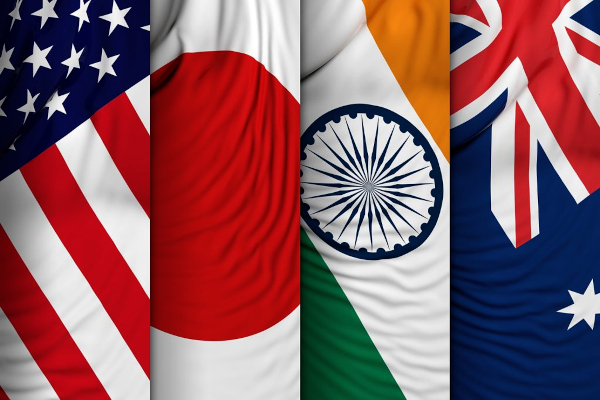
India will host the Quad Foreign Ministers’ Meeting in New Delhi on 26 May 2026, bringing together the foreign ministers of India, Australia, Japan and the United States at a time when the Indo-Pacific remains central to global strategic calculations. The meeting will be attended by External Affairs Minister Dr. S. Jaishankar, Australian Foreign Minister Penny Wong, Japanese Foreign Minister Toshimitsu Motegi and US Secretary of State Marco Rubio.
The meeting is being held at India’s invitation and will continue the discussions held by Quad ministers in Washington, D.C. on 1 July 2025. According to the Ministry of External Affairs, the ministers will exchange views on advancing Quad cooperation, review progress on ongoing initiatives, and discuss recent developments in the Indo-Pacific and other international issues of mutual concern.
The venue itself carries diplomatic weight. The Quad Foreign Ministers’ Meeting is scheduled for 0900 hrs at Hyderabad House, followed by joint press statements at 0950 hrs. Hyderabad House has often served as the setting for India’s high-level diplomatic engagements, and the choice of venue underlines the political importance New Delhi attaches to the meeting.
The Quad has evolved from a strategic consultation platform into a practical cooperation mechanism across maritime security, resilient supply chains, technology, cyber security, health, infrastructure, climate action and people-to-people partnerships. Its central idea remains a free, open, inclusive and rules-based Indo-Pacific, where countries can pursue development without coercion, disruption or strategic pressure.
For India, hosting the meeting reinforces its position as a major Indo-Pacific power with strong ties across the Indian Ocean, Southeast Asia, the Pacific and the wider democratic technology network. New Delhi’s role is especially important because India sits at the heart of the Indian Ocean, a region through which vital energy flows, trade routes and undersea connectivity networks pass.
The meeting also comes at a time when maritime security has become one of the Quad’s most practical areas of convergence. The Indo-Pacific is not an abstract map for the four countries; it is the world’s busiest commercial sea space, carrying trade, energy, data cables and strategic movement. For India, the Indian Ocean is both an economic lifeline and a security responsibility. For Japan and Australia, maritime stability is tied to trade routes and regional balance. For the United States, the Indo-Pacific remains central to alliance commitments and global presence.
Another important area is technology cooperation. Earlier Quad discussions have included work on trusted telecommunications, Open RAN, semiconductor supply-chain resilience, artificial intelligence, cyber capacity building and protection of critical infrastructure, including undersea cables. These are not symbolic themes; they are the foundations of modern national power. Secure networks, reliable chips, trusted digital systems and resilient cyber architecture now matter as much as ports, ships and aircraft.
The New Delhi meeting is therefore expected to review how far these initiatives have moved from declaration to delivery. The Quad’s credibility depends on visible outcomes: capacity building in the Indo-Pacific, secure technology ecosystems, maritime domain awareness, resilient supply chains, better disaster response coordination and practical support to smaller regional partners.
The presence of all three visiting ministers also gives India an opportunity to hold important bilateral engagements on the sidelines. The Ministry of External Affairs has said the foreign ministers of Australia and Japan, along with the US Secretary of State, are expected to hold bilateral meetings with Dr. Jaishankar and call on Prime Minister Narendra Modi during their visit.
These side meetings are important because the Quad is built on strong bilateral foundations. India-Australia ties have expanded in defence, education, critical minerals, trade and the Indian Ocean. India-Japan relations remain anchored in infrastructure, connectivity, technology, investment and strategic coordination. India-US ties cover defence, energy, technology, trade, education, space and regional security. The Quad works best when these bilateral partnerships remain healthy and active.
The timing of the meeting also gives it added significance. The Indo-Pacific is witnessing sharper strategic competition, supply-chain restructuring, maritime friction, cyber threats and concerns over economic coercion. The Quad does not function as a military alliance, but it gives four major democracies a platform to coordinate policies, pool strengths and support regional stability.
For India, the Quad also fits into a broader diplomatic pattern. New Delhi has maintained strategic autonomy while deepening partnerships with like-minded countries. It engages the Quad, BRICS, SCO, G20, ASEAN-led platforms and bilateral partnerships with equal seriousness. This multi-alignment gives India flexibility: it can cooperate with the Quad on the Indo-Pacific without reducing its independent voice on global issues.
The New Delhi meeting is also likely to send a message to smaller Indo-Pacific countries. Many regional states want infrastructure, climate resilience, digital connectivity, health security, disaster support and maritime awareness, but they do not want to be trapped in great-power rivalry. The Quad’s challenge is to offer practical benefits without appearing as a closed bloc. India’s diplomatic style, with its emphasis on inclusivity and development partnership, can help shape that balance.
The joint press statements after the meeting will be closely watched for signals on maritime security, regional developments, technology cooperation and future Quad initiatives. The wording will matter. Strong language may indicate sharper strategic alignment, while a delivery-focused statement may highlight practical cooperation across sectors.
India hosting the Quad Foreign Ministers’ Meeting on 26 May 2026 therefore marks more than another diplomatic calendar event. It places New Delhi at the centre of a major Indo-Pacific conversation, where security, technology, supply chains, maritime stability and regional development are all linked. The meeting will show how the Quad intends to move forward in a world where partnerships are increasingly judged not by slogans, but by delivery.
You may also like
-
Côte d’Ivoire Military Delegation Visits HAL, Shows Interest in India’s Indigenous Aerospace Platforms
-
India and Netherlands Move to Deepen Agricultural Cooperation in Seeds, Horticulture and Innovation
-
Tarang Shakti Delegates from 28 Countries Visit HAL and BEL to Explore India’s Defence Manufacturing Ecosystem
-
Swiss President Guy Parmelin to Visit India as EFTA Economic Partnership Deepens
-
India and Brazil Move to Expand Mercosur Trade Pact Beyond 450 Tariff Lines
