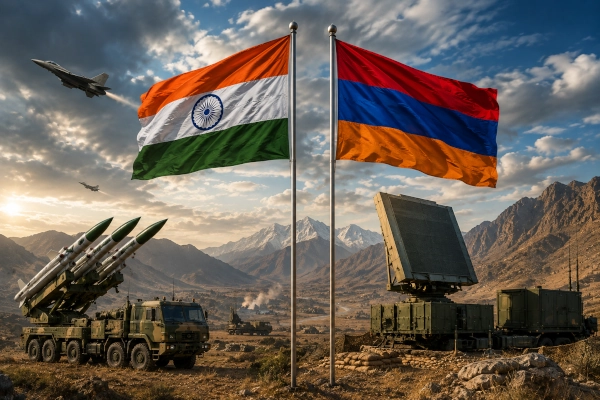
India and Armenia have opened a new phase in their rapidly expanding defence relationship by signing a Memorandum of Understanding covering research, development, innovation and shared production in the defence industry.
The agreement was signed in Yerevan on August 17, 2026, during an official visit by Indian Defence Secretary Rajesh Kumar Singh. He held a series of meetings with Armenia’s political, defence and military leadership during the two-day visit.
The Indian Ministry of Defence confirmed that Singh met Armenia’s Minister of High-Tech Industry Davit Tadevosyan, after which the two sides signed the new MoU. According to the ministry, India and Armenia intend to expand defence-industrial cooperation in areas of mutual interest through research, technological development, innovation and shared production.
The agreement represents an important progression in the relationship. India and Armenia are no longer discussing defence cooperation only in terms of government-to-government interaction or procurement. The new framework explicitly introduces cooperation in the development and production of defence technologies.
Defence Secretary Arrived in Armenia on August 16
Rajesh Kumar Singh arrived in Armenia on August 16, 2026, beginning a two-day official visit to the country.
The Armenian Ministry of Defence independently confirmed his arrival on August 16, providing an important second official source for the visit. The Indian Ministry of Defence also announced that Singh had arrived in Yerevan and would hold discussions aimed at shaping future India-Armenia defence and strategic cooperation.
His programme on August 17 included meetings with Defence Minister Suren Papikyan, Chief of General Staff Lieutenant General Edvard Asryan and High-Tech Industry Minister Davit Tadevosyan.
The breadth of these meetings is significant. They involved Armenia’s defence policymaking establishment, its senior military leadership and the ministry responsible for the country’s high-technology and military-industrial sectors.
Rajesh Kumar Singh Meets Armenian Defence Minister Suren Papikyan
Defence Secretary Singh first held talks with Armenian Defence Minister Suren Papikyan.
The Armenian Ministry of Defence said Papikyan welcomed the progress achieved in cooperation between the two countries. The discussions covered Armenia-India defence cooperation, including military-technical cooperation, as well as regional and international security issues.
India’s Ministry of Defence said the two sides explored new avenues for expanding bilateral defence cooperation and reaffirmed their intention to deepen the partnership. Indian Ambassador to Armenia Nilakshi Saha Sinha also participated in the meeting.
The reference to military-technical cooperation is particularly important because it places defence industry, technology and equipment cooperation alongside the broader political relationship.
New Framework Between the Two Armed Forces
Singh also met Lieutenant General Edvard Asryan, Armenia’s First Deputy Defence Minister and Chief of the General Staff.
The Armenian Ministry of Defence disclosed an additional development from this meeting that adds further significance to the visit.
According to the Armenian side, India and Armenia exchanged a document defining a new format of cooperation between the General Staffs of their armed forces, acting under a previously reached agreement.
The Indian Ministry of Defence said the discussion with Asryan focused on strengthening the defence partnership, with particular attention to defence-industrial cooperation and defence research and development.
This means the August 17 engagements produced movement on two related tracks: military-to-military cooperation between the armed forces and industrial-technological cooperation between the two countries.
MoU Signed With Armenia’s High-Tech Industry Ministry
The most important industrial outcome came during Singh’s meeting with Davit Tadevosyan, Armenia’s Minister of High-Tech Industry.
The Indian Ministry of Defence officially announced that the two sides signed an MoU covering research, development, innovation and shared production in the defence industry.
Armenia’s government identifies Tadevosyan as the country’s current Minister of High-Tech Industry. The ministry has responsibility for areas including communications, information technology, information security and military industry, making it a key institution in Armenia’s defence-industrial ecosystem.
The wording of the agreement is noteworthy. Cooperation in research and development can allow Indian and Armenian organisations to work together at the technology-development stage. Innovation cooperation could bring research institutions, defence companies and technology enterprises into common programmes.
Most significantly, the reference to “shared production” creates a formal basis for industrial collaboration rather than restricting the relationship to the purchase and sale of finished defence products.
However, the official announcement does not yet identify specific weapons, platforms, companies, production sites, investment commitments or joint-development programmes under the new MoU. Claims that a particular missile, artillery system or other weapon will now be jointly manufactured should therefore be treated as speculation unless either government announces such a project.
Defence Cooperation Has a Long Institutional Foundation
Although defence relations between India and Armenia have accelerated in recent years, the formal framework is not new.
Official records maintained by the Embassy of Armenia in India show that the two governments signed an MoU on cooperation in the defence sphere on May 23, 2003.
The August 2026 agreement therefore does not create India-Armenia defence relations from scratch. Instead, it adds a more specialised industrial and technological layer to a framework that has existed for more than two decades.
The latest MoU is especially significant because it specifically identifies R&D, innovation and production, areas that can produce a deeper and more durable relationship than straightforward equipment procurement.
High-Level Defence Exchanges Accelerated in 2026
The Yerevan visit also follows a series of senior military exchanges during 2026.
Official Armenian records show that India’s then Chief of Defence Staff General Anil Chauhan visited Armenia in February 2026. Armenia’s Chief of General Staff and First Deputy Defence Minister Edvard Asryan subsequently visited India in April.
Armenia’s Ministry of Defence provides further details of the April engagement. Asryan arrived in India on April 27, 2026, and held discussions with General Chauhan and Defence Secretary Rajesh Kumar Singh.
The two sides reviewed ongoing bilateral defence cooperation and discussed regional security. Armenia said the meetings resulted in agreements to deepen cooperation in several professional areas.
That April meeting now appears particularly relevant because Armenia’s August 17 announcement says the two General Staffs exchanged a document establishing a new format of cooperation under a previously reached agreement.
Taken together, the February, April and August exchanges point to a more structured relationship rather than occasional defence contacts.
From Defence Trade Towards Technology Partnership
The new MoU potentially marks a change in the character of India-Armenia defence cooperation.
Traditional defence exports create a supplier-customer relationship. Joint research, technology development and shared production can create a much deeper connection because engineers, defence companies, government agencies and research institutions from both countries may become involved.
For India, such cooperation fits its wider effort to expand the international footprint of its domestic defence industry while creating opportunities for Indian public and private companies to participate in overseas partnerships.
For Armenia, closer industrial cooperation with India offers another avenue for developing defence technologies and strengthening military-technical capabilities.
The exact commercial impact will depend on the projects selected under the MoU. Neither government has yet announced a list of programmes that will be jointly developed or produced.
A Broader India-Armenia Defence Architecture Is Emerging
Another important aspect of the August 17 visit is that the industrial MoU was not negotiated in isolation.
On the same day, Singh discussed military-technical cooperation with Defence Minister Papikyan, defence R&D and industrial cooperation with General Asryan, and research, innovation and production with High-Tech Industry Minister Tadevosyan. The two General Staffs also moved towards a new institutional format for military cooperation.
Together, these developments indicate that the relationship is broadening across government-to-government, military-to-military and defence-industry channels.
That is potentially more important in the long term than any individual defence sale. A structured framework can support recurring exchanges, technology programmes, industrial partnerships and future co-development opportunities.
India-Armenia Defence Relationship Enters a New Stage
The August 17 agreement is nevertheless an important development.
India and Armenia already had a formal defence cooperation arrangement dating to 2003. The increased frequency of senior-level exchanges in 2026 has now been followed by an agreement explicitly targeting defence technology, innovation and production.
The framework produces concrete projects, the relationship could evolve beyond arms procurement into co-development, technology collaboration and shared manufacturing.
That would give India another international partner for its expanding defence-industrial ecosystem while providing Armenia with access to a growing source of defence technology and industrial cooperation.
Sources
Ministry of Defence, Government of India — August 17, 2026: Official confirmation of the meeting between Defence Secretary Rajesh Kumar Singh and Armenian High-Tech Industry Minister Davit Tadevosyan and the signing of the MoU on research, development, innovation and shared production.
Ministry of Defence of the Republic of Armenia — August 17, 2026: Official account of Singh’s meeting with Defence Minister Suren Papikyan, confirming discussions on defence and military-technical cooperation.
Ministry of Defence of the Republic of Armenia — August 17, 2026: Official account of Singh’s meeting with Lt Gen Edvard Asryan and confirmation of the document establishing a new format of cooperation between the two General Staffs.
Ministry of Defence of the Republic of Armenia — August 16, 2026: Official confirmation of Defence Secretary Rajesh Kumar Singh’s arrival in Armenia.
Embassy of Armenia in India: Official bilateral-relations record showing the 2003 defence-cooperation MoU and the high-level Indian and Armenian defence visits in 2026.
Ministry of High-Tech Industry, Republic of Armenia: Official record identifying Davit Tadevosyan as Minister of High-Tech Industry and detailing the ministry’s role in Armenia’s military-industrial sector.
You may also like
-
India Moves Towards Five-Year Assured Orders for Defence Startups Under New Procurement Reforms
-
India and Italy Hold First Maritime Security Dialogue in Rome, Strengthen Strategic Maritime Cooperation
-
India and Azerbaijan Agree to Strengthen Security, Trade, Energy and Economic Cooperation
-
Zen Technologies Introduces Indigenous Hyper-Strike Falcon AI-Guided Counter-Drone Interceptor
-
L&T and Germany’s SCHOTTEL Expand Partnership for Controllable Pitch Propeller Systems in Indian Shipbuilding
