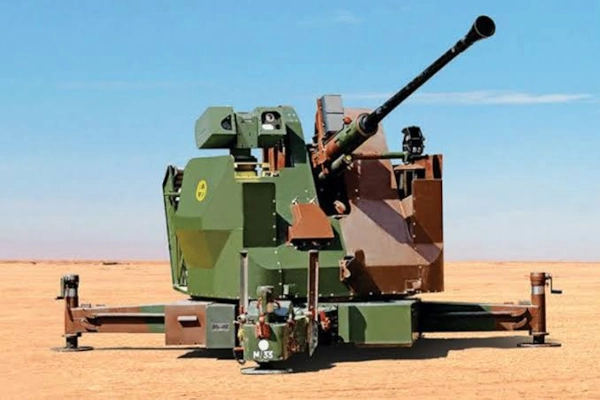
India is set to extend maintenance support to the Sri Lanka Air Force for six remaining 40mm L70 anti-aircraft guns as part of a new defence arrangement expected during Defence Minister Rajnath Singh’s visit to the island nation.
Sri Lankan Foreign Affairs Minister Vijitha Herath said on September 8 that three defence-related agreements are expected to be exchanged during Singh’s visit. One of them covers Indian support for air-defence systems already operated by the Sri Lanka Air Force.
India supplied Sri Lanka with 24 L70 air-defence guns between 2000 and 2006. According to Herath, India has subsequently provided free maintenance support for 18 of those weapons. The proposed arrangement will extend similar support to the remaining six guns.
This is therefore not an agreement for Sri Lanka to acquire a new Indian surface-to-air missile system or a fresh batch of anti-aircraft guns. It is concerned with keeping an existing Sri Lankan capability operational.
The agreement comes during Rajnath Singh’s three-day visit to Sri Lanka from September 8 to 10. India’s Ministry of Defence said before the visit that discussions would cover the broader bilateral relationship, with particular emphasis on maritime and defence cooperation.
What the L70 still offers
The 40mm L70 is an old weapon by modern air-defence standards, but the basic gun remains useful for short-range protection against targets operating at low altitude.
The system was originally developed by Sweden’s Bofors and has served with numerous armed forces for decades. India itself inducted L70 guns in the 1960s and subsequently manufactured them under licence.
Its enduring usefulness comes from the economics of gun-based air defence. Missiles are essential against faster and more distant threats, but using an expensive interceptor against every small drone can quickly become uneconomical. A rapid-firing gun can provide a cheaper last layer of defence against drones, helicopters and other targets that enter its engagement envelope.
The Indian experience also shows how much additional life can be extracted from the basic weapon when its electronics are modernised.
Bharat Electronics Limited has developed an upgraded L70 configuration incorporating all-electric drives, an integrated fire-control system, thermal imaging, day television, a laser rangefinder and automatic ballistic computation. The gun can also be linked to tactical and fire-control radars.
India’s upgraded L70s have consequently become quite different from the manually aimed guns originally fielded decades ago. DRDO material published following Operation Sindoor described upgraded Indian L70s as part of the air-defence network used against incoming drones in 2025.
There is no indication at present that the agreement with Sri Lanka includes this level of modernisation. The Sri Lankan government has described the arrangement as maintenance support. Unless either government subsequently announces an upgrade package, it should be treated as a programme to restore or sustain the existing guns rather than convert them to the latest Indian configuration.
Why maintaining six guns is still useful
For a relatively small air force, restoring six additional guns is not insignificant.
Sri Lanka does not face the same air-defence requirements as India, but it still has military airfields, ports, command centres and other installations that require protection. A functioning L70 battery can contribute to local point defence, particularly against low-altitude threats.
The proliferation of inexpensive unmanned aircraft has also made gun-based systems relevant again. Small drones can be difficult to justify engaging with costly surface-to-air missiles, especially when they are used in numbers.
The gun itself is only one part of an effective modern counter-air system. Its usefulness depends heavily on how quickly a target can be detected, tracked and handed over to the weapon. Radar cueing, electro-optical sensors, fire-control equipment and suitable ammunition can therefore be as important as the gun mechanism.
India has substantial experience in precisely this field. BEL’s upgraded L70 system incorporates radar interfaces and electro-optical tracking, while DRDO’s Air Defence Fire Control Radar is designed to work with anti-aircraft guns for short- and very-short-range point defence. The radar can detect low-flying targets and automatically provide tracking and fire-control information to L70 batteries.
That technical base gives India the ability to provide more extensive support in the future should Sri Lanka seek to modernise the guns rather than merely maintain them. No such programme has yet been announced.
Part of a wider defence relationship
The L70 arrangement follows the broader India-Sri Lanka Defence Cooperation MoU signed in April 2025 during Prime Minister Narendra Modi’s visit to Colombo. Sri Lanka’s Presidential Secretariat listed defence cooperation among seven agreements exchanged during that visit.
Two other agreements expected during Rajnath Singh’s current visit concern cooperation between the National Cadet Corps organisations of the two countries and between their respective National Defence Colleges.
These measures are modest individually, but they show how the defence relationship is developing through practical areas such as training, equipment support and institutional exchanges rather than through major weapons purchases alone.
For Sri Lanka, extending the service life of equipment it already owns avoids the immediate cost of replacing functioning weapon systems. For India, maintenance support provides another way to deepen defence ties with a close maritime neighbour while using capabilities already available within its defence-industrial base.
The immediate agreement concerns only six existing L70 guns. Its broader relevance lies in the model it represents: India supporting the availability and sustainment of defence equipment already operated by neighbouring countries, with the possibility of more substantial modernisation cooperation if requirements develop later.
You may also like
-
India Moves Towards Five-Year Assured Orders for Defence Startups Under New Procurement Reforms
-
India and Italy Hold First Maritime Security Dialogue in Rome, Strengthen Strategic Maritime Cooperation
-
India and Azerbaijan Agree to Strengthen Security, Trade, Energy and Economic Cooperation
-
Zen Technologies Introduces Indigenous Hyper-Strike Falcon AI-Guided Counter-Drone Interceptor
-
L&T and Germany’s SCHOTTEL Expand Partnership for Controllable Pitch Propeller Systems in Indian Shipbuilding
