India has begun examining whether Small Modular Reactors could form part of the future electricity system of the Andaman and Nicobar Islands, with scientists from the Bhabha Atomic Research Centre carrying out site inspections across the Union Territory.
A BARC team under the Department of Atomic Energy visited the islands from September 4 to 8 to assess potential locations across all three districts. The exercise follows a recommendation to examine nuclear power as electricity requirements rise alongside a series of major infrastructure projects. The scientists also met Lieutenant Governor Admiral D K Joshi and presented details of potential sites and other aspects of the proposal.
What makes the assessment significant is the nature of the islands’ electricity system.
Unlike mainland India, the archipelago does not operate as one interconnected grid. Individual islands and groups of islands depend on separate generating systems because they are separated by large stretches of sea. The Nicobar district administration notes that this geography prevents the existence of a single electricity grid serving the entire territory.
For decades, that has made diesel generation particularly important. Fuel has to be transported by sea, stored locally and supplied to generating stations spread across the islands. Solar and hydroelectric capacity have reduced some of that dependence, but providing round-the-clock electricity remains more difficult than it is on the mainland.
The Andaman and Nicobar Administration has set a goal of sharply reducing diesel use. Lieutenant Governor Joshi said earlier this year that diesel’s share of generation had fallen to about 70%, while solar had risen to around 25%. The administration is aiming to bring diesel dependence into single digits over the next three years, with solar and LNG expected to take a larger role. An undersea high-voltage direct-current link with the mainland has also been examined.
Small reactors are now being considered as another option.
Why SMRs could fit an island power system
The attraction of an SMR is not simply that it is a smaller nuclear reactor.
India’s Department of Atomic Energy specifically identifies remote locations without grid connectivity as one of the applications for which SMRs are being developed. The government also sees them as possible captive power plants for industry and replacements for retiring fossil-fuel generating stations.
That makes the technology relevant to the Andaman and Nicobar Islands.
A nuclear unit can provide electricity continuously rather than only when sunlight or wind conditions permit. In an isolated electricity system, such firm generation can reduce the amount of diesel capacity required to balance renewable power.
It could also support infrastructure that requires dependable electricity around the clock.
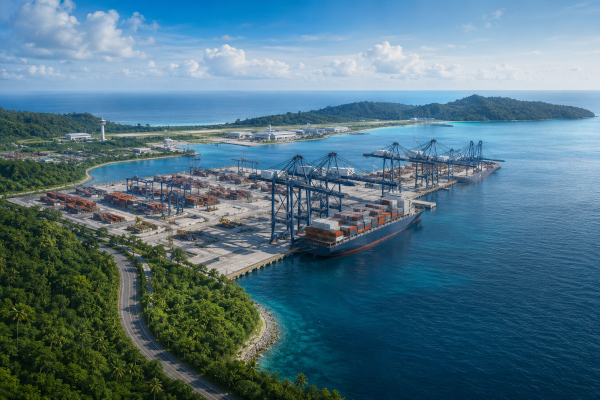
Projects planned in the islands include an International Container Transhipment Terminal, a greenfield airport and deep-water multipurpose port facilities. Great Nicobar in particular is expected to see a substantial increase in electricity demand as the proposed transhipment terminal, airport, township and associated infrastructure are developed.
Ports need electricity for cargo handling, communications, lighting, navigation systems, maintenance and increasingly for electrically powered equipment. Airports, water-treatment plants, telecommunications networks and other critical infrastructure similarly require reliable supply.
On an island, a prolonged interruption in fuel deliveries can also have a greater effect than on the mainland. A reactor with a long fuel cycle could therefore provide a different kind of energy security from diesel or LNG generation.
India already has two power-producing SMRs under development
The Andaman assessment coincides with a much larger national programme to develop indigenous small reactors.
Under the Nuclear Energy Mission, the government has allocated ₹20,000 crore for SMR research, design, development and deployment, with a target of operationalising at least five indigenous reactors by 2033.
BARC is developing two electricity-producing designs: the 220 MWe Bharat Small Modular Reactor, or BSMR-200, and a much smaller 55 MWe SMR-55. A separate high-temperature gas-cooled reactor of up to 5 MW thermal capacity is being developed for hydrogen production.
The government has not said which, if either, of the two power-reactor designs could eventually be considered for the Andaman and Nicobar Islands.
That distinction is important. An isolated island network is very different from the national grid. The size of a generating unit has to be matched carefully with local demand because the sudden shutdown of one large plant can remove a substantial proportion of available electricity at once.
Any eventual reactor configuration would therefore have to be designed around the actual load of the island or group of islands it serves, along with sufficient backup generation and transmission capacity.
The first demonstration units of India’s SMRs are planned at existing Department of Atomic Energy sites rather than in the islands. The government has said the reactors would require roughly 60 to 72 months to establish after administrative and financial sanction.
An Andaman project, if eventually approved, should consequently be viewed as a medium- to long-term option rather than an immediate replacement for diesel power.
The difficult part will be selecting the site
Building a nuclear reactor on an island poses requirements that go well beyond finding sufficient land.
The Andaman and Nicobar region requires particularly careful evaluation of seismic and coastal hazards. India’s Atomic Energy Regulatory Board requires prospective nuclear sites to undergo assessment for earthquakes, geotechnical hazards, flooding, cyclones, tsunamis, shoreline effects and the availability of emergency arrangements and essential infrastructure.
AERB’s licensing process also requires nuclear facilities to obtain approvals in stages covering siting, construction, commissioning, operation and eventually decommissioning. Site consent involves geological, hydrogeological, environmental and radiological studies as well as consideration of emergency response arrangements.
Those requirements assume added importance in an archipelago.
Heavy reactor components would have to reach the site by sea. Ports, roads and lifting facilities would have to support their movement. Fresh nuclear fuel, specialised equipment and replacement components would require secure logistics, while arrangements would be necessary for radioactive waste and spent fuel.
Emergency planning would also have to account for communities that may be separated from larger medical and administrative centres by considerable distances.
None of those issues rules out an SMR. They explain why BARC is inspecting possible sites well before any construction decision.
Nuclear power would complement, rather than replace, other options
An SMR programme would also need to be considered alongside the islands’ rapidly expanding renewable-energy capacity.
Solar power is particularly suited to the region and can reduce imported fuel consumption substantially. Battery storage can extend its usefulness after sunset, while LNG generation and potentially a future mainland electricity connection offer other ways of providing firm capacity.
A nuclear plant would serve a different role: For now, however, the programme remains an assessment.supplying a relatively steady block of electricity for long periods.
The practical question is therefore not whether the islands should choose nuclear power instead of solar power. It is whether a future combination of solar, storage, nuclear generation and other firm power sources can provide electricity more reliably and with less dependence on imported diesel.
That question will become more pressing as Great Nicobar and other parts of the archipelago add ports, aviation facilities, communications networks and other infrastructure.
The September BARC survey is the first concrete indication that SMRs are now being examined at site level rather than only discussed as a long-term possibility. The Andaman and Nicobar Administration had already publicly referred to exploring SMR technology and its aim of moving towards de-dieselisation.
BARC must first determine whether technically suitable locations exist. Any proposal would then have to pass nuclear safety, environmental, engineering and financial scrutiny before a reactor could move towards construction.
The importance of the current exercise lies precisely there: India is now testing whether its emerging indigenous SMR programme can solve one of the more difficult power problems for which small reactors have long been proposed — providing reliable electricity to a remote, fragmented and strategically important island system.
You may also like
-
ICAR Scientists Develop Indigenous Protective Gloves for Cotton Farmers, Sign Commercial Manufacturing Agreement
-
BHEL–Coal India Joint Venture Begins Construction of ₹25,016 Crore Indigenous Coal Gasification Project in Odisha
-
PM Modi to Inaugurate RBI’s Tier IV Data Centre and Cybersecurity Training Institute in Bhubaneswar
-
India Creates 11 Crore Digital Farmer IDs Five Months Ahead of Target, Strengthening AgriStack Infrastructure
-
Chak-Hao Black Rice of Manipur and Nagaland: The Aromatic Purple Heritage Grain with GI Recognition
