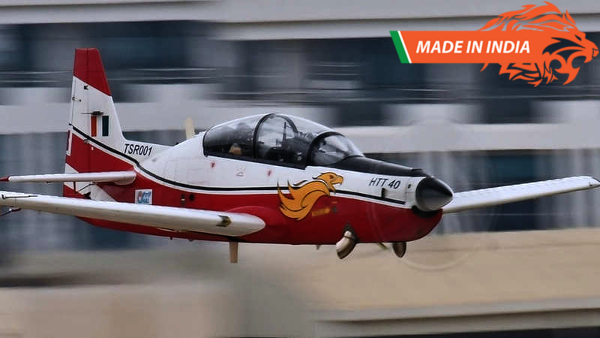
Hindustan Aeronautics Limited expects to begin deliveries of the indigenous HTT-40 basic trainer to the Indian Air Force during FY2026-27 and is targeting more than 20 aircraft during the year, signalling that one of the IAF’s delayed aircraft programmes is finally moving towards serial induction.
HAL provided the clearest official update on the programme during its investor interaction on May 15, 2026. Asked whether HTT-40 deliveries would begin in FY2026-27 or FY2027-28, company management replied that deliveries would start in FY2026-27.
HAL Chairman and Managing Director Ravi Kota said the supply problem involving the aircraft’s Honeywell engines, which had affected the programme during the preceding months, had stabilised. HAL expected engine deliveries to resume and was planning to deliver “around 20 plus” HTT-40s during the financial year.
That number is significant because it indicates HAL is preparing for a production ramp rather than a slow introduction of the aircraft. Kota said HTT-40 manufacturing is now supported by two production lines — one in Bengaluru and another in Nashik — giving the company additional capacity to accelerate deliveries once engines and other components arrive consistently.
HAL had already completed the maiden sortie of the first series-production HTT-40 on October 24, 2025. In its May investor presentation, the company said deliveries of the trainer were expected to contribute to manufacturing revenue during the current financial year and confirmed that production capacity had been expanded at both Bengaluru and Nashik.
A 70-Aircraft Programme
The Ministry of Defence signed a contract with HAL in March 2023 for 70 HTT-40 basic trainer aircraft at a cost of ₹6,828.36 crore. The package also includes associated equipment and training aids, including simulators.
The aircraft is intended for the initial stage of military flying instruction, where trainee pilots learn basic aircraft handling before progressing to more advanced trainers and eventually operational aircraft.
The HTT-40 is a tandem-seat turboprop designed and developed by HAL’s Aircraft Research and Design Centre. It has a glass cockpit, modern avionics, zero-zero ejection seats and a maximum speed of around 450 km/h. Training roles include basic flying, aerobatics, instrument flying, navigation, night flying and close-formation flying. The aircraft is powered by the Honeywell TPE331-12B turboprop engine.
When the contract was signed, the Ministry of Defence said the aircraft contained approximately 56% indigenous content, with that figure expected to increase beyond 60% as additional components and subsystems were localised. More than 100 Indian MSMEs were expected to participate in its supply chain.
Engine Supply The Principal Issue
The principal issue slowing the transition from development to serial deliveries was not the basic aircraft design but the availability of imported engines.
During the May interaction, HAL said the Honeywell supply chain had faced difficulties but had since stabilised. The company had also begun engaging more closely with suppliers further down the supply chain as part of its effort to reduce delivery risks across different programmes.
That distinction matters. HAL already has the aircraft production infrastructure in place. Once engines and other long-lead components arrive at the required rate, output can increase substantially because structures and other manufacturing activities can continue in parallel.
The two-line arrangement at Bengaluru and Nashik gives HAL additional room to recover time lost during the earlier supply disruption.
HAL’s stated target of more than 20 aircraft in FY2026-27 would represent close to one-third of the initial 70-aircraft order in a single financial year if achieved.
It would also leave the remaining aircraft to be distributed over subsequent production years, giving HAL scope to complete the programme without relying on a low-rate delivery schedule.
The Original Schedule Has Slipped
The original programme envisaged induction beginning on September 15, 2025 and continuing until March 15, 2030. That timetable was stated officially by the Ministry of Defence in September 2023.
Serial induction did not begin on that date.
HAL’s May 2026 statement therefore effectively confirms that the delivery phase has shifted into FY2026-27. The important development now is whether the manufacturer can compensate for the initial delay through higher annual production.
The planned 20-plus delivery target provides the first clear indication of how HAL intends to do that.
What It Changes for IAF Pilot Training
The HTT-40 fills the basic stage of the IAF training system.
Pilots do not move directly from classroom instruction into advanced jet trainers. They first need an aircraft on which they can repeatedly practise take-offs, landings, navigation, formation flying, instrument procedures, aerobatics and emergency handling.
For a training organisation, fleet size matters because every aircraft has to support repeated sorties involving successive batches of cadets while allowing sufficient time for maintenance.
Delivery of aircraft in batches of 20 or more therefore has greater operational value than introducing only a handful of trainers each year. It allows the IAF to establish complete training units, build instructor strength and progressively standardise courses around the new aircraft.
The simulator component of the contract is also relevant. Ground-based simulation allows trainees to practise cockpit procedures and emergency situations before using flying hours, reducing the amount of aircraft time required for certain elements of instruction.
An Important Test for HAL’s Production Model
The HTT-40 programme is also significant for HAL because it is one of the company’s own aircraft designs moving from development into relatively large-scale production.
HAL told investors that the HTT-40 and LCH differ from programmes where the company primarily functions as a production agency because both are HAL-designed platforms. Management said in May that the HTT-40 programme remained on track for delivery following the resolution of major supply concerns.
Running HTT-40 production simultaneously at Bengaluru and Nashik also reflects HAL’s broader effort to distribute aircraft manufacturing across more than one facility rather than depending on a single production line.
The approach has a straightforward purpose: once the supply chain can support higher output, the company can build aircraft in parallel.
There is still an external dependency at the heart of the programme because the TPE331-12B engine comes from Honeywell. The recent delay demonstrated how quickly that dependency can affect an otherwise indigenous aircraft programme.
At the same time, the airframe, avionics and an increasing share of the aircraft’s subsystems come from the Indian industrial base. The HTT-40 therefore remains an important domestic aerospace manufacturing programme even though it is not yet completely insulated from foreign supply chains.
The immediate milestone is now delivery.
HAL has moved from prototype development and certification into series production, established a second manufacturing line and says the engine bottleneck has stabilised. Its commitment to deliver more than 20 HTT-40s during FY2026-27 sets a measurable target for the programme.
You may also like
-
ICAR Scientists Develop Indigenous Protective Gloves for Cotton Farmers, Sign Commercial Manufacturing Agreement
-
India Moves Towards Five-Year Assured Orders for Defence Startups Under New Procurement Reforms
-
BHEL–Coal India Joint Venture Begins Construction of ₹25,016 Crore Indigenous Coal Gasification Project in Odisha
-
Zen Technologies Introduces Indigenous Hyper-Strike Falcon AI-Guided Counter-Drone Interceptor
-
L&T and Germany’s SCHOTTEL Expand Partnership for Controllable Pitch Propeller Systems in Indian Shipbuilding
