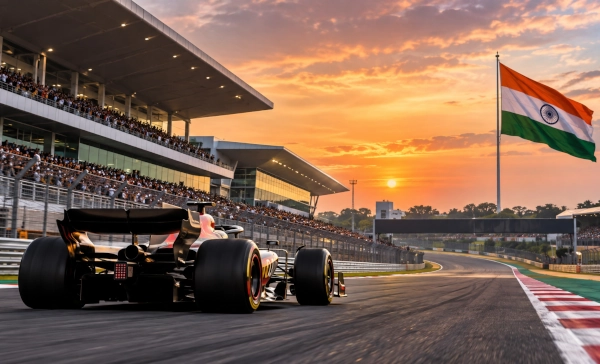
India has taken a formal step towards bringing Formula One racing back to the country, with the government constituting a dedicated task force to examine the feasibility of reviving the Indian Grand Prix while developing a broader roadmap for motorsport in the country.
Union Minister for Youth Affairs and Sports Mansukh Mandaviya announced the formation of the panel on September 15. The task force will be headed by Yugal Kishore Joshi, Programme Director and Adviser at NITI Aayog, and has been asked to examine the policy, taxation, infrastructure and operational issues involved in hosting major international motorsport events in India.
The government’s current objective is to examine whether Formula One can return to India in 2028, more than a decade after the last Indian Grand Prix was held at the Buddh International Circuit in Greater Noida.
Task Force to Examine Formula One Revival
The task force has been given a wider mandate than simply assessing whether another Formula One race can be staged at Buddh.
Its terms of reference include preparing a coordinated roadmap for the sustainable development of motorsport in India, identifying policy interventions required to support the sector and studying the challenges that have prevented major international racing championships from establishing a long-term presence in the country.
Taxation will be one of the issues under examination. The government also intends to assess the infrastructure and operational requirements associated with hosting major motorsport events and evaluate their potential economic, tourism and investment benefits.
Mandaviya said the panel would examine the obstacles facing motorsport development while preparing a comprehensive framework capable of supporting the sector over the longer term.
The emphasis on a broader policy structure suggests that the government is looking beyond a single Formula One race and considering how international motorsport can become part of India’s larger sports and events ecosystem.
NITI Aayog to Lead Multi-Agency Exercise
The composition of the task force reflects the range of issues involved in hosting an event of Formula One’s scale.
Apart from NITI Aayog and the Department of Sports, the panel includes representation from the Department of Commerce, Ministry of Tourism, Central Board of Indirect Taxes and Customs and Central Board of Direct Taxes.
The governments of Uttar Pradesh and Maharashtra will also be represented, along with officials connected with the Buddh International Circuit and Madras International Circuit.
The Federation of Motor Sports Clubs of India, the country’s recognised motorsport governing body, will participate through its leadership and a nominated technical expert.
Bringing tax authorities, state governments, circuit operators, sporting administrators and policy agencies onto the same platform could help address one of the difficulties that affected India’s earlier experience with Formula One: the absence of a stable, coordinated framework covering the commercial and regulatory requirements of the event.
Buddh International Circuit Remains Central to F1 Plans
The Buddh International Circuit in Greater Noida remains central to discussions about Formula One’s possible return.
The circuit was built specifically to international Formula One standards and hosted the Indian Grand Prix in 2011, 2012 and 2013. Formula One’s official records confirm that the most recent race at Buddh was held between October 25 and 27, 2013, with Sebastian Vettel winning for Red Bull Racing.
Vettel dominated Formula One’s brief Indian chapter, winning all three editions of the Indian Grand Prix.
Despite the circuit itself receiving considerable praise from drivers and teams, Formula One did not return after 2013. Regulatory and taxation complications became major obstacles to the continuation of the race.
The government’s present approach appears designed to address those structural problems before attempting to secure another place on the Formula One calendar.
Government Has Been Reviewing Buddh Infrastructure
The latest announcement follows months of renewed government attention towards the Buddh International Circuit and India’s motorsport infrastructure.
Sports Minister Mansukh Mandaviya had earlier visited the Greater Noida circuit as discussions intensified over the possibility of bringing Formula One back to the country.
NITI Aayog has also been examining the circuit and the wider potential of Indian motorsport infrastructure. During an official visit to Buddh, NITI Aayog Member Dr Joram Aniya reviewed the circuit’s Race Control Room, Pit Lane, Pit Garages, Paddock and supporting facilities.
According to NITI Aayog, discussions during the visit examined the optimal use of the infrastructure for national and international motorsport events as well as the potential of motorsport to contribute to sports tourism.
The involvement of NITI Aayog in the new task force therefore represents a continuation of a wider assessment rather than an isolated proposal to stage a single race.
Motorsport Being Viewed as an Economic Ecosystem
The government’s decision is significant because international motorsport involves substantially more than the race weekend itself.
A major championship requires circuit certification, specialised logistics, customs procedures, broadcast facilities, hospitality infrastructure, security, transport and coordination between numerous government and private agencies.
Formula One can also create commercial opportunities around tourism, sponsorship, automotive technology, engineering services and event management. These wider benefits are among the areas the task force has specifically been asked to evaluate.
This explains why the Commerce and Tourism departments, tax authorities and state governments have been included alongside traditional sporting bodies.
The objective appears to be the development of an institutional framework under which international motorsport events can operate predictably rather than being dealt with through individual administrative arrangements each time a race is proposed.
Public-Private Partnership Model Under Consideration
The task force will also examine whether Public-Private Partnership models could provide a sustainable mechanism for expanding India’s motorsport ecosystem.
Such a structure could allow the government to concentrate on regulatory coordination and enabling infrastructure while private promoters, circuit operators and commercial partners handle substantial portions of event organisation and investment.
This could become particularly important if India intends to host several international motorsport championships rather than depend on Formula One alone.
The inclusion of both the Buddh International Circuit and Madras International Circuit indicates that the government’s exercise is intended to examine motorsport development at the national level rather than restrict the discussion entirely to Greater Noida.
2028 Is a Target, Not Yet a Confirmed Grand Prix
The creation of the task force represents a significant advance in India’s effort to return to Formula One, but it does not yet mean that an Indian Grand Prix has been confirmed for 2028.
A Formula One race ultimately requires an agreement with Formula One’s commercial rights holder, a suitable promoter, financial arrangements, circuit compliance and a place on the championship calendar.
The government’s present move should therefore be seen as the beginning of the institutional and policy process required to make such a return possible.
Earlier discussions had considered an even earlier return, but Formula One indicated in April that India would not be part of the 2027 calendar. The establishment of a task force around a 2028 objective therefore provides a more structured and potentially realistic timeline.
For India, the significance of the initiative goes beyond restoring a sporting event that disappeared after only three editions. If the task force succeeds in resolving the taxation, regulatory and commercial issues that previously complicated international motorsport in the country, it could create a permanent framework for attracting Formula One and other major racing championships.
More than thirteen years after Formula One cars last raced at Buddh, the Indian Grand Prix is still some distance from a confirmed return. But for the first time in years, the effort is moving beyond expressions of interest towards a formal government-led process aimed at determining how international motorsport can return on a sustainable basis.
You may also like
-
India’s Quick Commerce Market Could Reach US$90 Billion by FY31 as Retail Shopping Undergoes Major Transformation
-
India Targets 10% of Global 6G Patents and Standards, Pushes Indigenous Telecom Technologies
-
Chokuwa Rice of Assam — The Traditional “Soak-and-Eat” Grain of the Brahmaputra Valley
-
India’s Satellite Broadband Industry Nears Commercial Launch as Bharti OneWeb, Jio and Starlink Await Final Approvals
-
India’s Defence Electronics Industry Expands as BEL, Astra Microwave and Private Manufacturers Strengthen Indigenous Supply Chains
