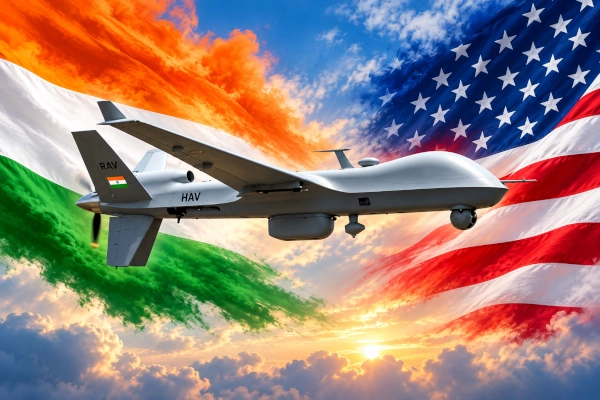
India’s effort to develop an indigenous High-Altitude, Long-Endurance unmanned aircraft has taken an important propulsion-related step, with Bharat Forge Limited and Pratt & Whitney Canada agreeing to evaluate the integration of advanced turboprop engines into the DRDO-developed HALE UAV programme.
Bharat Forge announced the collaboration on September 15, saying the two companies would work together to assess the suitability and integration requirements of Pratt & Whitney Canada’s propulsion technology for the indigenous unmanned aircraft.
The arrangement does not yet constitute a final selection of an engine for the HALE platform. Instead, it begins the technical work required to determine how a suitable turboprop engine can be matched with the aircraft and integrated with its airframe and associated systems.
Pratt & Whitney Canada to Evaluate Engine Compatibility
Under the collaboration, Pratt & Whitney Canada will evaluate engine compatibility, performance and installation requirements for the HALE UAV.
Propulsion integration is a critical part of the development of a long-endurance unmanned aircraft. The engine must operate within the aircraft’s aerodynamic, weight, electrical, thermal and mission requirements while providing the reliability needed for flights lasting many hours and operations at high altitude.
The company has not disclosed which specific Pratt & Whitney Canada turboprop engine is being evaluated for the Indian programme. It would therefore be premature to associate the UAV with a particular PT6 or PW100-series engine until an engine model is officially identified.
Pratt & Whitney Canada is part of RTX and has a long-established presence in India. Its turboprop engines already power several aircraft types operating in the country, including civil and military platforms.
Bharat Forge to Lead Engine-Airframe Integration
Bharat Forge will take responsibility for the engine-airframe integration effort, including installation design and the interfaces required between the propulsion system and the aircraft.
The work places the Indian company in an important systems-integration role rather than limiting its participation to component manufacturing.
Integrating an aircraft engine involves considerably more than providing a structural mounting point. The propulsion system must work with the aircraft’s fuel, electrical, control and monitoring architecture, while installation design must take account of cooling, airflow, vibration, maintainability and the physical constraints imposed by the airframe.
The evaluation being undertaken by Bharat Forge and Pratt & Whitney Canada will therefore help establish whether the proposed propulsion technology can meet the requirements of the HALE configuration before the programme moves further towards detailed integration.
Collaboration Supports DRDO’s Indigenous HALE Programme
The propulsion study is being undertaken for a High-Altitude, Long-Endurance UAV programme designed and developed by the Defence Research and Development Organisation.
HALE aircraft occupy the upper end of the unmanned surveillance category. Their purpose is to remain airborne for extended periods while operating at high altitude, allowing sensors and communications equipment to maintain persistent coverage over large areas.
Such platforms can support intelligence, surveillance and reconnaissance missions over land and maritime areas, where the ability to remain on station for prolonged periods is particularly valuable.
DRDO’s Aeronautical Systems cluster is responsible for the development of unmanned air vehicles and associated aeronautical technologies, with the Aeronautical Development Establishment serving as one of its principal laboratories for unmanned aircraft development.
The HALE programme would represent a significant step beyond the lower-altitude unmanned platforms previously developed within India’s indigenous UAV effort.
Bharat Forge and Pratt & Whitney Expand Aerospace Cooperation
The HALE collaboration also builds upon an existing aerospace relationship between Bharat Forge and Pratt & Whitney Canada.
In July 2025, Bharat Forge announced contracts with Pratt & Whitney Canada for aerospace components and said it would establish an advanced ring mill dedicated to aerospace applications. The company said the facility would manufacture high-performance products for aero-engine applications and support both domestic and international aerospace programmes.
That earlier cooperation was centred primarily on aerospace manufacturing. The HALE programme takes the relationship into the more complex area of propulsion-system and aircraft integration.
For Bharat Forge, the project also reflects its gradual expansion from high-precision manufacturing into defence systems, aerospace engineering and systems integration.
Focus on Reliability for Long-Endurance Operations
Pratt & Whitney India Vice President and Country Head Ashish Saraf said the company’s turboprop engines have a proven record of reliability in demanding operating environments, an attribute he described as particularly relevant to India’s HALE programme.
Reliability assumes particular importance in a long-endurance unmanned aircraft because the propulsion system may have to operate continuously for extended periods without the possibility of immediate maintenance intervention.
A failure aboard a conventional aircraft can require an emergency landing by its crew. An unmanned surveillance aircraft operating for long periods and potentially at considerable distance from its operating base instead depends heavily on system redundancy, propulsion reliability and autonomous fault-management capabilities.
The choice and integration of the propulsion system can consequently have a major influence on the achievable endurance, operating altitude, payload capacity and overall mission availability of a HALE aircraft.
Indigenous Integration at the Centre of the Programme
Bharat Forge Vice Chairman and Joint Managing Director Amit Kalyani said the cooperation combines Pratt & Whitney’s propulsion experience with Bharat Forge’s engineering and systems-integration capabilities, with the objective of supporting the development of a capable indigenous HALE platform.
The arrangement fits within India’s broader attempt to develop a domestic aerospace industrial base in which Indian companies perform increasingly complex engineering and integration work rather than remaining confined to the manufacture of individual components.
For an unmanned aircraft programme, propulsion integration is one of those higher-value capabilities. Experience gained in matching engines with indigenous airframes, designing installations and integrating aircraft systems can be applied across future unmanned and manned aerospace programmes.
The partnership therefore has relevance beyond the supply of an engine for a single aircraft. It can also contribute to the accumulation of domestic expertise in aircraft propulsion integration, systems engineering and unmanned-platform development.
Engine Selection Has Not Yet Been Announced
The present announcement should nevertheless be viewed as an engineering evaluation rather than the conclusion of the HALE propulsion programme.
Neither Bharat Forge nor Pratt & Whitney Canada has announced the specific engine model, power output, contract value, number of engines, production schedule or flight-test date associated with the collaboration.
There is also no official announcement yet stating that a Pratt & Whitney Canada engine has been selected as the final production powerplant for the DRDO HALE UAV.
The immediate objective is to evaluate compatibility and define the engineering requirements necessary to integrate an advanced turboprop engine with the indigenous airframe.
That distinction is important because propulsion selection can shape almost every major performance parameter of a long-endurance unmanned aircraft. The current collaboration therefore represents a significant technical step for the programme, but further development, integration and validation will be required before the propulsion configuration can be considered final.
You may also like
-
NTPC Identifies Three Nuclear Power Plant Sites as India Advances 30 GW Atomic Energy Expansion
-
Seven Indian SMEs Debut on Stock Exchanges as Electronics, Software and Engineering Firms Access Public Markets
-
DRDO Advances Indigenous Submarine AIP System as ₹1,990 Crore Kalvari-Class Integration Programme Progresses
-
Paras Defence Clarifies Guardian-1 Counter-Drone Partnership with US Firm Powerus Amid Pakistan Deal Concerns
-
India’s Defence Procurement Approvals Cross ₹1.62 Lakh Crore as Indigenous Manufacturing Gains Momentum
