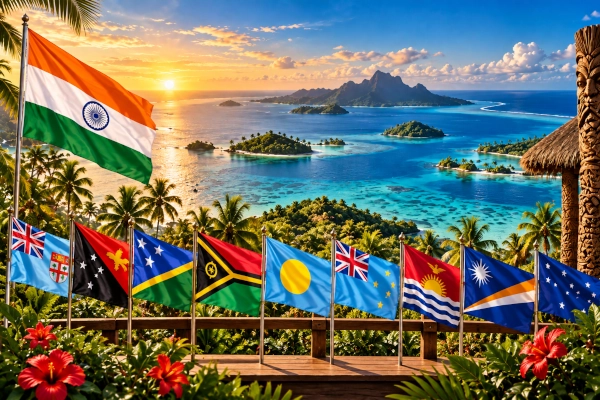
India and the Pacific island countries have renewed efforts to deepen cooperation through the Forum for India-Pacific Islands Cooperation, with External Affairs Minister S. Jaishankar chairing the second FIPIC Foreign Ministers’ Meeting in New York.
The meeting was held on September 23 on the sidelines of the 81st session of the United Nations General Assembly and was reported by Akashvani News on September 24. Participating countries reaffirmed their commitment to strengthening the FIPIC partnership and expanding cooperation in regional and multilateral forums.
The discussions also reviewed progress made since the previous FIPIC summits, particularly the implementation of the 12-Point Action Plan announced by Prime Minister Narendra Modi in 2023. Renewable energy, climate action, disaster resilience, education, healthcare and capacity building were identified as areas for further cooperation.
FIPIC Provides a Dedicated India-Pacific Platform
The Forum for India-Pacific Islands Cooperation was established in 2014 to create a structured platform for India’s engagement with 14 Pacific island countries. The first FIPIC Summit was held in Suva, Fiji, in November 2014, followed by the second summit in Jaipur in 2015.
The third summit was held in Port Moresby, Papua New Guinea, in May 2023, where India expanded its development partnership with Pacific countries through a series of programmes covering healthcare, technology, renewable energy, education and capacity building.
The latest foreign ministers’ meeting represents a continuation of this approach, with the emphasis increasingly moving from summit announcements towards implementing projects and maintaining regular institutional engagement.
Progress Under the 12-Point Action Plan
The 12-Point Action Plan announced during the 2023 FIPIC Summit remains at the centre of India’s current cooperation with Pacific island countries.
The programme included plans for a specialised cardiology hospital in Fiji, dialysis units for Pacific countries, sea ambulances, Jaipur Foot camps and support for yoga centres. India also proposed initiatives covering information technology, solar energy, small and medium enterprises and educational scholarships.
A regional information technology and cybersecurity hub at the University of Papua New Guinea was another initiative associated with the broader programme of cooperation.
At the latest meeting, representatives reviewed progress made under these commitments and discussed ways to expand cooperation in areas where Pacific governments have identified continuing development requirements.
Climate Resilience and Renewable Energy Remain Priorities
Climate change remains one of the most important issues confronting Pacific island countries. Rising sea levels, coastal erosion, extreme weather events and pressure on freshwater resources pose direct economic and social challenges for several island communities.
India has consequently placed renewable energy, disaster resilience and climate adaptation among the principal areas of its Pacific engagement. Jaishankar highlighted India’s cooperation in climate resilience, sustainable coastal and ocean research and the application of space technology to development requirements.
India has also encouraged Pacific countries to engage more closely with international initiatives such as the International Solar Alliance and the Coalition for Disaster Resilient Infrastructure.
Solar energy has particular relevance for island communities where conventional power generation can depend heavily on imported fuel. Distributed renewable-energy systems can also provide electricity to communities spread across remote islands where extending conventional infrastructure can be expensive.
Healthcare Cooperation Expands Across the Pacific
Healthcare has developed into another major component of FIPIC cooperation.
Small island countries can face difficulties in maintaining specialist medical facilities because of limited populations, dispersed geography and the cost of advanced healthcare infrastructure. India’s development initiatives have attempted to address some of these challenges through medical equipment, specialist facilities, training and other forms of assistance.
The cardiology hospital proposed for Fiji is intended to strengthen specialised treatment capacity within the region. Dialysis units, sea ambulances and Jaipur Foot camps form part of the wider programme aimed at expanding access to medical services.
Healthcare was again identified at the New York meeting as an area where India and the Pacific countries intend to deepen cooperation.
Education, Technology and Capacity Building
India’s relationship with the Pacific island countries also includes education and professional training programmes.
Scholarships and capacity-building programmes provide students and officials from Pacific countries with opportunities to study and train in India, while technology partnerships seek to strengthen local institutions and technical expertise.
The planned regional IT and cybersecurity hub in Papua New Guinea reflects the growing importance of digital skills and cybersecurity within the partnership. Such projects can provide regional capabilities that would be difficult for smaller island countries to establish individually.
The latest FIPIC discussions indicate that education, technology and institutional capacity building will continue alongside more visible infrastructure and healthcare programmes.
Broad Pacific Representation at the New York Meeting
The second FIPIC Foreign Ministers’ Meeting included representatives from across the Pacific region.
The Deputy Prime Minister and Finance Minister of Samoa participated alongside the foreign ministers of Fiji, the Marshall Islands, Palau, Papua New Guinea, the Solomon Islands and Tuvalu. Tonga was represented by its Finance Minister.
Representatives from the Federated States of Micronesia, Vanuatu and Nauru also attended, along with the Secretary-General of the Pacific Islands Forum.
The participation of the Pacific Islands Forum leadership connects India’s FIPIC engagement with the wider institutional framework through which Pacific countries coordinate policies on development, climate change, regional cooperation and maritime issues.
India Supports the Blue Pacific Framework
India has also expressed support for the Pacific Islands Forum’s 2050 Strategy for the Blue Pacific Continent.
The strategy represents a long-term regional framework covering climate change, sustainable development, ocean resources, technology, security and the social and economic interests of Pacific communities.
India has described its own approach towards the region as demand-driven, development-oriented and centred on priorities identified by partner countries. This allows FIPIC cooperation to be structured around individual national requirements while also supporting wider regional objectives.
Pacific countries differ greatly in population, geography and economic structure, making a flexible approach particularly important when designing development programmes.
A Wider Indian Presence in the Pacific
India’s engagement with Pacific island countries predates FIPIC, but the creation of the forum provided the relationship with a regular institutional structure.
Geographical distance has not prevented cooperation from expanding into healthcare, climate resilience, renewable energy, information technology, education, disaster management and professional training.
Pacific island countries also participate actively in international organisations where issues such as climate finance, development assistance, maritime governance and reform of multilateral institutions are frequently debated.
For India, continued FIPIC engagement therefore combines bilateral development cooperation with a broader relationship with a group of countries that play an increasingly visible role in discussions concerning the Indo-Pacific and the Global South.
From Commitments to Implementation
The second FIPIC Foreign Ministers’ Meeting did not attempt to replace the framework established through earlier summits. Its importance lies instead in reviewing implementation and maintaining political momentum behind programmes already announced.
Progress under the 12-Point Action Plan will therefore remain an important measure of the partnership as India and the Pacific island countries move towards deeper cooperation in healthcare, renewable energy, climate resilience, education, digital technology and capacity building.
The New York meeting demonstrates that FIPIC is gradually developing from a summit-based diplomatic initiative into a continuing platform for practical India-Pacific cooperation.
References
Akashvani / News On AIR — EAM S. Jaishankar Chairs Second FIPIC Foreign Ministers’ Meeting in New York, 24 September 2026. (News on Air)
Akashvani / News On AIR — EAM S. Jaishankar Holds Bilateral, Multilateral Meetings on UNGA Sidelines, 24 September 2026. (News on Air)
Ministry of External Affairs, Government of India — Background on the Forum for India-Pacific Islands Cooperation and India-Fiji relations, including the establishment of FIPIC and the third FIPIC Summit. (Ministry of External Affairs)
Ministry of External Affairs, Government of India — Annual Report covering FIPIC-III and the 12-step action plan for Pacific island countries. (Ministry of External Affairs)
You may also like
-
India and Russia Hold Seventh Strategic Security Dialogue on Pakistan and Afghanistan
-
Indian Coast Guard and Korea Coast Guard Strengthen Maritime Cooperation at 14th High-Level Meeting in Incheon
-
Indian Navy Completes Historic First Command of Combined Task Force 154, Training Personnel from 39 Nations
-
India and Brunei Strengthen Trade and Economic Cooperation
-
India Leads BIMSTEC Security Cooperation as Seven Nations Adopt Delhi Declaration
