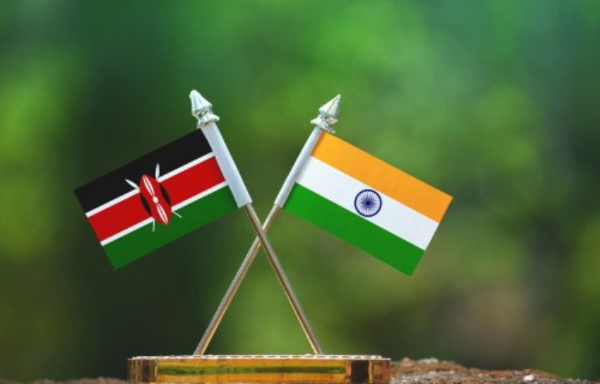
India and Kenya have reviewed recent developments in their bilateral relationship and discussed new proposals to deepen cooperation as the two countries strengthen engagement across diplomacy, trade, parliamentary exchanges and people-to-people ties.
India’s High Commissioner to Kenya, Adarsh Swaika, met Kenya’s Prime Cabinet Secretary and Cabinet Secretary for Foreign and Diaspora Affairs Musalia W. Mudavadi in Nairobi on Monday. The meeting focused on the state of the bilateral partnership and possible areas for further engagement.
The High Commission of India in Nairobi said Swaika briefed Mudavadi on recent bilateral developments and discussed proposals and ideas for further strengthening the India-Kenya partnership.
The discussions come only days after a high-level Kenyan parliamentary delegation visited New Delhi, highlighting the growing momentum in relations between the two countries.
India-Kenya Engagement Gathers Momentum
India and Kenya share longstanding diplomatic, commercial and cultural relations. The partnership has increasingly expanded into areas such as trade and investment, healthcare, pharmaceuticals, digital technology, education, capacity building, agriculture and development cooperation.
The latest meeting between Swaika and Mudavadi suggests that both governments are looking to build on this wider relationship through more regular political engagement and new areas of practical cooperation.
Kenya occupies an important position in East Africa and serves as a major economic and transport hub for the region. India, meanwhile, has steadily expanded its engagement with African countries through development partnerships, trade, investment, technology cooperation and training programmes.
The Ministry of External Affairs continues to maintain a dedicated bilateral framework for India’s relations with Kenya as part of New Delhi’s wider engagement with Africa.
Parliamentary Relations Also Deepen
The diplomatic meeting in Nairobi follows a major parliamentary engagement between the two countries in New Delhi.
On August 13, Lok Sabha Speaker Om Birla held talks with Moses M. Wetang’ula, Speaker of Kenya’s National Assembly, at the Parliament House Complex. The Kenyan delegation visited India as both legislatures seek to strengthen institutional and parliamentary cooperation.
Birla described India-Kenya relations as historical and multifaceted, noting that regular high-level engagements have continued to strengthen the partnership.
The two sides discussed stronger exchanges between their parliaments, including cooperation through Parliamentary Friendship Groups and regular visits by lawmakers.
India has also offered to share its experience in using technology and artificial intelligence in parliamentary functioning. Birla said these tools have been used to improve efficiency, transparency, inclusivity and public participation in India’s Parliament.
Capacity-building has emerged as another area of cooperation. India’s Parliamentary Research and Training Institute for Democracies has organised programmes for Kenyan parliamentarians and officials tailored to the requirements of the Kenyan legislature.
Centuries-Old People-to-People Connections
People-to-people links remain one of the strongest foundations of India-Kenya relations.
Indian traders have had a presence along the East African coast for centuries, while migration during the colonial period created a substantial Indian-origin community in Kenya. Members of this community have subsequently contributed to commerce, industry, healthcare, education and public life.
During his meeting with Wetang’ula, Birla welcomed the Kenyan government’s decision to recognise Persons of Indian Origin as an indigenous community, describing the move as another factor strengthening relations between the two countries.
Wetang’ula, in turn, highlighted the contribution made by people of Indian origin to Kenya’s development. He noted that the community participates in a wide range of sectors, including government and Parliament.
Both sides have increasingly presented these historical connections not merely as a legacy of the past, but as a foundation for expanding modern economic and political cooperation.
Gandhi Legacy Adds Historical Dimension
Mahatma Gandhi also occupies a unique place in the history connecting India and Kenya.
Gandhi spent significant periods in South Africa and travelled through East Africa during the formative years of his political life. His philosophy of non-violence and resistance to colonial rule later influenced freedom movements around the world.
During the parliamentary talks, Birla referred to Gandhi’s influence on Kenya’s struggle against colonialism and described him as an enduring international symbol of peaceful resistance based on truth and non-violence.
He also thanked Wetang’ula for agreeing to the installation of a statue of Mahatma Gandhi in the Parliament of Kenya.
The initiative adds another cultural and historical element to the expanding parliamentary partnership.
Kenya Backs India for Permanent UNSC Seat
The discussions have also highlighted close cooperation between India and Kenya on multilateral issues.
Wetang’ula emphasised the strength of the relationship in international institutions, particularly the United Nations. He also called for reforms to the United Nations Security Council and backed India’s inclusion as a permanent member.
The Kenyan Speaker argued that reform was necessary for the Security Council to better reflect the geopolitical realities of the 21st century.
India has consistently argued that the existing composition of the Security Council does not adequately represent developing countries, particularly Africa, Latin America and major emerging economies.
Kenya’s expression of support therefore adds to India’s diplomatic campaign for a more representative international governance system.
Trade, Technology and Development Offer Scope for Expansion
Beyond political and parliamentary engagement, economic cooperation remains central to the future of the India-Kenya relationship.
Kenya provides Indian businesses with access to one of East Africa’s largest markets and serves as an important gateway to neighbouring economies. Indian companies have established a presence in sectors including pharmaceuticals, manufacturing, automobiles, information technology, financial services and consumer goods.
Kenya also has strong requirements in infrastructure, digitalisation, healthcare, agricultural productivity and skills development. These areas align with sectors in which India has built significant domestic capabilities.
Digital public infrastructure and affordable technology could therefore become increasingly important components of bilateral cooperation.
Healthcare and pharmaceuticals remain another natural area of partnership. Indian medicines and medical services are widely used across Africa, while India remains a major destination for patients from several African countries seeking specialised treatment.
Agriculture, food processing, renewable energy, education and capacity building also offer considerable room for further cooperation.
Growing Focus on Africa Partnership
The renewed momentum in India-Kenya ties comes as New Delhi continues to expand its diplomatic and economic engagement with Africa.
India has promoted a model of cooperation focused on development partnerships, local capacity building and demand-driven projects. Kenya, given its economic weight and strategic location along the Indian Ocean, remains an important partner in that wider approach.
The two countries also share interests in maritime security and regional stability. Kenya’s coastline gives it an important role in the western Indian Ocean, a region that carries major international shipping routes and is increasingly central to India’s maritime diplomacy.
Greater connectivity between India and East Africa could also support trade and investment as both sides seek to diversify supply chains and expand South-South economic cooperation.
Bilateral Partnership Enters a More Active Phase
The August 17 meeting between High Commissioner Swaika and Mudavadi adds to a series of recent engagements that point to a more active phase in India-Kenya relations.
The combination of diplomatic consultations, parliamentary exchanges and discussions on new areas of cooperation indicates that both countries are seeking to broaden the relationship beyond its traditional foundations.
Historical ties and the Indian-origin community continue to provide a strong social base. However, trade, technology, development cooperation, parliamentary diplomacy and coordination at international institutions are increasingly shaping the modern partnership.
With Nairobi and New Delhi now exploring additional proposals for cooperation, the India-Kenya relationship appears set to deepen further as both countries seek stronger economic links and closer coordination on regional and global issues.
Official sources: High Commission of India in Nairobi, official communication dated August 17, 2026; Press Information Bureau/Lok Sabha Secretariat, India and Kenya Share Historical and Multifaceted Relations Going Back Over Millennia, August 13, 2026.
You may also like
-
India and Italy Hold First Maritime Security Dialogue in Rome, Strengthen Strategic Maritime Cooperation
-
India and Azerbaijan Agree to Strengthen Security, Trade, Energy and Economic Cooperation
-
Jaishankar Meets Azerbaijan President Ilham Aliyev in Baku, Discusses Trade, Technology and Strategic Cooperation
-
Piyush Goyal Holds High-Level Talks in Berlin to Strengthen India–Germany Trade, Investment and Industrial Cooperation
-
Indian Navy to Host Indo-Pacific Regional Dialogue 2026 with Experts from 18 Countries on Maritime Science and Technology
