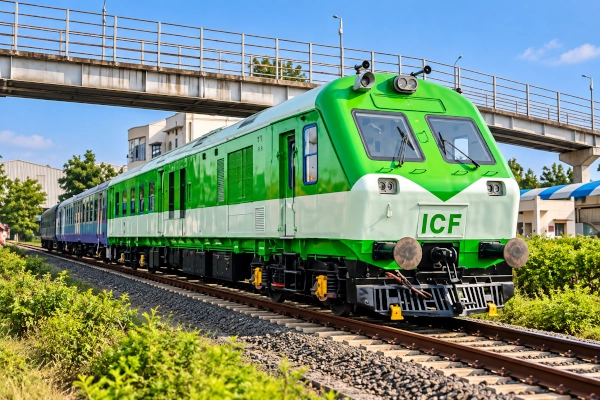
India has taken another step towards cleaner railway operations with the flagging off of the country’s first LNG-powered train from Sabarmati Railway Station in Ahmedabad on September 27, 2026. Union Home Minister Amit Shah launched the new train while inaugurating and commencing railway projects worth approximately ₹1,472 crore in Gujarat, covering locomotive maintenance, safety systems, railway-line expansion and freight infrastructure.
The new train uses an LNG-diesel dual-fuel configuration, allowing part of its conventional diesel consumption to be replaced by liquefied natural gas. Indian Railways is exploring such alternative propulsion technologies at a time when the national network is approaching complete electrification and diesel consumption has already fallen substantially. LNG is not expected to replace electric traction across the network, but it can provide another option for selected applications while India develops expertise in lower-emission railway propulsion.
LNG Adds Another Alternative Propulsion Option for Indian Railways
Liquefied Natural Gas can be used alongside diesel in suitably modified engines, reducing the quantity of conventional diesel required during operation. The technology offers potential reductions in several local pollutants and can lower dependence on petroleum-based railway fuel, although its overall environmental performance also depends on engine efficiency, fuel sourcing and methane management across the supply chain.
For Indian Railways, the significance of the programme lies as much in technology development as in immediate fuel savings. Experience with LNG propulsion can help build domestic capability in fuel storage, engine conversion, safety systems and control technologies that may later find applications elsewhere in the transport sector.
The LNG train also joins a wider railway modernisation effort that includes electrification, hydrogen propulsion trials, high-horsepower freight locomotives and indigenous safety technologies.
₹1,472 Crore Railway Infrastructure Programme Launched in Gujarat
The Sabarmati programme involved railway projects worth approximately ₹1,472 crore. These projects are aimed at improving freight handling, locomotive maintenance, operational safety and network capacity around Ahmedabad and other parts of Gujarat.
One of the largest components is a new WAG-12 locomotive maintenance shed, developed at an estimated cost of ₹700 crore. The facility will support some of the most powerful freight locomotives currently operating on the Indian Railways network and is expected to improve locomotive availability by providing specialised maintenance and servicing infrastructure.
The programme also includes the rollout of the indigenous Kavach Automatic Train Protection system and the doubling of the Sabarmati-Sarkhej railway line, both of which are important for improving safety and capacity on increasingly busy railway corridors.
WAG-12 Maintenance Facility Strengthens Heavy Freight Capability
The WAG-12 is a twin-section electric freight locomotive with an output of approximately 12,000 horsepower. It was developed for heavy freight operations and is particularly suited to the Dedicated Freight Corridor network and other high-capacity routes.
A WAG-12 locomotive can haul around 6,000 tonnes of freight, allowing Indian Railways to move larger loads with fewer locomotives compared with older configurations. This improves operational efficiency and helps increase the speed and capacity of freight movement.
A dedicated maintenance facility at Sabarmati can support this growing fleet by reducing downtime and ensuring that heavy-haul locomotives remain available for demanding freight operations. Reliable maintenance is especially important as Indian Railways increases axle loads and attempts to move a larger share of national freight by rail.
Kavach Expands on Sabarmati-Kalol-Sabarmati Section
Railway safety forms another major component of the Ahmedabad projects. The indigenous Kavach train protection system has been installed on the Sabarmati-Kalol-Sabarmati section at a cost of approximately ₹48 crore.
Kavach is designed to reduce the risk of collisions and signal-passing incidents by continuously monitoring train movement, signalling information and speed. When necessary, the system can automatically intervene to slow or stop a train if the locomotive pilot does not respond appropriately.
Work has also begun to extend Kavach coverage to the Ahmedabad-Palanpur and Ahmedabad-Samakhiali sections. The wider rollout of the technology is expected to create a stronger digital safety layer across heavily used railway corridors.
Sabarmati-Sarkhej Doubling Will Increase Network Capacity
Work has also started on doubling the Sabarmati-Sarkhej railway line. Railway-line doubling allows trains to operate independently in both directions rather than sharing a single track, reducing operational bottlenecks and increasing the number of services that can be handled.
The improvement is particularly relevant in and around Ahmedabad, where passenger traffic, freight movement and urban transport demand continue to increase. Higher line capacity can improve punctuality while allowing additional passenger and freight services to operate without placing excessive pressure on the existing network.
Sabarmati is also becoming increasingly important as a multi-modal transport hub because of its connection with conventional railways, metro systems and the Mumbai-Ahmedabad High-Speed Rail project.
Indian Railways Moves Closer to Complete Electrification
The introduction of an LNG-powered train comes at a time when India has already made substantial progress in railway electrification. Approximately 99.6 per cent of the broad-gauge railway network is now electrified, leaving only a small remaining portion to be completed.
This expansion has sharply reduced diesel consumption. Railway diesel use reportedly fell from around 293 crore litres in 2015-16 to approximately 108 crore litres in 2024-25 as electric traction replaced diesel locomotives across large parts of the network.
The scale of electrification has also increased dramatically. Annual railway electrification, which stood at about 75 route kilometres in 2010-11, rose to around 7,188 kilometres in 2023-24.
This transformation has reduced dependence on diesel while allowing Indian Railways to take advantage of increasingly efficient electric locomotives and a gradually changing national electricity mix.
LNG and Hydrogen Complement Electrification Rather Than Replace It
The development of LNG and hydrogen-powered trains should be viewed as complementary to electrification rather than as competing technologies.
Electric traction will remain the principal propulsion system across the Indian railway network because of its efficiency and suitability for high-density operations. LNG and hydrogen are being explored for specific roles where alternative propulsion may offer practical advantages or where Indian Railways wants to develop expertise in future energy technologies.
India has also begun work on hydrogen-powered railway systems, demonstrating a broader effort to diversify railway propulsion and reduce dependence on conventional fossil fuels.
Developing multiple technologies gives Indian Railways greater flexibility while allowing domestic engineering and manufacturing capabilities to evolve alongside changes in energy systems.
Double-Stack Container Trains Aim to Increase Freight Efficiency
The Sabarmati programme also drew attention to India’s effort to increase railway freight capacity through long-haul and double-stack container operations.
A successful trial has been conducted involving a long-haul double-stack container train between Jawaharlal Nehru Port and Vadodara. Double-stack trains carry two containers vertically, allowing substantially more cargo to be moved within the same train length.
This approach is particularly important on the Western Dedicated Freight Corridor, where infrastructure has been designed to accommodate taller and heavier freight trains.
Improving rail freight capacity can reduce logistics costs, ease pressure on highways and lower energy consumption per tonne of freight moved.
Dedicated Freight Corridors Reshaping Rail Logistics
India’s Dedicated Freight Corridors are a major component of this transformation. By moving freight traffic away from heavily congested passenger lines, the corridors are designed to improve the reliability and speed of both freight and passenger services.
The Western Dedicated Freight Corridor links industrial centres with major western ports, while the Eastern Dedicated Freight Corridor serves manufacturing and resource-intensive regions.
High-power locomotives such as the WAG-12, double-stack container trains and modern signalling systems are being developed as part of the same integrated freight ecosystem.
The long-term objective is to increase rail’s share of national freight movement while improving the efficiency of industrial supply chains.
Gujarat Receives Expanded Railway Investment
Railway investment in Gujarat has increased substantially, reflecting the state’s importance to national manufacturing, freight and port connectivity.
The railway allocation for Gujarat in 2026-27 stands at approximately ₹17,366 crore. This supports projects ranging from new lines and track doubling to electrification, station redevelopment, safety systems and freight infrastructure.
Gujarat’s large industrial base and major ports make railway capacity particularly important for the movement of raw materials, manufactured goods and containers.
The development of new maintenance facilities and higher-capacity freight infrastructure around Ahmedabad therefore has implications beyond passenger transport.
Sabarmati Is Emerging as a Major Multi-Modal Rail Hub
Sabarmati is becoming one of the most strategically important railway locations in western India.
The area already supports conventional Indian Railways operations and is also being developed as a major interchange for the Mumbai-Ahmedabad High-Speed Rail project.
Connections with metro services, bus networks and other urban transport systems are expected to make Sabarmati an increasingly important multi-modal hub.
The addition of WAG-12 maintenance infrastructure, Kavach deployment, line doubling and alternative-fuel train operations further strengthens the area’s role within India’s railway modernisation programme.
Cleaner Propulsion Becomes Part of a Wider Railway Transformation
India’s first LNG-powered train is best understood as one element of a much larger transformation underway across Indian Railways.
Near-complete electrification is reducing diesel dependence, while LNG and hydrogen technologies are being explored for specialised applications. High-power freight locomotives and double-stack container trains are increasing cargo capacity, while Kavach is creating an indigenous digital safety architecture.
Dedicated Freight Corridors, new maintenance infrastructure and major station and network upgrades are simultaneously improving operational efficiency.
The Sabarmati launch therefore represents more than the introduction of another train. It reflects a wider strategy in which cleaner propulsion, indigenous technology, freight modernisation and railway safety are being developed together as India prepares its railway network for higher passenger demand and a much larger freight economy.
References
DD India — Amit Shah flags off India’s first LNG-powered train and inaugurates railway projects worth ₹1,472 crore in Ahmedabad, September 27, 2026.
https://ddindia.co.in/2026/09/amit-shah-flags-off-indias-first-lng-powered-train-inaugurates-rs-1472-crore-railway-projects-in-ahmedabad/
Press Information Bureau, Ministry of Railways — Official information on WAG-12 electric freight locomotives and Dedicated Freight Corridor operations.
https://www.pib.gov.in/PressReleaseIframePage.aspx?PRID=1686785
Press Information Bureau, Ministry of Railways — Official update on Indian Railways hydrogen train and railway modernisation, 2026.
https://www.pib.gov.in/PressReleasePage.aspx?PRID=2288674
Press Information Bureau, Ministry of Railways — Sabarmati railway infrastructure and rolling-stock development, 2026.
https://www.pib.gov.in/
You may also like
-
BEML Secures ₹5,400 Crore High-Speed Train Order, Strengthening India’s Indigenous Rail Manufacturing
-
Ambemohar Rice: Maharashtra’s Fragrant Heritage Grain from the Sahyadri Foothills
-
Juniper Green Energy Commissions 65.40 MW Wind Power Capacity, Expands Operational Portfolio to 2,811 MWp
-
Zen Technologies to Acquire 51.98% Stake in Cogknit Semantics for ₹135 Crore, Expanding AI Defence Capabilities
-
Dynamatic Technologies Hosts India-Canada Aerospace Roundtable to Expand Industrial Cooperation
