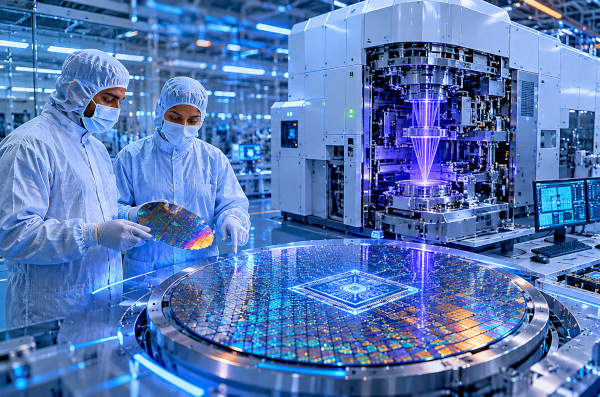
India’s electronics manufacturing sector has recorded a major expansion over the past decade, with exports increasing more than eleven-fold to ₹4.24 lakh crore, or about US$47.98 billion, in FY2025–26.
Electronic goods have now emerged as India’s third-largest export category, reflecting the rapid growth of domestic manufacturing and global supply-chain integration.
Exports stood at around ₹38,000 crore in FY2014–15. Their rise to ₹4.24 lakh crore in FY2025–26 marks one of the strongest transformations among India’s major manufacturing sectors.
Government programmes such as the Production Linked Incentive Scheme, Electronics Components Manufacturing Scheme, India Semiconductor Mission and Modified Electronics Manufacturing Clusters Scheme have supported this expansion.
Electronics Production Reaches ₹6.27 Lakh Crore
Domestic electronics production has also grown substantially.
Production increased from around ₹18,000 crore in FY2014–15 to ₹6.27 lakh crore in FY2025–26.
The expansion has created a larger manufacturing ecosystem involving mobile phones, electronic components, consumer electronics and emerging semiconductor-related industries.
The sector has also become an important source of employment. Around 12 lakh jobs have been generated across the electronics manufacturing ecosystem.
Women account for nearly 30% of the overall electronics workforce, making the industry an increasingly important source of formal manufacturing employment for women.
India Becomes World’s Second-Largest Mobile Phone Manufacturer
Mobile phone manufacturing has emerged as one of the biggest drivers of India’s electronics story.
India is now the world’s second-largest manufacturer of mobile phones.
The transformation in exports has been particularly striking. Mobile phones ranked only 153rd among India’s export products in FY2014–15. By FY2025–26, they had become the country’s largest individual export product.
Mobile phone exports increased from just ₹1,500 crore in FY2014–15 to ₹2.59 lakh crore in FY2025–26, representing a rise of around 165 times.
This growth indicates that India is moving beyond assembling devices primarily for its domestic market and is increasingly becoming a major production base for international markets.
Women Form Nearly 70% of Mobile Manufacturing Workforce
The mobile phone manufacturing industry has also developed a distinctive employment profile.
Women now account for nearly 70% of workers in mobile manufacturing, significantly higher than their share across the broader electronics sector.
Large-scale electronics factories have created employment opportunities in assembly, testing, quality control, packaging and related operations.
The sector’s continued expansion could therefore have a wider impact on women’s participation in India’s organised manufacturing workforce.
Digital Economy Expands Alongside Manufacturing
India’s electronics manufacturing growth has occurred alongside rapid expansion of the country’s digital economy.
The digital economy now contributes up to 14% of India’s GDP, supported by widespread internet access, lower mobile data prices and faster broadband networks.
Internet subscriptions increased from 25.15 crore in 2014 to more than 109.2 crore by March 2026.
At the same time, wireless data costs declined dramatically. The average cost fell from approximately ₹308 per GB in 2014 to ₹7.51 per GB in 2026.
Lower data costs have helped expand digital services, e-commerce, online payments, entertainment and technology-based businesses across the country.
Mobile Broadband Speeds Rise Sharply
Network quality has improved alongside wider internet penetration.
India’s average mobile broadband download speed increased from 13.67 Mbps in March 2022 to 132 Mbps by December 2025.
The rollout of 5G has also accelerated.
By June 2026, India had installed around 5.63 lakh 5G Base Transceiver Stations, with 5G services available in 99.9% of districts across States and Union Territories.
Meanwhile, 4G services have reached approximately 6.31 lakh villages, extending high-speed digital connectivity deep into rural India.
Electronics Emerging as a Major Manufacturing Pillar
The rise of electronics exports from ₹38,000 crore to ₹4.24 lakh crore demonstrates how rapidly the sector has moved into the mainstream of India’s manufacturing economy.
Mobile phone exports alone now account for more than ₹2.5 lakh crore, while the wider ecosystem is expanding into components, semiconductor manufacturing and advanced electronics.
The combination of large domestic demand, export-oriented production, lower data costs and nationwide digital connectivity provides India with a strong base for the next phase of electronics growth.
With electronics already among the country’s leading export categories, the sector is increasingly becoming an important pillar of Make in India, employment generation and India’s integration into global technology supply chains.
You may also like
-
Bihar’s GI-Tagged Mithila Makhana Expands Global Reach as India Exports 7,265 Tonnes in FY26
-
NHPC Announces Commercial Operation of Fifth 250 MW Unit at Subansiri Lower Hydroelectric Project
-
India and New Zealand Strengthen Trade Ties with Electronic Origin Data Exchange Agreement Under FTA
-
India Hosts Agrivoltaics World Conference 2026, Unveils Plans for Major Solar Farming Expansion Under PM-KUSUM
-
Piyush Goyal to Visit Germany and Netherlands with 100 Indian Businesses and Startups to Strengthen Trade and Investment
