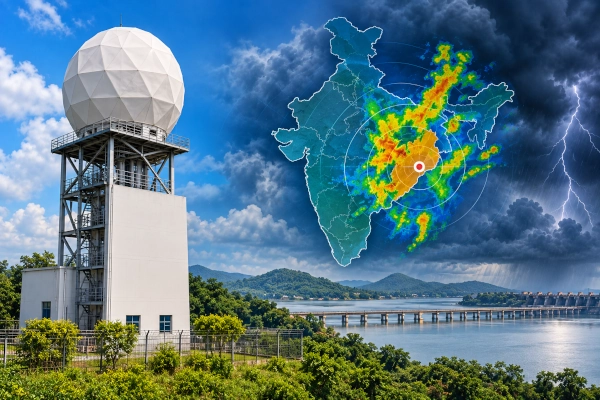
India has commissioned its 51st Doppler Weather Radar at Sambalpur in Odisha, expanding a national network that has grown from just 14 installations in 2014. Around 40 additional radars are planned under Mission Mausam as the country builds a denser observation network for more localised forecasting and earlier warnings of extreme weather.
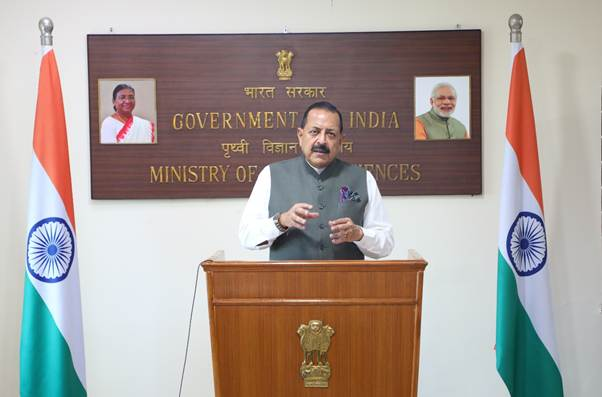
Union Minister of State for Earth Sciences Dr. Jitendra Singh virtually inaugurated the new radar on September 17 in the presence of Odisha Chief Minister Mohan Charan Majhi. The installation is expected to improve monitoring of thunderstorms, heavy rainfall, lightning and other significant weather systems across western Odisha and neighbouring regions.
With Sambalpur becoming operational, Odisha now has three Doppler Weather Radars, alongside existing installations at Gopalpur and Paradip.
Sambalpur Radar Fills an Important Observation Gap
The location of the new radar gives it significance beyond Odisha. Its observational coverage will provide additional meteorological information for adjoining areas of southern Jharkhand, northern Chhattisgarh and parts of northern Andhra Pradesh and West Bengal.
Doppler Weather Radars allow meteorologists to observe precipitation and the movement of weather systems with considerable spatial and temporal detail. Their ability to detect the movement of precipitation particles also provides information that can help identify the development and movement of severe thunderstorms and other hazardous weather.
For western Odisha, the Sambalpur installation is intended to close an important gap in radar observations and give meteorological agencies additional data for tracking rapidly developing weather systems.
The information can subsequently support shorter-range forecasts and warnings issued to district administrations, disaster-management authorities and communities potentially exposed to severe weather.
India’s Radar Network Has Grown From 14 to 51
The commissioning also illustrates the expansion of India’s weather-observation infrastructure over the past decade.
According to the Ministry of Earth Sciences, India had 14 Doppler Weather Radars in 2014. The Sambalpur commissioning has taken the number to 51 in 2026.
The expansion is set to continue under Mission Mausam, with approximately 40 additional Doppler Weather Radars planned. Their deployment would take the national network to around 81 radars.
A denser radar network is particularly important in a geographically large country where weather conditions can differ considerably across relatively short distances. Increasing radar coverage can reduce observational gaps and improve the data available for forecasting thunderstorms, intense rainfall and other localised events.
Mission Mausam Building a Multi-Layer Weather Network
India’s meteorological expansion is not limited to radar installations.
The government is simultaneously increasing the deployment of Automatic Weather Stations, rain gauges, radiosonde systems and microwave radiometers, creating multiple layers of atmospheric observations rather than relying on a single type of instrument.
Automatic weather stations and rain gauges are also being installed at district and school-level locations across Odisha to increase the amount of local weather information available to forecasters.
Radiosondes provide measurements through different levels of the atmosphere, while microwave radiometers can remotely observe atmospheric characteristics. Combined with radar and surface observations, these systems provide meteorologists with a more complete picture of changing atmospheric conditions.
The longer-term objective is to make forecasting increasingly localised so that warnings can be translated into action at district and community levels.
More Doppler Radars Planned for Odisha
Odisha’s radar network is also set for further expansion.
Additional Doppler Weather Radars are planned for Balasore, Puri and Bhubaneswar, according to the government. Once deployed, they would complement the installations at Sambalpur, Gopalpur and Paradip and substantially increase radar coverage across the state.
This is particularly relevant for Odisha because of its exposure to severe weather originating over the Bay of Bengal as well as thunderstorms, lightning and episodes of intense rainfall inland.
Better observations have applications extending beyond disaster warnings. More precise weather information can support agriculture, electricity management, water planning and other activities whose operations depend heavily on changing weather conditions.
From Forecasting to Earlier Local Warnings
The broader objective behind the expansion is not simply to accumulate more meteorological instruments. Greater observational density gives forecasters more information about what is happening in the atmosphere at a particular location and time.
That becomes especially important during rapidly developing events. Thunderstorms and intense rainfall can evolve on spatial and temporal scales that make them difficult to capture with a sparse observation network.
Combining Doppler radar information with surface observations, upper-atmosphere measurements, satellites and forecasting models can improve the ability of meteorological agencies to identify developing hazards and issue more geographically specific warnings.
Such improvements can give administrations and communities additional time to respond, particularly in areas vulnerable to lightning, flash floods, severe thunderstorms and intense rainfall.
India’s Weather Infrastructure Supporting Regional Forecasting
India’s expanding meteorological capabilities also have a regional dimension.
The India Meteorological Department currently provides weather, cyclone and flash-flood forecasting and early-warning support to 13 neighbouring countries, according to the Ministry of Earth Sciences.
India’s location in the northern Indian Ocean gives the country’s meteorological infrastructure particular importance for cyclone monitoring. Weather systems developing over the Bay of Bengal and Arabian Sea can affect several countries, making regional exchange of observations and warnings an important component of disaster preparedness.
The commissioning of Sambalpur’s Doppler Weather Radar therefore forms one part of a much larger expansion underway in Indian meteorology. With 51 radars now operational and around 40 more planned under Mission Mausam, India is moving towards a substantially denser observation network designed to detect dangerous weather earlier and deliver increasingly localised forecasts to the places where they are needed most.
Reference: https://www.pib.gov.in/PressReleaseDetail.aspx?PRID=2311270®=48&lang=1
You may also like
-
Nayan Technologies Selected by JSW MG Motor to Advance AI-Based Road Monitoring and Smart Mobility
-
Indian Navy to Commission Indigenous Anti-Submarine Warfare Ship Mangrol on October 12
-
3,898 Indian Scientists Feature in 2026 Global Top 2% Research Database; IISc Leads Indian Institutions
-
JSW Steel’s Crude Steel Production Rises 5% to 7.27 Million Tonnes in Q2 FY2027
-
Kabra Extrusiontechnik’s GEON Commissions 20 MWh Battery Storage Project in Rajasthan
