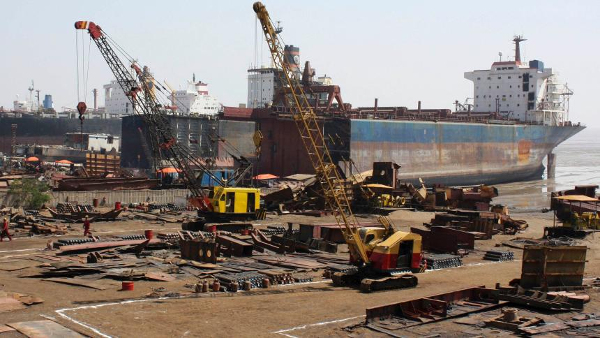
India has emerged as the world’s leading ship recycling nation in 2025, marking a major achievement for the country’s maritime sector. According to the latest data cited by the Government of India from the United Nations Conference on Trade and Development, India’s share in global ship recycling increased to 35.4% in 2025, up from 30.1% in 2024.
The growth has also been strong in volume terms. India recycled 2.99 million gross tons of ships in 2025, compared with 1.86 million gross tons in 2024. This represents a rise of nearly 60% in one year and places India at the top of the global ship recycling industry.
With this achievement, India has reached the ship recycling target set under Maritime India Vision 2030 five years ahead of schedule. The milestone reflects the impact of maritime reforms, infrastructure upgrades, safety compliance, environmental standards and ease-of-doing-business measures introduced to strengthen India’s position in the global maritime economy.
Union Minister for Ports, Shipping and Waterways Sarbananda Sonowal said that India’s rise to the top position reflects sustained policy reforms, industry participation and adherence to international environmental and safety norms. He said the achievement strengthens India’s position as a global hub for responsible and sustainable ship recycling.
A major foundation for this progress has been the Recycling of Ships Act, 2019, which was enacted to align India’s ship recycling ecosystem with the Hong Kong International Convention for the Safe and Environmentally Sound Recycling of Ships. India ratified the convention in 2019, giving a strong regulatory base to the modernisation of the sector.
The Government has also supported ship recycling yards through financial assistance. Around ₹53.5 crore has been provided for modernisation, helping 115 ship recycling facilities become compliant with Hong Kong Convention standards. This has improved safety, environmental protection, worker welfare and the global acceptability of Indian ship recycling yards.
Another important reform is the Ship-breaking Credit Note Scheme. Under this scheme, ship owners receive a credit note equal to 40% of the scrap value of a recycled ship. This credit note can be used for payment of up to 5% of the value of a new vessel built at an Indian shipyard. The measure is designed to create a strong link between ship recycling and domestic shipbuilding, supporting India’s larger goal of building an integrated maritime industrial ecosystem.
The Ministry of Ports, Shipping and Waterways has also been working closely with key stakeholders, including the Gujarat Maritime Board, Ship Recycling Industries Association, global shipping companies, classification societies, cash buyers and international organisations. These consultations are helping identify industry challenges, improve compliance systems and prepare Indian yards for higher global demand.
India is also pursuing the inclusion of its ship recycling yards in the approved list under the European Union Ship Recycling Regulations. Approval under this framework would strengthen India’s access to European vessels and further enhance the country’s reputation as a responsible recycling destination.
The planned expansion of the Alang Ship Recycling Yard in Gujarat is another major part of India’s future strategy. Alang is already one of the world’s most important ship recycling clusters. The Government of Gujarat has prepared a master plan to nearly double India’s ship recycling capacity to about 9 million light displacement tons. The expansion is expected to improve infrastructure, attract more vessels and strengthen India’s competitiveness in the global market.
Future demand also appears strong. According to industry estimates cited by the Government, more than 16,000 vessels are expected to be recycled globally over the next decade. With its current global share of 35.4%, India is well placed to recycle around 500 to 600 vessels every year, supported by expanding capacity and stronger compliance with international norms.
India’s rise in ship recycling also has wider economic and environmental importance. Ship recycling supports the circular economy by recovering steel, machinery and reusable materials from end-of-life vessels. It reduces waste, supports domestic industry, creates employment and provides raw material for downstream sectors. When carried out under modern safety and environmental standards, the sector becomes an important part of sustainable maritime development.
The 2025 milestone shows that India’s maritime sector is moving beyond ports and shipping into a broader industrial ecosystem. By combining regulation, infrastructure, green compliance and industry support, India has positioned itself as the world’s leading destination for sustainable ship recycling. The achievement marks a major step towards the goals of Maritime India Vision 2030 and strengthens India’s role in the global blue economy.
Source: PIB
You may also like
-
Vietnam Expands Business and Investment Links Across India’s Major Economic Hubs
-
India’s GST Collections Rise 14.7% to ₹2.04 Lakh Crore in September
-
SberIndia Lending to Indian Companies Quadruples as India-Russia Trade Finance Expands
-
India Manufacturing PMI Rises to Seven-Month High of 55.1 in September
-
Nothing and Optiemus Announce $100 Million Joint Venture to Expand Smartphone Manufacturing in India
