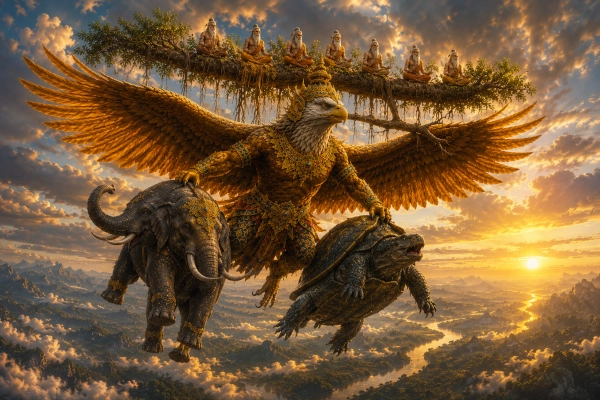
The sun had climbed high above the forests, pouring molten gold across the mountains and rivers of the earth. Far above the clouds, Garuda, the mighty king of birds, flew with wings that seemed broad enough to shadow entire valleys.
Each beat of those wings stirred the sky. Trees bent beneath the force of the wind, lakes rippled from shore to shore, and the creatures below looked upward in awe.
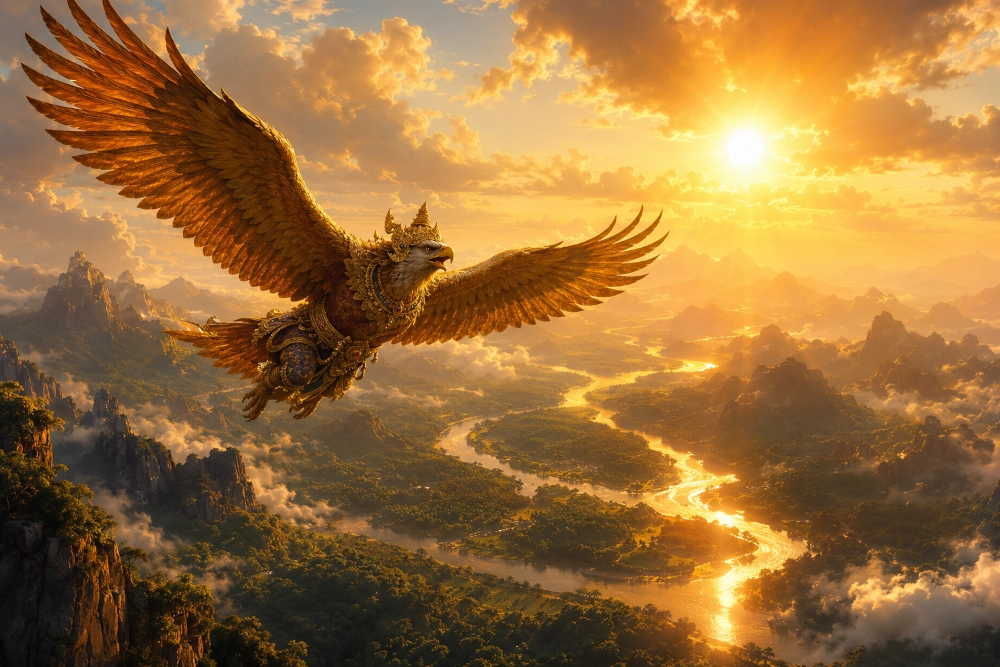
Garuda was searching for food.
His strength was immense, but so too was his hunger. The journey before him was long, and he needed nourishment powerful enough to sustain his flight.
As he crossed a vast wilderness, his sharp eyes caught sight of a great disturbance below. In the middle of a broad lake, the waters churned as though a storm had risen from beneath the surface.
Garuda descended through the clouds.
There, he saw two colossal creatures locked in furious combat.
One was an enormous elephant, towering like a moving hill. His tusks gleamed like crescent moons, and every stamp of his feet sent waves crashing against the banks. Opposite him was a gigantic tortoise whose shell was wide and dark like an island of stone. His claws tore through the lakebed, while his great jaws snapped with terrible force.
The elephant wrapped his trunk around the tortoise and tried to drag him from the water. The tortoise caught the elephant’s leg and pulled him deeper into the lake.
Their roars and splashes echoed through the forest.
Garuda watched them for a moment, astonished by their size and strength. Yet there was something strange in their fury. They did not fight like animals defending territory or seeking food. Their hatred seemed ancient, heavy with memory.
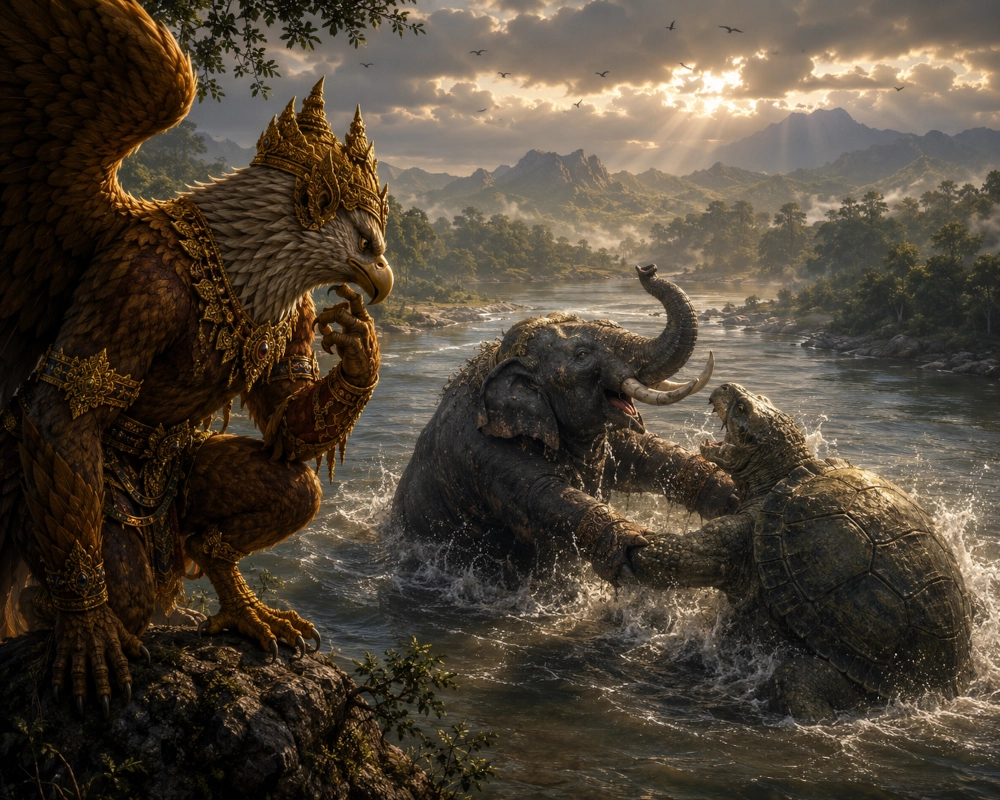
He descended to the branch of a nearby tree and called out in a voice that rolled across the water like thunder.
“Why do you struggle with such bitterness? What cause could make two mighty beings waste their strength in endless combat?”
For a moment, the elephant and tortoise stopped.
The elephant raised his head, his eyes still burning with anger.
“We were not always as you see us,” he said.
The tortoise released his hold and surfaced beside him.
“We were once brothers,” he added, his voice deep and sorrowful.
Garuda leaned forward, curious.
The elephant began their tale.
“In another life, we were born into a wealthy family. Our father possessed great lands, treasures, cattle and grain. When he died, all that he owned was left to us.”
“But instead of honouring him through unity,” said the tortoise, “we quarrelled over the inheritance.”
Each brother believed the other had taken more than his rightful share. What began as suspicion became accusation. Accusation became insult, and insult became hatred.
They stopped speaking with affection. They forgot the games they had played as children, the meals they had shared and the protection they had once offered one another.
At last, their dispute grew so fierce that each brother sought the power of curses against the other.
“May you become a beast of the forest,” one brother had cried, “huge in body but ruled by anger!”
“And may you crawl upon the earth,” the other had replied, “hidden beneath a shell as hard as your heart!”
Their words, spoken with rage and strengthened by destiny, took effect.
One brother became the elephant.
The other became the tortoise.
Yet even after transformation, their anger did not leave them. Whenever they met, the old quarrel awoke. They fought again and again, though neither could remember any longer what treasure had first caused their hatred.
Garuda looked at them with wonder.
“You have carried your anger beyond your human lives,” he said. “You lost your wealth, your forms and your brotherhood, yet still you hold tightly to the quarrel.”
The elephant lowered his head, but pride soon hardened his expression.
“He wronged me first.”
The tortoise struck the water with one claw.
“He speaks falsely. The injustice was his.”
At once, their fury returned. The elephant charged, and the tortoise lunged forward. The lake erupted around them.
Garuda’s hunger sharpened.
He remembered the words of his father, the sage Kashyapa, who had told him that he might feed upon these two mighty creatures. Their enormous bodies would give him the strength needed for the journey ahead.
With a sudden sweep of his wings, Garuda rose above the lake.
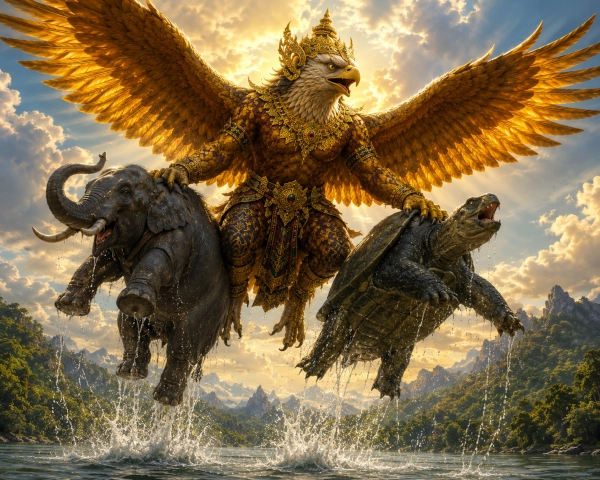
Then he descended like lightning.
In one talon, he seized the elephant.
In the other, he grasped the tortoise.
The two creatures struggled, but even their combined strength was nothing against the king of birds. Garuda lifted them effortlessly from the lake and soared into the sky.
Below him, forests became patches of green. Rivers turned into silver threads, and mountains appeared like stones scattered across the earth.
Garuda now searched for a place where he could rest and eat.
Soon he saw an immense banyan tree. Its crown stretched over many miles, and one of its branches appeared strong enough to bear even his tremendous weight.
Garuda descended and settled upon it, still holding the elephant and tortoise.
But the moment his claws touched the branch, a loud crack split the air.
The branch began to break.
Garuda looked down and saw, hanging beneath it, a group of tiny sages known as the Valakhilyas. They were engaged in deep meditation, suspended upside down from the branch.
Though small in body, they possessed great spiritual power.
Garuda immediately forgot his hunger.
If the branch fell, the sages would be crushed.
With extraordinary care, he caught the breaking branch in his beak while continuing to hold the elephant in one talon and the tortoise in the other.
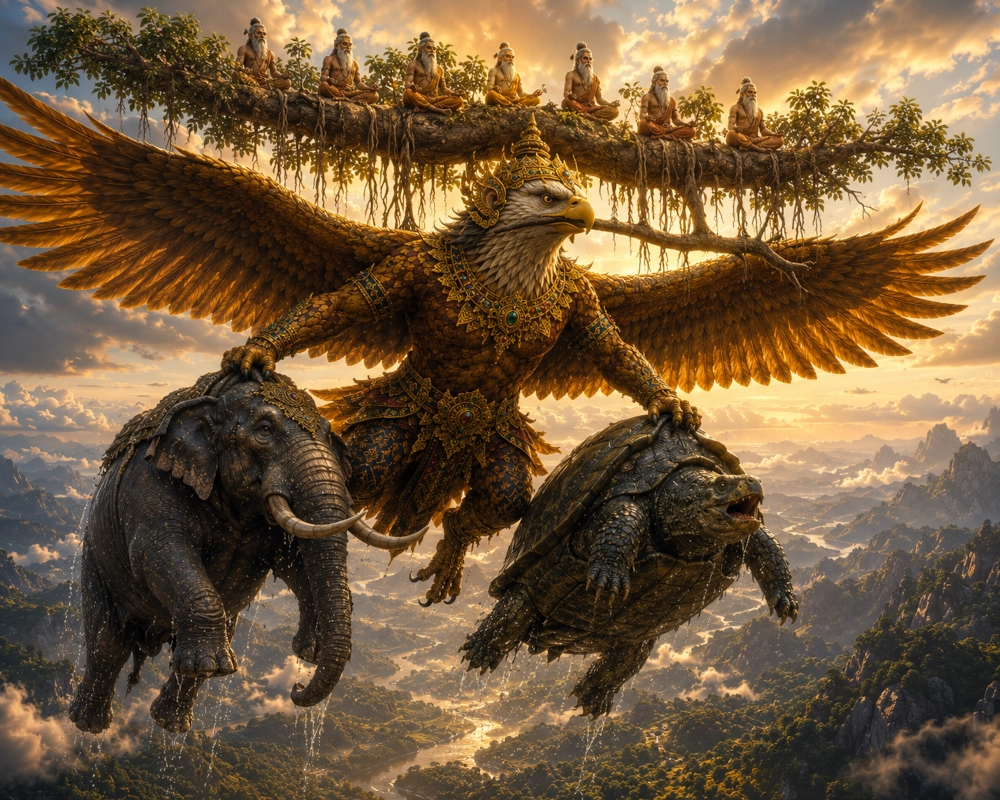
Now he flew through the sky carrying all three burdens—the enormous elephant, the giant tortoise and the vast banyan branch upon which the sages remained absorbed in meditation.
Garuda searched for a safe place to set the branch down, but every mountain and forest below was inhabited. He feared that the falling branch might destroy villages, animals or hermitages.
At last, guided by his father, he found a remote mountain of bare stone where no living creature would be harmed.
There, Garuda gently placed the branch.
The sages opened their eyes and saw what he had done. They understood that, though driven by hunger and engaged in a great mission, Garuda had chosen compassion over convenience.
They blessed him.
“May your strength never fail,” they said. “May no burden be too great for your wings, and may your purpose be fulfilled.”
Garuda bowed his magnificent head.
Then he carried the elephant and tortoise to a lonely peak. Their ancient quarrel had at last reached its end, not through victory or justice, but because both brothers had allowed anger to consume everything they once possessed.
Garuda fed and regained his strength.
Soon he rose once more into the heavens, his wings blazing in the sunlight, ready to continue his extraordinary quest.
Far below, the lake became calm again.
The waves faded. The mud settled. The forest grew quiet.
Nothing remained of the brothers’ vast inheritance, their pride or their endless accusations.
Their story endured as a warning: wealth may divide a family, but anger can destroy far more than wealth. When resentment is carried too long, even brothers may become strangers, and a quarrel once begun for treasure may continue long after the treasure itself has been forgotten.
Garuda, however, carried a different lesson into the sky.
True greatness is not found in strength alone. It is revealed when strength protects the small, honours the wise and serves a purpose greater than hunger.
You may also like
-
Gnani AI Launches Nationwide Challenge Offering Up to 100 Paid AI Internships
-
NMMSS Scholarship Application Deadline Extended to October 31, 2026
-
DGCA Introduces Training Framework for Gyroplane Pilots in India
-
DRDO CASDIC Opens 30 Paid Internships for Engineering and Science Students
-
Duryodhana Wins Shalya Through Hospitality: Gifts, Obligation and Political Leverage Before the Kurukshetra War
