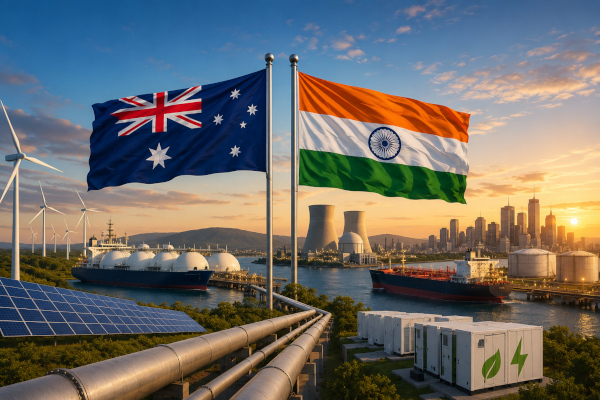
India and Australia have taken another important step in their Comprehensive Strategic Partnership with the release of the India-Australia Joint Statement on Energy Security during Prime Minister Shri Narendra Modi’s visit to Australia. The statement places energy at the heart of the bilateral relationship and connects it directly with Indo-Pacific stability, economic resilience, open trade and the long-term transition toward cleaner energy systems. PIB listed the energy security statement among the major outcomes of the Prime Minister’s Australia visit on 9 July 2026.
The statement comes at a time when global energy markets are facing pressure from geopolitical tensions, especially the situation in the Middle East. India and Australia expressed deep concern over the wider consequences of these disruptions, including their impact on energy, resources, commodity supply chains and prices. This makes the statement highly relevant because energy security today is linked with national security, inflation control, industrial stability and maritime trade.
A major message from the statement is the shared commitment to open markets and rules-based trade. For India, reliable access to energy resources is essential for sustaining economic growth, manufacturing expansion, transport, agriculture and urban development. For Australia, India is one of the most important growth markets in the Indo-Pacific. By supporting open trade arrangements, both countries are seeking to reduce uncertainty in energy flows and protect their economies from external shocks.
The statement recognises the role of private sector partnerships and strategic investments in maintaining sustainable and reliable energy flows. This is important because energy security is shaped by government policy as well as commercial investment, logistics, shipping, refining, storage, infrastructure and technology partnerships. India and Australia have therefore linked energy cooperation with wider trade mechanisms such as the Economic Cooperation and Trade Agreement and ongoing work toward a Comprehensive Economic Cooperation Agreement.
The fuel trade relationship between the two countries already has a strong foundation. Australia is an important supplier of liquefied natural gas to India, while India is an important supplier of liquid fuels and downstream petroleum products to Australia. This two-way energy trade gives the partnership practical value. It creates a supply relationship where both nations contribute to each other’s energy stability rather than building a one-sided buyer-seller model.
The most significant long-term outcome is the finalisation of administrative arrangements that enable the export of Australian uranium to India for exclusively peaceful purposes under International Atomic Energy Agency safeguards. This is linked to the Australia-India Nuclear Cooperation Agreement. For India, Australian uranium can support the civil nuclear energy programme and contribute to a diversified energy mix. Civil nuclear power has strategic value because it offers stable, low-carbon baseload electricity, which can support India’s clean energy transition while strengthening energy security.
The statement also highlights energy supply chain resilience. This includes cooperation in regional supply chains, renewable energy resources, liquid fuels, natural gas and clean energy technologies. Both countries recognise that the future of energy security will increasingly depend on electrification. As transport, industry and household energy systems move toward electricity-based solutions, reliable power generation, storage, transmission, critical minerals and grid resilience will become central national priorities.
Renewable energy cooperation is another important pillar. India is rapidly expanding solar, wind, green hydrogen, biofuels and battery-linked infrastructure, while Australia has large renewable energy potential, critical minerals and clean technology capabilities. This creates natural space for cooperation in low-carbon fuels, clean energy investment, grid technologies, storage systems and critical mineral supply chains.
Australia’s reference to India’s Global Biofuels Alliance is also important. The Global Biofuels Alliance reflects India’s attempt to position biofuels as a practical energy transition solution for developing and developed economies. Biofuels can help reduce dependence on imported fossil fuels, support farmers, create rural value chains and lower emissions in transport sectors where full electrification will take time.
The statement also widens the energy discussion beyond India and Australia by recognising the vulnerabilities of Pacific Island Countries. These countries face serious energy resource security challenges due to geography, limited domestic fuel availability, high import dependence and exposure to climate-related disruptions. By acknowledging the energy needs of the Pacific, India and Australia are giving their partnership a regional development dimension.
Coal, diesel, liquid fuels and natural gas remain part of the statement’s energy security framework. This reflects a realistic approach. While both countries support energy transition and low-carbon fuels, they also recognise the continuing role of conventional fuels in maintaining stable energy supplies. For India, this balance is especially important because the country must support economic growth, electricity demand, industrial production and cleaner energy expansion at the same time.
The statement therefore presents energy security as a bridge between today’s needs and tomorrow’s transition. It does not treat traditional fuels and clean energy as separate worlds. Instead, it places them within a broader strategy of reliability, affordability, open trade, diversification and gradual transition. This approach gives the India-Australia partnership a practical and balanced energy framework.
For India, the statement strengthens energy access through LNG, uranium, liquid fuel trade, clean energy cooperation and supply chain resilience. For Australia, it reinforces India as a major strategic energy partner and a key market for resources, technology and investment. For the Indo-Pacific, it supports open energy flows, resilient supply chains and regional stability.
The India-Australia Joint Statement on Energy Security is a strategic statement about economic resilience, trusted partnerships and future-ready energy systems. It connects fuel security with nuclear cooperation, renewable transition, biofuels, private sector investment and regional responsibility. As global energy markets become more uncertain, this partnership can become one of the strongest pillars of India-Australia cooperation in the Indo-Pacific.
Reference: PIB
You may also like
-
India, Russia and the Ukraine Conflict: Putin Highlights Modi’s Continued Push for Dialogue and a Negotiated Settlement
-
EON Space Labs and Dhruva Space Advance Indian Space Hardware on Transporter-18 Mission
-
SatLeo Labs’ TAPAS-1 Reaches Orbit, Advancing India’s Private Thermal-Imaging Capability
-
TakeMe2Space’s MOI-1A Reaches Space on Falcon 9 Transporter-18 Mission
-
Bank of Baroda Enters Pension Fund Management After PFRDA Appointment
