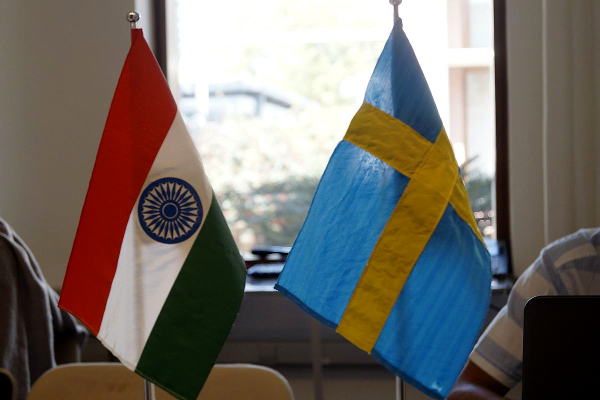
India and Sweden have raised their bilateral relationship to the level of a Strategic Partnership, marking a major step forward in ties between the two innovation-driven democracies. Prime Minister Narendra Modi held bilateral consultations with Swedish Prime Minister Ulf Kristersson in Gothenburg, Sweden, where the two leaders reviewed the full range of India-Sweden cooperation and agreed to give the partnership a broader, long-term strategic direction. Her Royal Highness Crown Princess Victoria of Sweden also participated in the meeting and conveyed greetings from King Carl XVI Gustaf and Queen Silvia, while Prime Minister Modi extended warm wishes on the occasion of the King’s 80th birthday.
The discussions covered a wide spectrum of cooperation, including trade and investment, innovation, green transition, emerging technologies, defence and security, digitalisation, small and medium enterprises, space, research, education, culture and people-to-people relations. Both sides acknowledged that the relationship has gained momentum in recent years and reaffirmed that it is built on democratic values, innovation, sustainability and strong research-and-development linkages.
A key outcome of the meeting was the decision to elevate India-Sweden ties into a Strategic Partnership guided by four pillars: Strategic Dialogue for Stability and Security, Next-Generation Economic Partnership, Emerging Technologies and Trusted Connectivity, and Shaping Tomorrow Together – People, Planet, Health and Resilience. These pillars show that the relationship is no longer limited to trade or technology cooperation alone, but is expanding into security, resilient supply chains, climate action, trusted connectivity and future-facing innovation.
To operationalise this upgraded partnership, the two leaders adopted the India-Sweden Joint Action Plan 2026–2030. The plan is expected to serve as a roadmap for cooperation across political, economic, technological, security, climate and people-to-people domains. Regular high-level political engagement and institutional dialogues were also identified as important mechanisms to guide the expanding relationship.
The leaders also welcomed the recently concluded India-EU Free Trade Agreement, describing it as a development that opens a new chapter in economic and commercial relations. They agreed to continue efforts for early implementation so that trade, investment and technology linkages can deepen further. For Sweden, a country known for advanced manufacturing, clean technology, sustainable mobility and digital transformation, India’s expanding market and industrial growth offer significant opportunities. For India, Swedish expertise in innovation, green technologies and high-end manufacturing can support its wider development and modernisation goals.
Prime Minister Modi appreciated Sweden’s continued engagement with India in strategic sectors such as innovation, clean technologies, advanced manufacturing, sustainable mobility and digital transformation. Prime Minister Kristersson, in turn, praised India’s progress in digital transformation and artificial intelligence, while also recognising the contribution of the Indian community to Sweden’s economy and innovation ecosystem. Modi invited greater Swedish participation in India’s growth story, underlining New Delhi’s interest in drawing more technology, investment and industrial collaboration from Stockholm.
The two leaders also exchanged views on regional and global issues. They stressed the need for reform of the United Nations and other multilateral institutions, while reaffirming their commitment to peace, stability, resilient supply chains and sustainable economic growth. Prime Minister Modi also thanked Sweden for its strong support in the fight against terrorism, reflecting the growing security dimension in the relationship.
The Gothenburg meeting therefore marks an important moment in India-Sweden relations. By upgrading ties to a Strategic Partnership and adopting a five-year action plan, the two countries have created a structured framework for cooperation in areas that will shape the future economy and global order—technology, climate resilience, defence, digital systems, supply chains, research and innovation.
You may also like
-
India and Uzbekistan Strengthen Counter-Terrorism Cooperation, Focus on Terror Financing and Regional Security
-
India and Poland Target Doubling Bilateral Trade by 2030, Expand Defence and Technology Cooperation
-
India Calls for Legally Binding International Treaty to Prevent Weaponisation of Outer Space
-
India and New Zealand Strengthen Trade Ties with Electronic Origin Data Exchange Agreement Under FTA
-
Polish Prime Minister Donald Tusk Arrives in India to Strengthen Strategic Partnership in Defence, Trade and Technology
