आयुः कर्म च वित्तं च विद्या निधनमेव च ।
पञ्चैतानि हि सृज्यन्ते गर्भस्थस्यैव देहिनः ॥
Meaning: lifespan, karma/action, wealth, learning and death are shaped even while the being is still in the womb.
Chanakya Niti 4.1 offers one of the most striking reflections on human life: “आयुः कर्म च वित्तं च विद्या निधनमेव च । पञ्चैतानि हि सृज्यन्ते गर्भस्थस्यैव देहिनः ॥” The verse means that lifespan, action, wealth, learning and death are shaped for the embodied being while it is still in the womb. At first glance, it may appear to be a statement of fate, as though every major feature of life is sealed before birth. But when read in the light of modern science and social understanding, the verse becomes far more meaningful. It reminds us that human life does not begin as a blank slate at birth. The foundations of health, intelligence, opportunity, vulnerability and future capacity begin much earlier — in the womb, in the mother’s body, in the family’s condition and in the social world waiting outside.
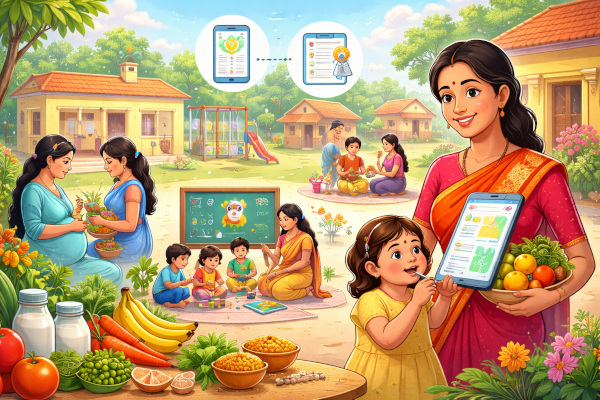
Modern science offers a powerful parallel through the idea of the first 1,000 days, the period from conception to a child’s second birthday. This window is now widely recognised as one of the most important phases in human development. The nutrition a mother receives, the healthcare available during pregnancy, the emotional stress she experiences, the safety of the environment, the quality of childbirth care, breastfeeding, early nutrition and infant stimulation all influence the child’s growth and future well-being. In this sense, Chanakya’s phrase “गर्भस्थस्यैव देहिनः” — while the being is still in the womb — sounds remarkably modern. The womb is not merely a place where the child waits to be born; it is the first environment in which life is shaped.
The first word in the verse is आयुः, lifespan. Modern medicine would not say that the exact length of a person’s life is fixed before birth, but it does show that early-life conditions can affect long-term health. Poor maternal nutrition, untreated illness, low birth weight, premature birth, exposure to toxins, infections and lack of early medical care can increase the risk of future disease. On the other hand, good prenatal care, safe delivery, proper infant nutrition and early protection from illness create a stronger foundation for life. Chanakya’s reference to lifespan can therefore be understood as a deep observation that longevity is not shaped only in adulthood. The roots of health are planted before a child even sees the world.
The second word is कर्म, which can mean action, work, conduct or the path into which one is drawn. In a modern reading, this connects with the field of opportunity into which a child is born. No child chooses the circumstances of birth. One may be born into stability, nutrition, education and affection, while another may be born into poverty, hunger, insecurity or social neglect. These conditions do not remove free will, but they influence the starting point from which a person must act. A child born into privilege may walk through doors already open, while another must first fight to reach the door itself. Chanakya’s use of कर्म can be read as a reminder that action is never born in isolation. Human effort matters, but the environment in which effort begins also matters.
The third word is वित्तम्, wealth or fortune. In ancient times, this could mean inheritance, land, royal status, family resources or material prosperity. In today’s world, it can be understood as economic background and social capital. A child born into a secure household may inherit not only money, but also books, language exposure, healthcare, confidence, networks and expectations of success. A child born into deprivation may inherit debt, malnutrition, unsafe surroundings and limited access to schooling. This does not mean that wealth is fixed forever. History is full of people who rose above difficult beginnings. But the verse forces us to acknowledge that fortune begins unevenly. Chanakya’s insight becomes socially powerful when it is not used to justify inequality, but to challenge it. If birth conditions shape future fortune, then society has a responsibility to reduce inherited disadvantage.
The fourth word, विद्या, learning, is perhaps the easiest to connect with modern science. The child’s brain develops rapidly during pregnancy and the early years. Nutrition, emotional security, touch, speech, attention and early stimulation all influence cognitive growth. A child who receives affection, language exposure and nourishment begins learning before formal education begins. A child who faces hunger, neglect or chronic stress may struggle before entering a classroom. This does not mean that education later in life is powerless. Chanakya himself represents the importance of training, discipline and instruction. But the verse reminds us that the roots of learning lie deeper than school walls. Education begins in the womb, in infancy, in the family, in the first sounds, first food, first care and first feeling of safety.
The final word is निधनम्, death. This is the most difficult part of the verse for a modern reader, because science does not support the idea that the exact moment or manner of death is predetermined in the womb. Yet even this word can be read with practical wisdom. Early deprivation can increase the risk of premature death. Malnutrition, unsafe childbirth, preventable infection, poor sanitation, lack of vaccination, pollution and poverty all place a child at greater risk. In that sense, death is not written as a single fixed event, but the dangers surrounding life can begin very early. A society that neglects mothers and children silently increases the risks that follow them for years. A society that protects them reduces those risks.
This is where Chanakya Niti 4.1 becomes deeply relevant to modern public policy. The verse is not useful if it is read as helpless fatalism. Chanakya was not a thinker of passivity. His writings are filled with strategy, discipline, education, governance and practical action. Therefore, the verse should not be understood as saying that nothing can be changed. Its better meaning is that the beginning of life must be taken seriously because the beginning has consequences. If lifespan, action, fortune, learning and vulnerability are influenced from the earliest stage, then maternal healthcare, nutrition, early childhood care and social justice are not minor welfare concerns. They are among the most important investments a civilisation can make.
The modern idea of the first 1,000 days gives Chanakya’s verse a new language. What ancient wisdom expressed as आयुः, कर्म, वित्तम्, विद्या and निधनम्, modern science discusses through prenatal health, brain development, early nutrition, social determinants, child survival and human capital. The vocabulary has changed, but the core insight remains surprisingly close: life is shaped before it becomes visible. By the time a child enters school, many foundations have already been laid. By the time a person enters the world of work, many advantages and disadvantages have already accumulated. By the time society judges success and failure, it often forgets the invisible beginnings that made the journey easier for some and harder for others.
The ethical message is clear. A mother’s health is not only a private family matter; it is a national concern. A child’s nutrition is not charity; it is future-building. Early childhood care is not sentimental softness; it is the architecture of human potential. When a society invests in pregnant women, infants and young children, it is not merely helping individuals. It is shaping its future citizens, workers, thinkers, creators and leaders. Chanakya’s verse becomes a call to look at the womb, the home and the earliest years as the first institutions of civilisation.
Therefore, Chanakya Niti 4.1 remains powerful today not because it tells us to surrender to destiny, but because it teaches us to respect origins. A human being is born carrying more than a body. He carries the imprint of nourishment or hunger, safety or fear, care or neglect, opportunity or deprivation. Modern science gives us the tools to improve that beginning. Chanakya gives us the wisdom to understand why that beginning matters. The verse becomes most meaningful when read not as a sentence written by fate, but as a responsibility placed before society: if life begins being shaped before birth, then care must begin before birth too.
You may also like
-
Ayush Patent Filings Rise Eightfold as India Records 4,077 Applications and 711 Grants in 12 Years
-
Why Ayurveda Warns Against Suppressing Hunger, Thirst and Sleep
-
India Strengthens Quality Standards for Ayurveda, Yoga and Sowa-Rigpa Through Nationwide BIS Initiative
-
Sanofi Receives Indian Approval for Qfitlia, a New RNA-Based Treatment for Haemophilia A and B
-
Dr. Reddy’s Receives Indian Approval for Zytorvi Immunotherapy to Treat Advanced Oesophageal Cancer
