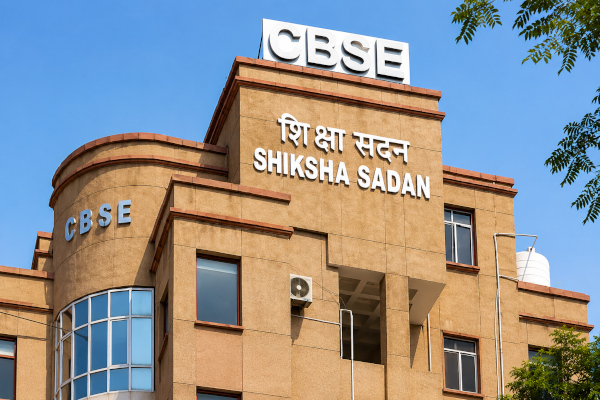
The Central Board of Secondary Education has introduced an important language-policy change for secondary classes, making the study of three languages compulsory for Class 9 from July 1, 2026, with the structure continuing into the secondary stage. The move aligns CBSE’s scheme of studies with the National Education Policy 2020 and the National Curriculum Framework for School Education 2023, both of which emphasise multilingual learning, Indian languages and flexible education. CBSE’s circular says the revised Class 9 NCERT syllabus for 2026-27 includes three languages — R1, R2 and R3 — at the secondary stage.
Under the new arrangement, students will study three languages, and at least two of them must be native Indian languages. Students who wish to take a foreign language may do so as the third language only if the other two are Indian languages, or they may take it as an additional fourth language. This means the policy does not shut the door on foreign languages, but it clearly gives priority to Indian languages within the core curriculum.
The most important clarification for parents and students is that the third language will not become a Class 10 board-exam burden. CBSE has stated that there will be no board examination for R3 at the Class 10 level. Assessment for the third language will be entirely school-based and internal, while the student’s performance in R3 will be reflected in the CBSE certificate. The Board has also clarified that no student will be barred from appearing in the Class 10 board examinations because of R3.
This makes the reform more balanced than it may first appear. The intention is not to add another high-pressure board paper, but to expose students to multilingual learning in a structured way. In a country where children often grow up hearing more than one language at home, in school and in public life, formal recognition of multilingual ability can become a strength rather than an academic burden.
The transition, however, will require careful implementation. Since the 2026-27 academic session had already begun in April, CBSE has adopted a transitional approach. Until dedicated R3 textbooks are available for Class 9, students will use Class 6 R3 textbooks of the chosen language for the 2026-27 edition, supplemented by suitable local or state literary material such as short stories, poems or non-fiction works selected by schools. CBSE has said detailed guidelines on such supplementary material will be issued by June 15, 2026.
The Board has also recognised the practical challenge of teacher availability. Schools that face a shortage of qualified native Indian language teachers may temporarily use teachers of other subjects who have functional proficiency in the chosen language. CBSE has also suggested inter-school sharing through Sahodaya clusters, virtual or hybrid teaching support, retired language teachers and qualified postgraduates as interim solutions during the transition.
The policy gives schools some autonomy in choosing languages from the CBSE list, provided at least two of the three languages are native Indian languages. Schools must update their R3 offering for Classes 6 to 9 on the OASIS portal by June 30, 2026. CBSE has also listed special provisions: Children with Special Needs will receive relaxations under the RPwD Act, CBSE schools outside India are exempted, and foreign students returning to India may receive case-by-case exemptions from the requirement of studying two native Indian languages.
For India’s education system, this move is significant because language is not merely a subject; it is a carrier of culture, memory and identity. English will continue to remain important for higher education and global mobility, but Indian languages give students access to regional literature, local history, social communication and civilisational knowledge. A well-implemented three-language framework can help students become more rooted without becoming less global.
The success of the reform will depend on how sensitively schools handle it. If implemented mechanically, it could become another timetable burden. If implemented creatively, with stories, songs, local literature, conversation, theatre, translation exercises and cultural activities, it can make language learning joyful and meaningful. CBSE’s own circular stresses that the focus should remain on meaningful language learning, not examination pressure.
The larger message is clear: CBSE is trying to move secondary education toward multilingual competence while avoiding an additional board-exam load. The policy will demand preparation from schools, clarity for parents and flexibility for students, but it also opens a valuable opportunity. In a country as linguistically rich as India, learning more than two languages should not be seen only as compliance. Done properly, it can become one of the most practical forms of cultural literacy.
You may also like
-
Ayush Patent Filings Rise Eightfold as India Records 4,077 Applications and 711 Grants in 12 Years
-
DRDO Announces Paid Research Internships at Gwalior for Science and Engineering Students
-
PM-SETU: Government Approves ₹1,194.92 Crore to Modernise 25 ITIs Across Maharashtra, Odisha and Jammu & Kashmir
-
Indian Railways Announces 3,548 NTPC Graduate Vacancies, Applications Open Until November 6, 2026
-
National Institute of Naturopathy Opens Admissions for BNYS Programme at Pune for 2026–27
