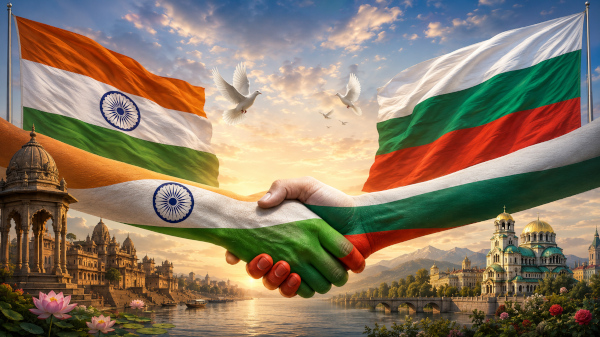
India and Bulgaria have opened a fresh diplomatic push to expand cooperation across multiple fields, with External Affairs Minister Dr. S. Jaishankar’s official visit to Sofia giving new momentum to an old and friendly relationship. The visit is significant because it comes at a time when India is widening its engagement with Europe beyond the big capitals and looking at smaller but strategically placed partners who can support trade, technology, education, cultural exchange and regional connectivity.
During the Bulgaria leg of his 10–11 June visit, Dr. Jaishankar was scheduled to meet the Bulgarian leadership and hold discussions with his counterpart before travelling to Finland for the Kultaranta Talks. News on AIR had reported the visit as part of India’s wider diplomatic outreach to Bulgaria and Finland. DD News also reported that Dr. Jaishankar visited the National Historical Museum in Sofia, where he appreciated Bulgaria’s civilisational heritage and cultural continuity.
The India-Bulgaria relationship rests on a strong historical foundation. Diplomatic relations were established in December 1954, and the two countries marked 70 years of diplomatic ties in 2024. The Indian Embassy in Sofia describes the relationship as long-standing, warm and multi-dimensional, shaped by mutual respect, cultural familiarity and regular high-level engagement.
The areas of cooperation are broad. India and Bulgaria already have agreements covering tourism, defence cooperation, science and technology, information technology, economic cooperation, health and medicine, civil nuclear cooperation, youth affairs, sports, legal assistance and air services. This gives both countries a ready-made framework to move from diplomatic goodwill to practical projects.
Economic cooperation is one of the most promising parts of the relationship. Bulgaria’s location inside Europe gives Indian companies a useful gateway to European markets, while India offers Bulgaria a large consumer market, skilled talent, pharmaceutical strength, digital capability and manufacturing partnerships. The Indian Embassy notes that major Indian IT companies such as TCS, Infosys, Wipro, HCL and Tech Mahindra are already present in Bulgaria.
Trade also has room to grow. Bilateral trade stood at $415.99 million in 2023–24, with Indian exports to Bulgaria including organic chemicals, pharmaceuticals, electrical machinery, wool, construction material, plastics, steel and aluminium products. Bulgarian exports to India include laboratory instruments, animal feeding preparations, machinery, copper scrap, aluminium scrap and industrial equipment.
The next phase can focus on high-value sectors. Bulgaria has shown interest in cooperation with India in IT, services, agriculture, defence, pharmaceuticals, mechanical engineering, clinical research, tourism and hospitality. Bulgaria’s Ministry of Economy had earlier highlighted that Indian companies are showing growing interest in investing across these areas.
Culture remains a special bridge. Indian literature, yoga, Ayurveda, classical texts and cinema have a visible presence in Bulgaria. Rabindranath Tagore visited Bulgaria in 1926, and Indian classics such as the Ramayana, Mahabharata, Vedas, Upanishads, Bhagavad Gita and Panchatantra have been translated into Bulgarian. International Yoga Day is celebrated in more than 40 Bulgarian cities and towns, showing that the relationship extends beyond government channels into society.
For India, Bulgaria is more than a European partner. It is a civilisational friend, an EU member, a technology and education contact point, and a possible bridge for Indian business into southeastern Europe. For Bulgaria, India offers scale, talent, investment, pharmaceuticals, digital public infrastructure experience and a fast-growing economy. The latest diplomatic engagement gives both sides an opportunity to convert historical warmth into modern cooperation across economy, technology, education, defence, health and culture.
You may also like
-
India and Italy Hold First Maritime Security Dialogue in Rome, Strengthen Strategic Maritime Cooperation
-
India and Azerbaijan Agree to Strengthen Security, Trade, Energy and Economic Cooperation
-
Jaishankar Meets Azerbaijan President Ilham Aliyev in Baku, Discusses Trade, Technology and Strategic Cooperation
-
Piyush Goyal Holds High-Level Talks in Berlin to Strengthen India–Germany Trade, Investment and Industrial Cooperation
-
Indian Navy to Host Indo-Pacific Regional Dialogue 2026 with Experts from 18 Countries on Maritime Science and Technology
