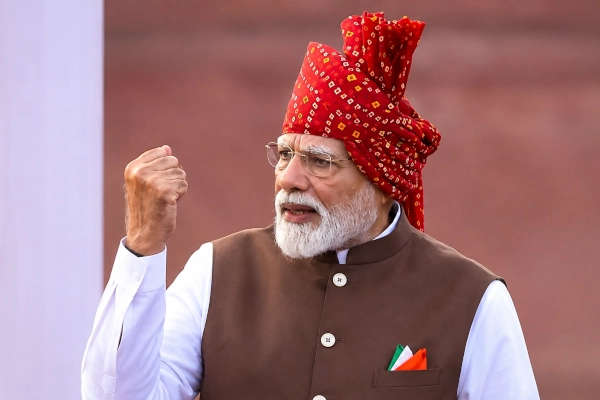
Prime Minister Narendra Modi used his address from the Red Fort on India’s 80th Independence Day to present both a report card of the past 12 years and a roadmap for the next two decades. At the centre of the speech was a clear target: India must become a Viksit Bharat, or developed nation, by 2047.
The Prime Minister argued that the progress achieved since 2014 has created the foundation for a much larger transformation. He also made it clear that the next phase cannot simply continue at the old pace. India, he said, must complete in the coming five to seven years several tasks that remained unfinished for decades.
Twelve Years of Development at Scale
Modi highlighted the expansion of India’s manufacturing, infrastructure, digital economy and welfare systems since 2014. According to figures cited in his address, 25 crore Indians have moved out of poverty, while India has moved from being counted among the “Fragile Five” economies to becoming one of the fastest-growing major economies.
The transformation has been particularly visible in domestic manufacturing. The Prime Minister said defence production has grown nearly four-fold over the past 12 years. Khadi and village industry production has increased about five-fold. Electronics manufacturing has risen around seven-fold, while production of modern railway coaches has expanded about 21 times.
Mobile phone production, meanwhile, has grown around 35 times. India has also experienced a massive digital expansion. Internet usage has grown several times, patent grants have increased, and digital transactions have multiplied roughly one hundred-fold, according to the figures presented in the speech.
The government also expanded basic services at a much faster pace. Modi said tap-water connections were provided at about 15 times the earlier annual rate. Gas connections expanded at around six times the previous pace. Toilet construction for poorer households accelerated four-fold, while housing delivery moved around three times faster.
Energy Security Becomes a Development Priority
Energy emerged as one of the strongest themes of the address. India’s future industries, including artificial intelligence, semiconductor manufacturing and data centres, will require enormous quantities of reliable electricity.
The Prime Minister said India’s solar capacity has grown from roughly 2 GW twelve years ago to around 160 GW. City gas distribution, which covered around 70 cities before 2014, has expanded to about 700 cities. The number of homes receiving piped gas has also risen sharply.
Under the PM Surya Ghar programme, Modi said rooftop solar installations have crossed 50 lakh households. The programme is intended to reduce household electricity bills while allowing some families to earn by supplying excess electricity to the grid.
Railway electrification also featured prominently. The Prime Minister said only around 30 per cent of the network had been electrified over the nine decades after the process began in 1925. The remaining network has been electrified during the past decade, reducing diesel dependence and supporting cleaner transportation. India has also entered the hydrogen-powered railway segment, he said.
Semiconductors, Critical Minerals and Nuclear Power
India’s development strategy is increasingly focused on technologies that determine economic and strategic independence.
Modi said three major semiconductor plants have already begun operations or production-related activity, with output beginning to reach export markets. He announced that another five to eight semiconductor plants could come up over the next seven to eight years. The objective is to build a domestic ecosystem that extends beyond assembly and covers a larger part of the electronics value chain.
Critical minerals form another part of this strategy. India has launched a national mission, announced critical-mineral corridors and begun developing international partnerships to secure raw materials required for electronics, clean energy and advanced manufacturing.
Nuclear power will also occupy a larger place in India’s future energy mix. Modi set out a target of 100 GW of nuclear power capacity by 2047 and said the country aims to commission five new reactors during the current decade. He also highlighted advances in fast-breeder nuclear technology as an important step towards greater nuclear-fuel security.
India is simultaneously widening exploration for domestic oil and gas. Areas of the offshore zone that were once closed to exploration have been opened. Modi said ₹85,000 crore had been allocated to accelerate the broader offshore exploration initiative associated with the government’s “Samudra Manthan” approach.
‘Sapta Dhara’: Seven Engines for the Next Development Phase
The most important forward-looking announcement was the Prime Minister’s “Shakti ki Sapta Dhara”, or seven streams of national strength. Modi presented these seven areas as the framework that will drive India towards developed-country status.
The first stream is manufacturing power. India wants to build complete domestic value chains, from individual components to finished products. Modi placed particular emphasis on three factors: cost, quality and scale. His vision is for India to become a trusted global manufacturing and supply-chain centre known for precision and zero-defect production.
The second stream covers agriculture, food production and processing. The government wants Indian farmers and food producers to move beyond the domestic market and connect directly with global value chains. Millets, spices, fruits, flowers, traditional foods and chemical-free agricultural products could become major export brands.
The third stream is technology and innovation. India intends to expand its capabilities in artificial intelligence, quantum technologies, space, robotics and data centres. Building on UPI and India’s digital public infrastructure, Modi called for India to become an innovation hub rather than merely a market for technologies developed elsewhere. He also set the ambition of establishing Made-in-India 6G technology as a global platform.
The fourth stream is Gati Shakti and connectivity. Future infrastructure plans include high-speed rail between cities, modern highways, inland waterways, expanded airports and multimodal logistics networks. Ports are expected to evolve beyond cargo-handling facilities into centres of industrial and economic development.
The fifth stream is defence power. India will push deeper into defence self-reliance while attempting to emerge as a global supplier of advanced military systems. Modi specifically mentioned drones, counter-drone systems and hypersonic defence technologies. Cybersecurity will also become an increasingly important part of national defence.
The sixth stream combines the green and blue economies. India plans to expand green hydrogen, renewable energy, energy storage, electric mobility and green manufacturing. At the same time, the country will seek greater economic value from its coastline through fisheries, coastal tourism and ocean technology.
The seventh stream is India’s soft power. Yoga, Ayurveda, holistic healthcare, the Heal in India initiative, handicrafts, cinema, animation, gaming and digital content were identified as areas with major international potential. Tourism, global sporting events and the rapidly expanding concert economy could also become important engines of employment and international engagement.
One Crore Youth to Receive AI Training
Youth development received a major place in the Prime Minister’s roadmap.
India now has more than 2.5 lakh registered startups, according to figures cited in the address. The government has also announced a ₹1 lakh crore innovation fund to support research and emerging technologies.
Modi announced that one crore young Indians will receive AI-related skill training during the coming year. The programme is intended to ensure that India’s workforce does not merely adapt to artificial intelligence but develops the capability to lead in the sector.
Another new initiative will address the financial burden created by private coaching. The government plans to establish a national free online coaching network for competitive examinations, combining digital public infrastructure with teachers and educational resources.
The Prime Minister also pointed to the rapid rise of India’s bioeconomy. According to his speech, its value has grown from roughly ₹60,000 crore before 2014 to around ₹20 lakh crore. Electric-vehicle adoption has also accelerated, with about 25 lakh EVs sold during 2025–26, compared with much smaller volumes in earlier years.
A New Sports Development Pipeline
India’s sporting ambitions are also becoming part of the development strategy. Modi reiterated India’s desire to host the 2036 Olympic Games and referred to the country’s plans for the 2030 Commonwealth Games.
More importantly, the government plans to create a nationwide sports talent-identification system.
Children between the ages of five and 15 will be identified through talent hunts across villages, towns and schools. Promising athletes will then receive specialised training. The programme seeks to expand India’s participation into Olympic disciplines where the country currently has little or no representation.
Defence Production Moves Towards Global Markets
The development agenda is also closely tied to national security and industrial capability.
Modi said India’s defence exports have increased nearly 50-fold, with Indian defence products now reaching around 100 countries. The next objective is to move from domestic self-reliance towards global leadership in next-generation defence technologies.
The government also plans to build a modern civil-defence volunteer network. The Prime Minister argued that contemporary conflict can affect refineries, banks, data centres, communications networks and industrial infrastructure far away from traditional battlefields. Civil-defence systems therefore need to be redesigned for modern security challenges.
Women at the Centre of Rural Economic Transformation
Women-led development will remain another pillar of the government’s strategy.
The Prime Minister said the earlier goal of creating three crore Lakhpati Didis has been achieved. The next target is six crore, which would bring another three crore women into higher-income livelihood activities linked largely to the rural economy and self-help-group ecosystem.
Modi also called for the implementation of the constitutional provision providing 33 per cent representation for women in the Lok Sabha and State Assemblies, asking political parties to cooperate in taking the process forward.
Social Security Expands Towards Universal Coverage
The Prime Minister linked developed-country status with reaching citizens at the bottom of the economic pyramid.
He said social-security coverage has expanded from around 25 crore people before 2014 to about 100 crore people today. Ayushman Bharat has also been extended to senior citizens aged 70 and above, with eligible beneficiaries receiving healthcare coverage of up to ₹5 lakh.
The underlying message was that infrastructure, technology and industrial growth cannot operate separately from social welfare. The government’s development model increasingly seeks to combine industrial capacity with digital delivery and wider social protection.
From Indian Companies to Global Champions
Modi also set several ambitious benchmarks for corporate India.
He asked why India should not have 50 companies in the Fortune 500 within the coming decade. He also called for Indian banks to enter the global top five and for Indian pharmaceutical, technology, consulting and professional-services companies to emerge among the world’s leading firms.
These were presented less as individual government schemes and more as national goals. Achieving them would require deeper reforms by the Union Government, States, local bodies and industry.
The Next Five to Seven Years Could Define the Road to 2047
The central message of the 80th Independence Day address was therefore not simply about what India has achieved since 2014. It was about using those gains as the launch platform for a much larger economic transformation.
India has expanded digital infrastructure, renewable energy, domestic manufacturing, social security, defence production and startup activity during the past decade. The next phase aims to connect these achievements into a larger system built around technology, energy security, manufacturing depth, logistics, human capital and strategic independence.
The Sapta Dhara framework gives that strategy a defined structure. Manufacturing will provide industrial scale. Agriculture and food processing will connect rural India with global markets. Technology will shape future productivity. Gati Shakti will provide connectivity. Defence capability will strengthen strategic independence. Green and blue industries will create new economic frontiers, while India’s soft power will expand its global reach.
Modi’s target remains 2047. However, his speech made clear that the decisive period may arrive much earlier. The government now sees the next five to seven years as the window in which India must dramatically accelerate reforms, build domestic capabilities and establish itself in industries that will shape the global economy for decades.
The 80th Independence Day address thus presented a transition from development at scale to development with global ambition — from providing basic services and building infrastructure to creating advanced technologies, global Indian companies and strategic industries capable of supporting a developed India by the centenary of Independence.
Source: PIB:
https://www.pib.gov.in/PressReleaseDetail.aspx?PRID=2299775®=48&lang=1
You may also like
-
CCPA Removes 3,940 Explosive Substance Listings from Seven Online Platforms, Imposes ₹30 Lakh in Penalties
-
NTPC Explores Russian Nuclear Technology Cooperation as India Targets 30 GW Capacity by 2047
-
Centre Prepares Nationwide Khet Bachao Abhiyan to Promote Scientific Farming and Protect Soil Health
-
Government Caps Trade Margins on 137 Anti-Cancer Medicines, Prices to Fall by Up to 70% from November 9
-
Government Approves 1.93 Lakh More Houses Under PMAY-Urban 2.0, Taking Total Sanctions to 20.80 Lakh
