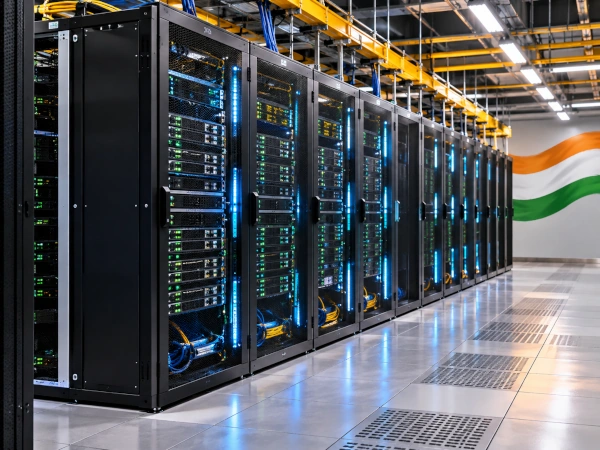
Bengaluru-based artificial intelligence infrastructure startup JohnAIC has announced plans to expand its manufacturing and supply-chain capabilities to achieve production capacity of up to 100 AI servers per month. The expansion follows the company’s successful raising of US$1.9 million in pre-seed funding, led by Crane Venture Partners with participation from Neon Fund, as announced on 17 November 2026.
JohnAIC specialises in developing on-premise artificial intelligence infrastructure that allows enterprises and government organisations to deploy advanced AI systems within their own computing environments. Its solutions combine high-performance graphics processing unit (GPU) servers, AI inference software, optimised open-source models and local data management capabilities.
The company is investing in factory infrastructure, server configuration facilities and supply-chain development to support growing demand from Indian organisations seeking greater control over their AI computing resources.
The expansion is particularly significant as India seeks to strengthen its domestic artificial intelligence ecosystem, reduce dependence on externally hosted computing services and develop infrastructure capable of supporting enterprise AI applications.
US$1.9 Million Funding to Support AI Infrastructure Expansion
JohnAIC secured US$1.9 million in pre-seed investment in a funding round led by Crane Venture Partners, with participation from Neon Fund.
The company intends to use the capital to strengthen its manufacturing, configuration and supply capabilities for AI servers.
Unlike conventional software startups that primarily provide AI applications through cloud-based platforms, JohnAIC focuses on delivering integrated computing infrastructure that enterprises can install and operate within their own facilities.
The investment will support the development of an infrastructure business combining specialised hardware, software and deployment services.
Anandamoy Roychowdhary, Managing Director for India and Asia-Pacific at Crane Venture Partners, highlighted the company’s focus on improving the efficiency and affordability of AI inference.
Neon Fund also expressed support for JohnAIC’s efforts to develop infrastructure that enables enterprises to deploy artificial intelligence securely and economically.
The funding represents an important early-stage investment in India’s emerging domestic AI infrastructure industry.
JohnAIC Targets Manufacturing Capacity of 100 AI Servers Monthly
JohnAIC is expanding its factory and supply-chain infrastructure with the objective of establishing the capacity to produce up to 100 AI servers every month.
The proposed production scale is intended to serve enterprises, public-sector organisations and emerging private AI cloud infrastructure providers.
AI servers differ from conventional computing systems because they are configured to handle computationally intensive workloads associated with artificial intelligence models.
Many AI applications require specialised processors, high-speed memory, efficient data movement and software capable of managing complex computational operations.
JohnAIC combines these computing components with model optimisation and inference software to provide integrated systems suitable for enterprise deployment.
The company’s focus extends beyond supplying standalone hardware. It aims to provide systems that customers can deploy and operate without separately integrating computing equipment, AI models, software tools and security controls.
The announced monthly production target represents a planned expansion of manufacturing and configuration capacity. The company has not disclosed that it is already producing 100 servers per month.
On-Premise AI Infrastructure Enables Local Control of Computing and Data
The principal technological focus of JohnAIC is on-premise artificial intelligence infrastructure.
In conventional cloud-based AI deployment, organisations may use computing resources operated by external service providers. Depending on the application and hosting arrangement, data and computational workloads may be processed through remote infrastructure.
On-premise systems provide an alternative by allowing organisations to deploy AI computing resources within infrastructure under their direct control.
JohnAIC’s integrated servers are designed to enable enterprises to operate AI models while maintaining local control over computing resources, data management and system administration.
This approach is particularly relevant to organisations handling sensitive commercial information, financial records, healthcare data and internal government information.
The ability to operate AI models within an organisation’s own infrastructure can also support customised security policies, access restrictions and integration with existing enterprise systems.
JohnAIC is targeting customers that require private AI environments rather than relying entirely on externally hosted AI services.
GPU Computing and AI Inference Form the Technological Foundation
JohnAIC’s infrastructure combines high-performance GPU computing with specialised inference software and optimised artificial intelligence models.
GPUs are widely used in artificial intelligence because they can perform large numbers of computational operations in parallel.
These capabilities are important for both training AI models and running trained models to generate responses, analyse information or perform automated tasks.
JohnAIC is particularly focused on the inference layer of artificial intelligence.
AI inference refers to the process of using a trained model to process new inputs and generate outputs. Applications include document analysis, automated customer support, image recognition, predictive maintenance and enterprise data processing.
As AI adoption increases, organisations require infrastructure capable of performing inference workloads efficiently and at an economically sustainable cost.
JohnAIC is developing integrated systems intended to improve the relationship between computing expenditure and AI processing output.
Its approach includes optimising open-source models and combining hardware and software components to support enterprise workloads.
The company’s emphasis on inference reflects the growing importance of making deployed AI systems efficient, reliable and commercially practical.
AI Infrastructure Designed for Banking, Healthcare and Public-Sector Organisations
JohnAIC is targeting sectors where data security, system reliability and control over computing infrastructure are important operational requirements.
These include banking, financial services, insurance, healthcare and public-sector organisations.
Financial institutions handle large volumes of sensitive customer and transaction information. Their computing systems must operate within established security and regulatory frameworks.
JohnAIC’s infrastructure is designed to enable these institutions to deploy AI models behind organisational firewalls while retaining control over data and computing resources.
The company states that its systems are designed to support requirements associated with India’s Digital Personal Data Protection framework and applicable Reserve Bank of India regulations.
However, the installation of on-premise infrastructure does not automatically establish regulatory compliance. Compliance also depends on an organisation’s operational controls, data management practices and implementation of applicable requirements.
Healthcare organisations can use private AI infrastructure to support applications involving medical records, administrative workflows, document processing and specialised analytical systems.
Public-sector organisations may similarly require AI systems capable of operating within controlled computing environments.
JohnAIC’s integrated approach is intended to reduce the technical complexity of deploying such infrastructure.
AI Server Deployed With Andhra Pradesh Power Distribution Company
JohnAIC has also reported an operational deployment involving Andhra Pradesh Eastern Power Distribution Company Limited (APEPDCL).
According to the company, its AI server infrastructure has been integrated into routine operational survey processes undertaken by the electricity distribution utility.
The system is intended to support the processing of field information and convert operational data into information that can assist decision-making.
Electricity distribution companies manage extensive infrastructure networks involving power lines, transformers, poles, substations and consumer connections.
Maintaining accurate operational information across these networks is important for infrastructure management and service reliability.
Artificial intelligence can assist utilities by analysing field observations, identifying patterns and improving access to information obtained through routine surveys.
The APEPDCL engagement provides an example of how locally deployed AI systems can be applied to infrastructure management.
It also demonstrates the relevance of AI computing technology beyond conventional software applications, extending into public utilities and industrial operations.
The deployment has been reported through company statements. Detailed independent performance assessments, contract values and system specifications have not been disclosed in the November announcement.
Building India’s Sovereign Artificial Intelligence Infrastructure
The expansion of JohnAIC’s business comes amid increasing interest in sovereign AI infrastructure.
Sovereign AI generally refers to the ability of a country or organisation to develop, deploy and govern artificial intelligence systems while maintaining control over important elements such as computing resources, data and technological operations.
For Indian enterprises, domestic AI infrastructure can offer an alternative to depending exclusively on computing services hosted outside their own organisations.
Local deployment can also provide opportunities for adapting AI models to Indian languages, industry-specific requirements and existing institutional systems.
JohnAIC’s focus on enterprise-owned AI servers addresses one component of this broader technological ecosystem.
Its integrated systems are designed to make private AI deployment more accessible to organisations that may not have the specialised technical teams required to build AI computing infrastructure independently.
The development of domestic server configuration, system integration and supporting software capabilities can contribute to India’s growing AI infrastructure industry.
However, domestic assembly and configuration should be distinguished from indigenous semiconductor manufacturing. The company has not claimed that all the processors and hardware components used in its servers are manufactured in India.
Growing Demand for Private AI and Neocloud Infrastructure
JohnAIC’s expansion plans also reflect the growing interest in private AI environments and specialised AI cloud services.
Traditional enterprise computing infrastructure was largely designed around conventional software applications, databases and networking requirements.
Artificial intelligence introduces additional demands involving high-performance processors, memory capacity, model deployment and computational efficiency.
Organisations adopting AI at scale increasingly need systems capable of handling these specialised workloads.
Neocloud providers represent an emerging category of computing businesses that focus on supplying infrastructure optimised for artificial intelligence workloads.
JohnAIC intends to serve both organisations developing private AI environments and companies building specialised AI infrastructure services.
Its proposed increase in server production capacity is intended to address these requirements through integrated, enterprise-ready computing systems.
The company’s ability to scale will depend on successful infrastructure expansion, component availability, customer demand and operational execution.
Indian Engineering Capabilities in Enterprise AI Infrastructure
JohnAIC was founded by Sasank Chilamkurthy, who has experience in artificial intelligence development and deployment.
The company’s approach combines expertise in AI software, computing infrastructure and system integration.
Rather than developing only application-level AI software, JohnAIC is working on the computing systems required to operate artificial intelligence within enterprises.
This distinction is important because the growth of India’s AI industry depends not only on the development of models and applications but also on the availability of computing infrastructure capable of running them.
Building integrated AI servers requires expertise in hardware configuration, thermal management, computing performance, software optimisation, networking and security.
The expansion of companies working in these areas can support the development of a broader domestic ecosystem involving engineering services, equipment suppliers, system integrators and enterprise technology providers.
JohnAIC’s investment in production and supply-chain infrastructure therefore represents a development in India’s emerging AI hardware and computing services industry.
Strengthening India’s Domestic AI Computing Ecosystem
JohnAIC’s US$1.9 million funding round and its proposed expansion to 100 AI servers per month highlight the growing opportunities for Indian startups developing specialised artificial intelligence infrastructure.
The company’s integrated approach combines GPU computing, optimised AI models, inference software and local data management to address the requirements of enterprises seeking greater control over their AI operations.
Its reported deployment with Andhra Pradesh Eastern Power Distribution Company Limited also demonstrates the potential application of private AI infrastructure in public utility operations.
The proposed expansion in server production capacity provides an opportunity to strengthen domestic expertise in AI system integration, configuration and enterprise deployment.
As Indian organisations increasingly adopt artificial intelligence for industrial, financial, healthcare and administrative applications, locally managed computing infrastructure is becoming an important part of the technology ecosystem.
By developing integrated AI computing solutions and expanding its domestic production capabilities, JohnAIC is contributing to the growth of India’s enterprise AI infrastructure sector and the broader objective of strengthening technological self-reliance.
You may also like
-
Reliance Industries Plans ₹15,000 Crore Investment to Expand Compressed Biogas Production Across India
-
Dynamatic Technologies Strengthens Global Aerospace Engagement with Canadian Defence Delegation and French Manufacturer Mecachrome
-
Bengaluru’s Tonbo Imaging Wins ₹35.62 Crore Defence Ministry Order for Indigenous Thermal Weapon Sights
-
Vasmat Haldi – The Golden Agricultural Heritage of Maharashtra’s Marathwada Region
-
Glenmark’s Innovation Arm Submits US FDA Application for Experimental Cancer Immunotherapy ISB 2301
