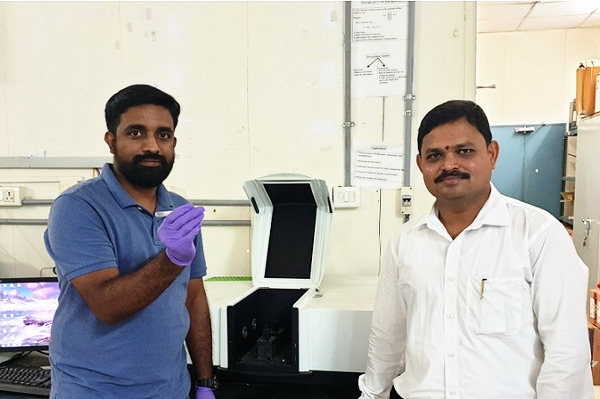
Researchers at the Indian Institute of Technology Hyderabad have developed a new process that promises to improve performance of Dye Sensitized Solar Cells (DSSC).
Dye sensitized solar cells hold a lot of promise because of possible cost and environmental benefits. But they have low light-to-power conversion efficiency. The new process promises to enhance the efficiency.
The first-generation silicon-based cells with energy harvesting efficiency of about 26 per cent continue to be costly. Second-generation thin film solar cells based on semiconductors like cadmium-telluride and cadmium-selenide have comparable efficiencies, and not much lower cost. The third generation of dye sensitized solar cells can significantly lower costs of solar cells while being environment-friendly. But, their efficiencies need improvement to translate to practical products.
” A dye molecule absorbs the light energy in DSSC and causes electrons in the dye to jump to titania and then to the external circuit, which causes a flow of electrons,leading to a current ”
Researchers initially tried introducing holmium oxide, a powerful paramagnetic material, into the anode of the cell and by applying external magnetic fields. The experiment showed an enhancement in efficiency. However, application of external magnetic field can be power-consuming because electromagnets themselves require energy for their functioning.
The team consequently replaced holmium oxide with iron oxide magnetic nanoparticles since it produced a magnetic field internally. The result was as good. “A dye molecule absorbs the light energy in DSSC and causes electrons in the dye to jump to titania and then to the external circuit, which causes a flow of electrons, leading to a current,” explained Dr. Jammalamadaka Suryanarayana, who led the research team.
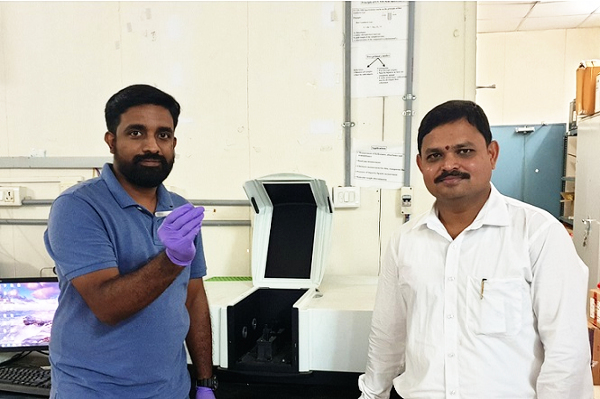
Dr. Suryanarayana conducted the study with his student U.M.Kannan and Dr. L. Giribabu, senior scientist, Indian Institute of Chemical Technology, Hyderabad. The team has published a report on their work in the journalSolar Energy.
India Science Wire
Source: VigyanPrasar
Image Courtesy:Vigyan Prasar
You may also like
-
TDB Backs Multi Nano Sense With ₹37.51 Crore to Build Indigenous Multi-Gas Sensor Platform
-
IISER Berhampur and NIT Rourkela Researchers Explore Cotarnine Derivatives for Wound Healing and Biomedical Applications
-
IISER Tirupati Develops pH-Responsive DNA Nanostructures for Controlled Drug Delivery
-
India and France Expand Space Cooperation Into Human Spaceflight, TRISHNA and Start-up Ecosystem
-
Indian Researchers Decode Graphene Oxide Droplet Patterns for Next-Generation Printed Sensors and Electronics
