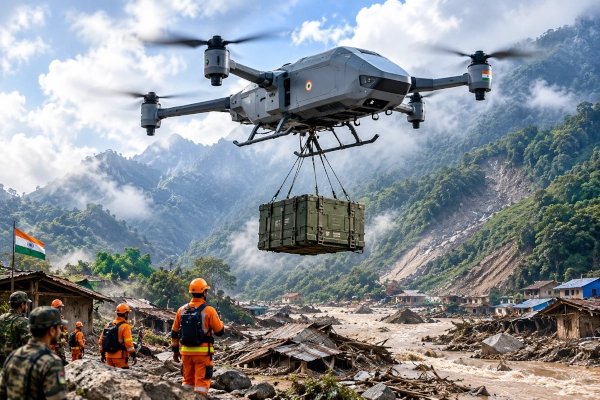
India’s indigenous unmanned aviation industry has received a significant boost with the Technology Development Board (TDB), under the Department of Science and Technology, signing an agreement with Mumbai-based ideaForge Technology Limited to provide ₹151 crore in financial assistance for developing the YETI heavy-lift autonomous aerial logistics vehicle. The funding will be provided through the government’s Research Development and Innovation (RDI) Fund to support the development of an advanced unmanned aircraft capable of transporting heavy cargo across difficult terrain and remote locations.
Announced on October 14, 2026, the project involves a total investment of ₹302 crore and aims to establish indigenous capabilities in long-range autonomous aerial logistics. YETI is being developed as a hybrid vertical take-off and landing (VTOL) fixed-wing unmanned aerial vehicle capable of carrying payloads weighing up to 200 kilograms, with a targeted range of 200 kilometres. The aircraft is also designed to operate at altitudes reaching 6,500 metres above mean sea level, making it particularly relevant for logistics operations in mountainous and geographically challenging regions.
The agreement represents an important investment in India’s emerging heavy-lift drone industry. The development programme aims to advance YETI from Technology Readiness Level 4 (TRL-4) to TRL-9, supporting its progression from early-stage technology validation towards a fully developed and operationally proven system.
₹302 Crore Project to Strengthen Indigenous Autonomous Aviation
The agreement between TDB and ideaForge provides government-backed financial support for the development of a sophisticated autonomous aerial logistics platform. Of the total ₹302 crore project cost, TDB will provide ₹151 crore through debt financing under the RDI Fund, covering half of the planned investment.
The project falls under the Deep Technology sector, with Intelligent Systems and Robotics identified as its sub-sector. The funding will support engineering development, system integration, testing and validation as the aircraft progresses towards higher levels of technological maturity.
Advancing a platform from TRL-4 to TRL-9 involves a comprehensive process of design refinement, integration and operational testing. TRL-4 generally represents technology validated at the component or subsystem level in a laboratory environment, while TRL-9 signifies a system that has demonstrated successful performance under actual operational conditions.
For YETI, this progression will require the integration and validation of its propulsion architecture, autonomous flight systems, navigation technologies, communications equipment and cargo-handling capabilities. The programme will also support the engineering work necessary to establish reliable performance across the different environments for which the aircraft is being designed.
The investment reflects India’s increasing focus on developing complex indigenous aerospace technologies that combine advanced engineering, intelligent control systems and autonomous capabilities.
YETI Combines Vertical Take-Off with Long-Range Fixed-Wing Flight
One of YETI’s most important technological features is its hybrid aircraft configuration, which combines vertical take-off and landing capabilities with the aerodynamic advantages of fixed-wing flight. This design is intended to overcome some of the operational limitations associated with conventional multirotor drones and fixed-wing unmanned aircraft.
Multirotor drones can take off and land vertically without requiring runways, making them suitable for operations in confined spaces. However, their flight endurance and range can become increasingly constrained when transporting heavy payloads. Conventional fixed-wing aircraft generally offer greater aerodynamic efficiency and longer flight ranges but typically require runways or specialised launch and recovery arrangements.
YETI is being developed to combine the advantages of these two configurations. Its vertical take-off capability is intended to allow the aircraft to operate from locations without conventional aviation infrastructure, while its fixed-wing design will support efficient flight over longer distances.
The aircraft is designed to operate from relatively small, unprepared landing areas measuring approximately 15 metres by 15 metres. This capability could enable deployment near forward military locations, remote settlements, temporary logistics centres and disaster-affected areas where constructing or maintaining airstrips would be difficult.
By reducing dependence on established aviation infrastructure, the platform is intended to expand the possibilities for transporting essential cargo to locations that remain difficult to access using conventional ground or air transportation.
200 kg Payload Capacity and 200 km Range Target Heavy-Lift Logistics
YETI is being designed to carry cargo weighing up to 200 kilograms over a targeted range of up to 200 kilometres. These proposed capabilities place the platform in a specialised category of unmanned aerial vehicles intended for transporting substantial payloads over relatively long distances.
The aircraft’s cargo capacity could support the transportation of medical supplies, emergency equipment, food, communication systems, critical spare parts and other essential materials. Such capabilities are particularly relevant in regions where difficult terrain, limited road connectivity or adverse weather conditions complicate conventional logistics operations.
YETI’s proposed operating altitude of up to 6,500 metres above mean sea level is another important feature of its design. Aircraft operating at high elevations encounter significant aerodynamic and propulsion challenges because reduced air density affects lift generation, propulsion performance and overall flight efficiency.
Developing a heavy-lift autonomous aircraft for these environments requires careful integration of the airframe, propulsion systems, onboard power architecture and flight-control technologies. The aircraft must also maintain reliable performance while carrying substantial cargo loads under demanding operating conditions.
The platform’s weather-resistant design is intended to support operations across mountainous regions, deserts and marine environments. This versatility could make it suitable for different logistical requirements involving remote locations, temporary facilities and areas with limited transportation infrastructure.
Distributed Propulsion and Redundant Systems to Improve Flight Reliability
Reliability forms a central element of YETI’s design because heavy-lift autonomous aircraft may need to operate over difficult terrain and in locations where immediate technical assistance is unavailable. To address these requirements, the platform incorporates a distributed and redundant propulsion and power architecture intended to improve fault tolerance.
Distributed propulsion uses multiple propulsion elements rather than relying entirely on a single propulsion unit. Redundant power and propulsion arrangements provide additional system capacity that can reduce vulnerability to certain individual component failures, depending on the aircraft’s configuration and control architecture.
For an unmanned cargo aircraft, these features are particularly important during extended operations across mountainous landscapes, remote regions or maritime environments. The ability to maintain stable flight and respond to technical problems can contribute to greater operational resilience.
YETI’s development programme will involve further engineering and validation of its propulsion, power distribution and autonomous flight-control systems. The integration of these technologies is intended to support the aircraft’s ability to perform repeated logistics missions under challenging operating conditions.
The emphasis on fault tolerance also reflects the technical demands associated with transporting heavier cargo using autonomous systems, where reliable propulsion and power management are essential to flight safety and mission performance.
GNSS-Denied Navigation and Long-Range Communication Capabilities
YETI is being designed with autonomous navigation capabilities intended to support operations in environments where Global Navigation Satellite System signals are unavailable, degraded or unreliable. This proposed capability is particularly relevant for missions involving mountainous terrain, remote locations and areas affected by navigation interference.
Satellite navigation systems such as GPS and India’s NavIC provide positioning and navigation information for aircraft and unmanned platforms. However, signal availability can be affected by terrain obstruction, interference and deliberate disruption, creating challenges for systems that depend heavily on satellite-based positioning.
GNSS-denied navigation involves the use of alternative positioning and navigation techniques to support aircraft operations when reliable satellite navigation is unavailable. Such capabilities may involve onboard sensors, inertial navigation technologies and intelligent flight-control algorithms, although the specific technical architecture selected for YETI forms part of its development.
The aircraft is also designed to support communication links extending up to 200 kilometres. Long-range communication capability is important for managing unmanned logistics missions across geographically dispersed locations, particularly when aircraft operate beyond the immediate visual range of their operators.
Together, autonomous navigation and long-distance communications are intended to provide YETI with greater operational flexibility while supporting the transportation of cargo across challenging environments. Actual deployments will remain subject to applicable technical, safety and aviation regulatory requirements.
Swarm Operations and Containerised Transportation Support Rapid Deployment
YETI’s proposed capabilities extend beyond conventional single-aircraft cargo transportation. The platform is also being developed with swarm operation capabilities, creating possibilities for coordinated missions involving multiple unmanned aerial vehicles.
In an aerial logistics environment, coordinated autonomous operations could allow several aircraft to transport supplies to different destinations or distribute cargo across multiple locations. Such missions require reliable communication, mission planning and coordination between participating platforms.
The inclusion of swarm capabilities reflects the growing importance of intelligent systems in unmanned aviation, where multiple autonomous vehicles can operate as part of an integrated network rather than functioning entirely independently.
Another feature of YETI is its containerised transportation concept, which is intended to facilitate movement, storage and rapid deployment. A transportable aircraft system could simplify the establishment of temporary aerial logistics facilities in locations where permanent infrastructure is unavailable.
For defence applications, containerised deployment could support the movement of autonomous logistics capabilities between operational areas as requirements change. In civilian settings, similar arrangements could assist emergency response teams, infrastructure operators and organisations working in remote regions.
The combination of coordinated autonomous operations, compact landing requirements and transportable deployment infrastructure is intended to make YETI a flexible aerial logistics platform capable of supporting different mission requirements.
Heavy-Lift Drones Could Transform Logistics in High-Altitude Regions
One of the most significant potential applications of YETI is the transportation of essential supplies across mountainous and high-altitude regions. Such areas frequently present major logistical challenges because of rugged terrain, limited roads, extreme weather and the difficulty of maintaining conventional transport networks.
Ground transportation in mountainous regions may involve long journeys along narrow roads, while landslides, snowfall and other environmental conditions can interrupt access. Helicopters and conventional aircraft provide important logistical support but require suitable operational arrangements and resources.
An autonomous aerial logistics platform capable of carrying substantial cargo without requiring a conventional runway could provide an additional transportation option for these environments.
YETI’s proposed operating altitude of 6,500 metres and payload capacity of 200 kilograms make it particularly relevant to the development of indigenous unmanned logistics solutions for high-altitude conditions.
For military operations, heavy-lift drones could support the movement of rations, medical supplies, spare parts and other essential materials to remote positions. Such platforms could complement existing ground and aerial logistics systems while providing greater flexibility for selected transportation requirements.
The aircraft’s ability to operate from compact landing areas could also support supply delivery to locations where establishing large transport facilities is impractical.
Developing these capabilities domestically would strengthen India’s technological foundation for addressing specialised logistics challenges in difficult geographical environments.
YETI Offers Potential Applications in Disaster Relief and Emergency Response
Heavy-lift autonomous aircraft also have important potential applications in humanitarian assistance and disaster management. Natural disasters frequently damage roads, bridges and essential transportation infrastructure, making it difficult for emergency agencies to reach affected communities.
Floods, landslides, earthquakes and severe storms can isolate settlements and interrupt the movement of food, medicines, emergency equipment and communication systems. In such circumstances, an unmanned aircraft capable of transporting substantial cargo could provide an additional means of delivering essential supplies.
YETI’s proposed payload capacity and range could support the movement of emergency materials between temporary logistics centres and remote destinations. Its vertical take-off and landing capabilities would be particularly relevant in areas where conventional aviation facilities are unavailable or have suffered damage.
The aircraft’s containerised transportation concept could also support deployment to regions requiring emergency logistical assistance. Once transported to an appropriate operating location, the platform could potentially undertake repeated cargo missions within its validated operational limits.
For disaster management agencies, heavy-lift autonomous aircraft could complement helicopters, ground vehicles and other transportation systems. Their use could contribute to more flexible logistics planning, particularly during the initial stages of emergency response when access remains difficult.
As autonomous aerial technologies mature, such applications could help strengthen India’s ability to provide essential supplies during emergencies and improve logistical connectivity with remote communities.
Technology Development Board Supports India’s Deep-Tech Aerospace Ambitions
The Technology Development Board’s agreement with ideaForge reflects the government’s emphasis on supporting technology-intensive projects that require substantial investment before reaching operational maturity.
Advanced autonomous aerial vehicles combine multiple engineering disciplines, including aerodynamics, propulsion, robotics, embedded electronics, navigation, communications and intelligent control systems. Integrating these technologies into a reliable heavy-lift platform requires sustained research, engineering development and validation.
The ₹151 crore assistance under the RDI Fund is intended to support this process by enabling further technological development and helping the project advance towards TRL-9.
Rajesh Kumar Pathak, Secretary of the Technology Development Board, highlighted the importance of indigenous autonomous systems in addressing complex operational and logistical challenges. He observed that heavy-lift aerial platforms could improve access to remote and difficult-to-reach locations while strengthening India’s capabilities in robotics and next-generation aerospace technologies.
Pathak also emphasised that technology-intensive projects require sustained investment as they progress from advanced development towards deployment. The RDI Fund provides a mechanism for supporting such initiatives and encouraging the development of strategically important domestic technologies.
The agreement with ideaForge reflects the growing role of government-supported financing in advancing Indian deep-technology enterprises and enabling the development of sophisticated indigenous aerospace systems.
ideaForge Expands into Heavy-Lift Autonomous Aerial Logistics
ideaForge Technology Limited has established its presence in India’s unmanned aerial systems industry through the development of indigenous drone technologies. The YETI programme represents an expansion into heavy-lift autonomous logistics, a segment that demands greater payload capacity, longer operational range and more complex aircraft systems than smaller unmanned surveillance platforms.
The company’s CEO and Co-founder described YETI as an important advancement in India’s ability to design, manufacture and operate sophisticated autonomous aircraft. He highlighted the difficulties faced by India’s armed forces and logistics networks when transporting essential supplies to locations where roads are unavailable and weather conditions complicate conventional operations.
According to the company, YETI is being engineered to deliver cargo reliably and repeatedly in some of the most demanding operational environments. Its development combines heavy-lift capability with autonomous navigation, long-range communications and a hybrid VTOL configuration.
The company also described government support through the RDI framework as recognition of the growing capabilities of Indian deep-technology enterprises and their role in building advanced national technological capabilities.
By combining its experience in unmanned aerial systems with the RDI-supported development programme, ideaForge aims to establish a new indigenous platform capable of addressing specialised aerial logistics requirements.
Indigenous Heavy-Lift Drone Development Strengthens India’s Aerospace Ecosystem
The development of YETI aligns with India’s broader efforts to strengthen domestic capabilities in advanced aviation, robotics, autonomous systems and aerospace manufacturing. Heavy-lift unmanned logistics represents an important technological segment with potential applications across defence supply chains, commercial transportation, disaster management and remote infrastructure operations.
Developing such aircraft within India can contribute to the growth of specialised aerospace engineering capabilities while creating opportunities for domestic suppliers involved in propulsion systems, electronics, navigation equipment, communications and precision manufacturing.
The integration of advanced autonomous technologies also supports the development of engineering expertise that can contribute to other unmanned aviation applications. Experience gained in integrating distributed propulsion, intelligent navigation, long-range communications and reliable flight controls can strengthen the broader domestic aerospace technology ecosystem.
YETI’s development programme brings together private-sector innovation and government-backed financial support to advance a sophisticated indigenous platform towards operational maturity.
The transition from TRL-4 to TRL-9 will be an important part of establishing the aircraft’s technical performance, operational reliability and suitability for its intended applications.
YETI Marks a Major Step Towards Next-Generation Aerial Logistics
The ₹302 crore YETI project represents a significant development in India’s efforts to establish indigenous capabilities in heavy-lift autonomous aerial transportation. With government financial assistance of ₹151 crore, ideaForge is advancing a platform designed to combine substantial cargo capacity, long-range flight, vertical take-off and landing, and intelligent autonomous operations.
The aircraft’s targeted ability to transport 200-kilogram payloads across distances of up to 200 kilometres, operate at altitudes reaching 6,500 metres and function from compact landing areas demonstrates the technological ambition of the programme.
Its proposed capabilities in GNSS-denied navigation, distributed propulsion, swarm operations and rapid deployment further highlight the expanding sophistication of India’s indigenous unmanned aviation industry.
The project also demonstrates the importance of sustained investment in deep technologies that require extensive engineering development, testing and validation before reaching operational maturity.
By supporting the development of YETI through the Research Development and Innovation Fund, the Technology Development Board is helping strengthen India’s capabilities in autonomous systems, intelligent robotics and advanced aerospace technologies.
The programme represents an important step towards building a domestic ecosystem capable of developing next-generation aerial logistics platforms while supporting India’s wider objectives of technological self-reliance, industrial innovation and advanced aerospace manufacturing.
References
1. Press Information Bureau, Ministry of Science & Technology, Government of India
TDB Signs Agreement with ideaForge for ₹151 Crore RDI Support to Develop YETI Heavy-Lift Autonomous Aerial Logistics Vehicle
Published: October 14, 2026
https://www.pib.gov.in/
2. Technology Development Board, Department of Science & Technology, Government of India
Official information on technology development financing and indigenous innovation.
https://tdb.gov.in/
3. ideaForge Technology Limited
Official company information on indigenous unmanned aerial systems and aerospace technologies.
https://ideaforgetech.com/
You may also like
-
India and ASEAN Strengthen Defence Cooperation for a Secure and Stable Indo-Pacific
-
Indian Navy Completes Historic First Command of Combined Task Force 154, Training Personnel from 39 Nations
-
JSR Dynamics Advances Indigenous Jet-Powered Weapons and Guided Rockets
-
Pune Startup Hyperonic Engineering Develops Indigenous Hydrogen Refuelling Systems for Clean Transportation
-
IIT Madras Startup Folium Sensing Develops Fibre-Optic Technology to Monitor Railways, Pipelines and Border Security
