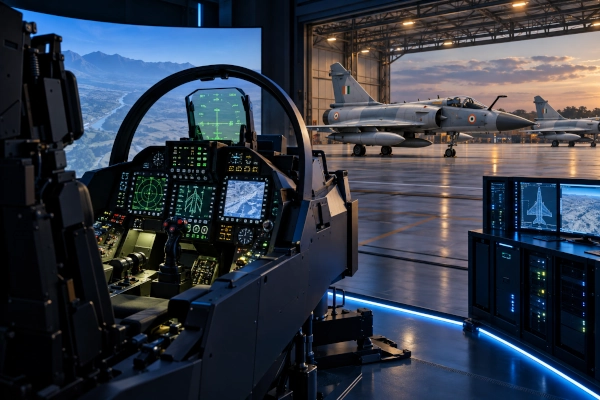
The Indian Air Force has awarded a contract worth about ₹135 crore to Threye Interactive for indigenous Mirage 2000 part-task combat simulators, strengthening the use of advanced simulation in fighter-pilot training while reducing the need to consume flying hours on operational aircraft.
The contract was signed in late September 2026, with the value publicly confirmed on September 30. Threye Interactive is a subsidiary of NewSpace Research & Technologies and works in virtual-reality, simulation and synthetic training systems for military applications.
The programme is intended to provide Mirage 2000 pilots with a high-fidelity training environment where they can rehearse combat procedures, weapons employment, target identification and coordinated multi-aircraft missions without using frontline fighters for every training sortie.
Mirage 2000 Training Moves Further Into Simulation
The Mirage 2000 remains one of the Indian Air Force’s important multirole fighter platforms, and its continued operational relevance requires regular pilot training across increasingly complex mission profiles.
Part-task simulators are designed to reproduce specific cockpit functions and mission procedures rather than replace full-flight simulators entirely. They allow pilots to practise selected combat tasks repeatedly in a controlled environment before progressing to live flying.
For the Mirage 2000 fleet, such systems can support training in areas including sensor management, target acquisition, weapons selection, tactical decision-making and coordinated engagements.
This reduces dependence on operational aircraft for routine procedural training and allows valuable flying hours to be reserved for missions that require actual airborne experience.
Threye Interactive Brings Indigenous Simulation Capability
Threye Interactive has developed virtual-reality and synthetic training technologies for defence applications, with a focus on creating realistic mission environments using advanced software, visualisation and interaction systems.
The Mirage 2000 simulator contract represents a significant order for an Indian private-sector company in a field that has traditionally depended heavily on imported training systems and proprietary foreign platforms.
Building the system domestically gives the Indian Air Force greater control over software upgrades, mission-data integration and future customisation.
It also allows the training architecture to evolve alongside changes in tactics, weapons and operational requirements.
Multi-Aircraft Combat Scenarios Can Be Rehearsed Virtually
One of the most important advantages of modern combat simulation is the ability to link multiple training stations and create complex tactical scenarios.
Pilots can practise coordinated missions involving several aircraft, different threat environments and multiple target sets without deploying an equivalent number of operational fighters.
Such scenarios are particularly valuable for developing decision-making under pressure and improving coordination between pilots before live exercises.
Simulation can also allow instructors to recreate specific threat conditions repeatedly, something that is often difficult and expensive to achieve during actual flying.
Simulator Training Reduces Cost and Aircraft Wear
Fighter aircraft training involves significant expenditure on fuel, maintenance, spares and airframe life.
Using simulation for procedures that do not require live flight can reduce these costs while increasing the number of training repetitions available to pilots.
An operational fighter sortie also requires extensive ground support, maintenance preparation and airspace coordination. A simulator can reproduce many mission elements without placing similar demands on the aircraft or support infrastructure.
The advantage is not simply lower cost. Pilots can repeat difficult scenarios until procedures become familiar, review mistakes immediately and train for situations that may be too risky or impractical to reproduce frequently in the air.
Synthetic Training Is Becoming More Important in Modern Air Warfare
Modern fighter operations increasingly depend on complex sensors, electronic warfare systems, precision weapons and networked information.
Pilots must process large amounts of information while simultaneously managing the aircraft and responding to rapidly changing threats.
This has increased the importance of synthetic training, where operational environments can be recreated digitally and modified according to mission requirements.
Advanced simulators can expose crews to dense air-defence networks, electronic interference, multiple airborne threats and time-sensitive targeting situations without the logistical requirements of a full-scale exercise.
For the Indian Air Force, expanding this capability provides a way to increase training intensity while preserving aircraft availability.
Private Defence Companies Gain Larger Role in Training Systems
The Threye Interactive contract also highlights the growing participation of Indian private companies and defence startups in military training technologies.
India’s defence-indigenisation effort is increasingly extending beyond weapons and platforms into software, artificial intelligence, simulation, autonomous systems and mission-support technologies.
These areas can offer faster development cycles and allow specialised companies to contribute capabilities that complement larger defence public-sector programmes.
Simulation is particularly suited to this model because much of the technological value lies in software, visualisation, computing and system integration.
A Significant Step for Indigenous Fighter Training Technology
The ₹135-crore Mirage 2000 simulator order demonstrates that indigenous companies are moving into increasingly sophisticated areas of combat-training infrastructure.
For the Indian Air Force, the system offers a way to improve mission preparation, increase training repetitions and reduce unnecessary use of operational fighter aircraft.
For India’s defence industry, the contract provides another example of private-sector capability moving from prototype development into substantial military procurement.
As synthetic training becomes more closely integrated with operational preparation, indigenous simulators such as the Mirage 2000 part-task trainer will form an increasingly important component of India’s combat aviation ecosystem.
References
NewSpace Research & Technologies — Official company information on Threye Interactive and defence simulation capabilities.
Home
Threye Interactive — Official company information and simulation technologies.
https://threye.com
The Week — Report on the Indian Air Force’s ₹135-crore Mirage 2000 simulator contract with Threye Interactive, September 30, 2026.
https://www.theweek.in/news/defence/2026/09/30/how-indian-rupee135-crore-simulator-deal-will-make-iafs-mirage-2000-pilots-more-combat-ready.html
Livefist — Reporting on the Mirage 2000 simulator procurement contract, September 2026.
https://www.livefistdefence.com/
You may also like
-
Rajnath Singh to Lead Indian Delegation at ASEAN Defence Summit in Philippines, Strengthening Indo-Pacific Security Cooperation
-
Bengaluru Startup Paar Autonomy Develops AI-Powered Drone Systems for GPS-Denied Environments
-
Sigma Advanced Systems Secures Fresh ₹973 Crore NATO Artillery Ammunition Order
-
India Advances Indigenous Defence and Space Technologies Through Naval Innovation, Drones and Advanced Electronics
-
Thales Seeks Indian Partnerships for Next-Generation Missiles, Radars and Electronic Warfare Systems
