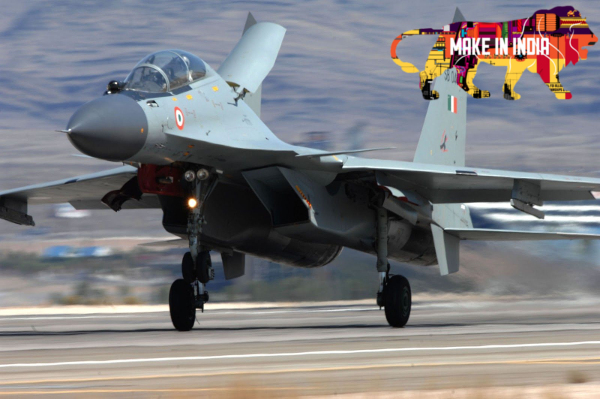
Hindustan Aeronautics Limited will increase annual production capacity of the AL-31FP aero-engine from 30 to 50 units at its Koraput Division in Odisha, strengthening the Indian Air Force’s ability to sustain its large Su-30MKI fighter fleet.
Defence Minister Rajnath Singh announced the expansion on October 6, 2026, while marking the delivery of the 2,000th aero-engine produced by HAL Koraput. HAL will invest ₹335 crore to expand AL-31FP manufacturing capacity.
Capacity Expansion Comes During 240-Engine Programme
The Ministry of Defence signed a contract with HAL in September 2024 for 240 AL-31FP engines for the Indian Air Force’s Su-30MKI fleet at a cost of more than ₹26,000 crore.
Under the original programme, HAL was expected to deliver around 30 engines annually over eight years from its Koraput facility. Raising capacity to 50 engines a year therefore represents a significant expansion over the contracted production rate.
The order is intended to support fleet sustainment and maintain the operational availability of the Su-30MKI, which remains one of the Indian Air Force’s principal combat aircraft.
HAL Has Already Delivered Ahead of Target
HAL’s Koraput Division has delivered 63 AL-31FP engines against a target of 60 by the end of the second year, according to the Ministry of Defence.
The first engine under the current order was also delivered ahead of schedule despite global supply-chain and raw-material challenges.
The additional production capacity will give HAL greater flexibility to meet scheduled deliveries while also responding to future maintenance and replacement requirements.
AL-31FP Availability Is Critical for Su-30MKI Sustainment
The AL-31FP is the thrust-vectoring turbofan engine that powers the Su-30MKI.
Maintaining a large fighter fleet requires a steady supply of engines for replacement, overhaul and long-term life-cycle support. Engine availability becomes increasingly important as aircraft accumulate flying hours and enter deeper maintenance cycles.
The Indian Air Force has also been working with HAL and other defence organisations on extending the service life of the AL-31FP from 2,500 to 3,000 flying hours, which could further improve utilisation of existing engines.
Indigenous Content Is Increasing
The 2024 procurement programme was approved under the Buy (Indian) category, with the engines being manufactured at HAL Koraput.
The government had earlier stated that indigenous content would exceed 54%, with further localisation planned during the production cycle. HAL has also indicated that indigenisation could rise to around 63% by the end of the programme.
The engine programme draws on Indian public-sector and private-sector suppliers, including MSMEs, helping widen the domestic aero-engine manufacturing ecosystem.
Koraput Remains Central to India’s Military Propulsion Base
HAL Koraput has been associated with military aero-engine production for nearly six decades and has emerged as one of India’s most important propulsion manufacturing centres.
The October 6 event marked the delivery of the division’s 2,000th aero-engine, underlining the scale of its contribution to Indian military aviation.
The government also announced a second Shakti helicopter-engine production line at Koraput with an investment of ₹218 crore. That programme is expected to support annual production of up to 100 Shakti engines by 2028-29 for platforms including the Dhruv Advanced Light Helicopter and Prachand Light Combat Helicopter.
Stronger Engine Production Supports Fleet Readiness
Raising AL-31FP capacity from 30 to 50 engines annually is important because it strengthens the industrial base behind the Su-30MKI fleet rather than simply adding another aircraft platform.
For a large operational fighter fleet, propulsion availability directly affects sortie generation, maintenance planning and long-term readiness.
The ₹335 crore expansion at Koraput therefore supports both immediate production requirements and India’s broader effort to build a more resilient military aero-engine manufacturing base.
As localisation deepens and capacity expands, HAL Koraput is set to play an even larger role in sustaining one of the Indian Air Force’s most important combat fleets.
References
- Press Information Bureau, Ministry of Defence, Government of India, HAL Koraput Delivers 2,000th Aero-Engine and Announces Expansion of AL-31FP Production Capacity, October 6, 2026.
- Press Information Bureau, Ministry of Defence, Government of India, MoD Signs ₹26,000 Crore Contract with HAL for 240 AL-31FP Aero Engines for Su-30MKI Aircraft, September 9, 2024.
- Press Information Bureau, Government of India, official material on AL-31FP indigenisation and Su-30MKI fleet sustainment.
You may also like
-
Bengaluru Startup Paar Autonomy Develops AI-Powered Drone Systems for GPS-Denied Environments
-
Sigma Advanced Systems Secures Fresh ₹973 Crore NATO Artillery Ammunition Order
-
India Advances Indigenous Defence and Space Technologies Through Naval Innovation, Drones and Advanced Electronics
-
Thales Seeks Indian Partnerships for Next-Generation Missiles, Radars and Electronic Warfare Systems
-
Indian and Australian Armies Conduct Jungle and Coastal Warfare Drills in AUSTRAHIND 2026
