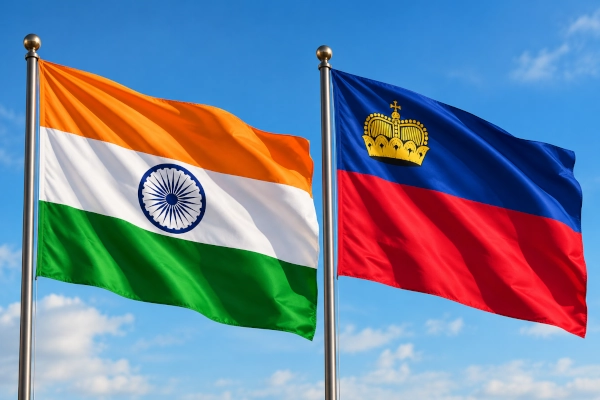
New Delhi, October 27, 2026: India and Liechtenstein have explored opportunities to strengthen bilateral cooperation in science, technology, innovation, advanced manufacturing, trade and investment during high-level discussions between Prime Minister Narendra Modi and Hereditary Prince Alois, the Acting Head of State of the Principality of Liechtenstein, in New Delhi on October 27, 2026.
The discussions, held at Hyderabad House, focused on expanding economic and technological engagement between the two countries, particularly following the implementation of the India–European Free Trade Association (EFTA) Trade and Economic Partnership Agreement (TEPA) in October 2025.
Both leaders discussed cooperation in trade, investment, science, technology and innovation, alongside opportunities for strengthening people-to-people exchanges. They also exchanged perspectives on regional and international developments.
The meeting reflects the growing importance of technology-driven partnerships in India’s economic diplomacy, particularly with European countries possessing specialised industrial capabilities, advanced engineering expertise and innovation-oriented economies.
Prime Minister Modi Holds Bilateral Talks with Prince Alois
Hereditary Prince Alois arrived in India accompanied by his spouse, Hereditary Princess Sophie, senior officials and a business delegation comprising leading representatives of Liechtenstein’s industry.
On October 27, the visiting dignitary received a ceremonial welcome at Rashtrapati Bhavan, where he was welcomed by President Droupadi Murmu and Prime Minister Narendra Modi.
The official programme included bilateral discussions at Hyderabad House and meetings with senior Indian government representatives.
External Affairs Minister Dr S. Jaishankar also met Prince Alois during the visit, reflecting the wider diplomatic engagement between the two countries.
Prince Alois and Princess Sophie paid homage to Mahatma Gandhi at Raj Ghat in New Delhi.
Speaking during the visit, Prince Alois emphasised the importance Liechtenstein attaches to its relationship with India. He identified the implementation of the India–EFTA Trade and Economic Partnership Agreement as an important development in bilateral economic relations and expressed his country’s intention to build upon the progress achieved.
The visit provided an opportunity for both governments to review existing cooperation and identify areas where scientific, technological and commercial partnerships could be expanded.
Science, Technology and Innovation Emerge as Important Areas of Cooperation
Science, technology and innovation were among the principal subjects discussed during the bilateral meeting. India’s expanding technological and manufacturing capabilities offer opportunities for cooperation with specialised European industrial economies such as Liechtenstein.
The principality has an established industrial sector with expertise in precision engineering, specialised manufacturing and high-value industrial products. These capabilities could complement India’s expanding manufacturing ecosystem, growing research infrastructure and large pool of engineering and technology professionals.
Potential areas of cooperation include precision manufacturing, industrial automation, advanced materials, specialised electronic components and other technology-intensive industrial applications. The India–EFTA economic partnership also provides a framework for cooperation involving research, innovation and industrial investment.
For Indian manufacturers, closer engagement with European technology companies could create opportunities to improve production processes, develop specialised engineering capabilities and participate in higher-value international supply chains. Such partnerships could be particularly relevant to businesses seeking advanced machinery, precision components and specialised manufacturing technologies.
The October 27 discussions identified science, technology and innovation as priorities for cooperation. However, no separate technology transfer agreement or specific joint research project was confirmed in the publicly available account of the meeting.
Advanced Manufacturing Offers Opportunities for Industrial Partnerships
Advanced manufacturing represents an important area of potential cooperation between India and Liechtenstein.
Modern manufacturing increasingly depends on specialised technologies, including precision engineering, automated production systems, advanced sensors, industrial electronics and sophisticated materials-processing techniques.
Liechtenstein’s industrial economy has developed capabilities in several of these areas, creating opportunities for technology-oriented commercial partnerships.
India, meanwhile, has been expanding domestic manufacturing capacity in electronics, engineering, industrial machinery and other sectors requiring increasingly sophisticated production technologies.Closer cooperation could allow Indian enterprises to explore partnerships involving advanced equipment, industrial components, manufacturing processes and technology development.
The Ministry of Commerce and Industry has previously identified industrial control systems, secure embedded electronics and high-precision components as potential areas of commercial opportunity under the India–EFTA framework.
Such products are used across modern industrial applications, including factory automation, electronic equipment, precision machinery and specialised manufacturing systems. The opportunities are relevant to India’s efforts to strengthen domestic industrial capabilities and increase the share of higher-value manufacturing in its economy.
The development of these partnerships would depend on commercial negotiations, investment commitments and the willingness of participating companies to pursue joint projects.
India–EFTA Trade Agreement Provides Foundation for Economic Cooperation
The India–European Free Trade Association Trade and Economic Partnership Agreement provides an important institutional foundation for expanding economic cooperation between India and Liechtenstein. The agreement was signed on March 10, 2024, and entered into force on October 1, 2025.
EFTA comprises Iceland, Liechtenstein, Norway and Switzerland, bringing together four European economies with established capabilities in manufacturing, services, innovation and international trade. The agreement provides a framework for expanding market access, encouraging investment, facilitating trade and strengthening cooperation across several economic sectors.
One of its major features is the investment objective established under the agreement.
The EFTA countries have committed to promoting an increase of $100 billion in foreign direct investment into India over 15 years, alongside the facilitation of one million direct jobs. The investment framework envisages an increase of $50 billion during the first ten years, followed by another $50 billion during the subsequent five years.
These commitments apply collectively to the EFTA countries and should not be interpreted as an individual investment commitment by Liechtenstein. The investment provisions are intended to support economic activities involving manufacturing, innovation, research, technology and other productive sectors.
The agreement also establishes mechanisms for monitoring implementation and facilitating commercial engagement. For India and Liechtenstein, TEPA provides a structured platform for expanding business relationships and exploring opportunities in technology-intensive industries.
Investment Cooperation Could Strengthen India’s Industrial Ecosystem
The implementation of the India–EFTA agreement creates opportunities for companies from Liechtenstein to explore investment in India’s expanding industrial and technology sectors.
India has been seeking to attract long-term investment in manufacturing, electronics, renewable energy, engineering, digital infrastructure and research-oriented industries. European companies possessing specialised technologies may find opportunities to establish manufacturing facilities, develop partnerships with Indian firms or participate in the country’s industrial supply chains.
Indian businesses could also benefit from improved access to technical expertise, advanced machinery and specialised components. Such cooperation can support productivity improvements and help domestic manufacturers meet international quality and engineering standards.
Investment partnerships may also create opportunities for workforce development through technical training, industrial research and knowledge exchange. The broader India–EFTA framework encourages commercial engagement between established industries and emerging enterprises, including Micro, Small and Medium Enterprises.
These smaller businesses form an important part of India’s manufacturing ecosystem and could benefit from partnerships involving specialised technologies and industrial equipment.
However, the economic impact of the agreement will depend on the actual investments undertaken and the implementation of commercial projects.
Earlier Meeting at AI Impact Summit Strengthened Technological Dialogue
The October 27 meeting builds upon earlier discussions between Prime Minister Modi and Prince Alois during the AI Impact Summit in New Delhi on February 20, 2026.
During that meeting, the two leaders reaffirmed their commitment to strengthening bilateral relations and welcomed the implementation of the India–EFTA trade agreement.
They also agreed to deepen cooperation in high-value manufacturing, advanced technologies and innovation-driven sectors. The February engagement established a clear technological dimension to the relationship, with both countries identifying opportunities for cooperation beyond conventional merchandise trade.
Prince Alois’s participation in the AI Impact Summit also demonstrated Liechtenstein’s interest in international discussions concerning emerging technologies and their economic applications.Artificial intelligence and related technologies are increasingly important to advanced industrial production, research and digital transformation.
For India, engagement with technologically specialised European economies could support international research connections and encourage cooperation between technology developers and industrial enterprises. The October visit provides an opportunity to build on these earlier discussions and translate shared interests into sustained economic and scientific engagement.
India–EFTA Prosperity Summit Highlights Growing Industrial Engagement
The bilateral discussions also follow the second India–EFTA Prosperity Summit, held in New Delhi on October 7, 2026, to mark the first anniversary of the implementation of TEPA.
The summit brought together government representatives, business leaders and industry organisations from India and the four EFTA countries. Discussions focused on expanding investment, strengthening commercial relationships and developing partnerships in technology-intensive sectors.
The programme included sectoral business engagements covering smart and advanced manufacturing, healthcare and life sciences, the blue economy, maritime technologies, clean energy and climate innovation. Liechtenstein participated in the summit, with its Minister of Home Affairs, Economy and Sport, Hubert Büchel, holding bilateral discussions with Indian Minister of State for Commerce and Industry Jitin Prasada.
The engagement reflected the continuing effort to encourage industry participation in the implementation of the trade agreement. The summit also highlighted investment announcements and industrial expansion plans involving companies from the EFTA countries.
These developments provide a broader economic context for Prince Alois’s visit and the discussions concerning advanced manufacturing and technological cooperation.
Precision Engineering and Electronics Present Opportunities for Indian Industry
Liechtenstein’s industrial capabilities may offer opportunities for Indian manufacturers seeking cooperation in specialised engineering and electronics.Precision engineering plays an important role in industries where components must meet demanding dimensional, mechanical and quality requirements.
These technologies are relevant to machinery manufacturing, industrial automation, electronics, medical equipment and other high-value production activities. Advanced industrial control systems and embedded electronic technologies are also increasingly important as manufacturing facilities adopt digital monitoring, automated processes and connected equipment.
Indian companies operating in these fields could explore technical partnerships with specialised European manufacturers. Such cooperation may involve commercial sourcing, joint product development, manufacturing partnerships or the exchange of technical expertise.
The India–EFTA trade framework could facilitate business engagement by providing greater certainty concerning applicable trade and investment arrangements. For Indian enterprises, participation in international engineering supply chains can also create opportunities to improve manufacturing standards and develop products for demanding global markets.
At the same time, successful partnerships would require attention to intellectual property protection, technical certification, market requirements and commercial viability.
Innovation Partnerships Could Support Indian Startups and MSMEs
The growing relationship between India and Liechtenstein may also create opportunities for startups and smaller technology-oriented businesses. India has developed an expanding startup ecosystem across fields such as industrial technology, artificial intelligence, electronics, engineering and clean-energy solutions.
Smaller European economies with specialised industrial capabilities can offer potential partnerships for Indian enterprises developing advanced products or seeking access to international markets.
Collaboration could take the form of research partnerships, technology development, industrial supply arrangements or investment relationships. The India–EFTA framework includes provisions intended to encourage investment and facilitate economic cooperation across a range of sectors.
It also supports greater engagement between businesses through institutional mechanisms and commercial outreach. For Indian MSMEs, opportunities involving advanced manufacturing technologies could contribute to improvements in productivity, quality and international competitiveness.
However, these benefits remain potential outcomes rather than confirmed results of the October 27 bilateral meeting.Specific startup collaborations or investment projects would require separate announcements and commercial agreements.
India and Liechtenstein Discuss Regional and Global Developments
In addition to economic and technological cooperation, Prime Minister Modi and Prince Alois exchanged views on regional and international developments. The discussions reflected the broader diplomatic relationship between the two countries and their interest in maintaining dialogue on issues affecting international cooperation.
India and Liechtenstein have friendly bilateral relations, with economic engagement receiving greater attention following the conclusion and implementation of TEPA. The trade agreement has provided additional institutional opportunities for interaction between the governments, business communities and industrial organisations of both countries.
The October 27 visit also included people-to-people exchanges as an area for further cooperation. Such engagement can contribute to stronger educational, professional and cultural connections while complementing formal diplomatic and commercial relationships.
The accompanying business delegation further underscored the importance of industry participation in developing the partnership.
Strengthening India’s Technology-Oriented Economic Diplomacy
India’s engagement with Liechtenstein reflects a wider approach to economic diplomacy in which technology, manufacturing capability, investment and innovation are increasingly interconnected.
International trade partnerships are no longer limited to the exchange of finished goods. They also involve industrial research, specialised technologies, production networks and the development of skilled human resources. For India, cooperation with technologically advanced economies can create opportunities to improve domestic manufacturing capabilities and participate in higher-value global industries.
Liechtenstein’s specialised industrial expertise offers potential areas of engagement that complement India’s expanding manufacturing and technology sectors.The India–EFTA Trade and Economic Partnership Agreement provides the institutional framework through which such cooperation can be developed.
The October 27 discussions between Prime Minister Narendra Modi and Hereditary Prince Alois reaffirmed the importance of science, technology, innovation and investment in the bilateral relationship.
While no specific new technology project was confirmed during the publicly reported meeting, the discussions demonstrate continued interest in expanding cooperation in areas relevant to India’s industrial and technological development.
As the India–EFTA agreement progresses through implementation, sustained engagement between Indian and Liechtenstein businesses, researchers and institutions could help translate these opportunities into practical economic partnerships.
The visit therefore represents another step in the evolution of India–Liechtenstein relations from a primarily diplomatic relationship towards a broader partnership encompassing trade, investment, advanced manufacturing and technological innovation.
References
- Akashvani News / News On AIR. “India, Liechtenstein Explore Ways to Strengthen Cooperation in Trade, Technology & Innovation; PM Modi Holds Talks with Hereditary Prince Alois.” 27 October 2026.
https://newsonair.gov.in/india-liechtenstein-explore-ways-to-strengthen-cooperation-in-trade-technology-pm-modi-holds-talks-with-hereditary-prince-alois/ - Prime Minister’s Office, Government of India. “Visit of HSH Prince Alois, Hereditary Prince of Principality of Liechtenstein to India.” Press Information Bureau, 20 February 2026.
https://www.pib.gov.in/PressReleasePage.aspx?PRID=2230715 - Ministry of Commerce and Industry, Government of India. “India–EFTA Trade and Economic Partnership Agreement Enters into Force.” Press Information Bureau, 1 October 2025.
https://www.pib.gov.in/PressReleseDetailm.aspx?PRID=2173964 - Ministry of Commerce and Industry, Government of India. “India and EFTA States Mark First Year of TEPA with Investment Announcements and Success Stories.” Press Information Bureau, 7 October 2026.
https://www.pib.gov.in/PressReleseDetailm.aspx?PRID=2320142 - Ministry of Commerce and Industry, Government of India. “India-EFTA Trade Pact: Boosting $100 Billion Investment and 1 Million Jobs.” Press Information Bureau, 11 October 2025.
https://www.pib.gov.in/PressNoteDetails.aspx?ModuleId=3&NoteId=155492 - Prime Minister’s Office, Government of India. “PM Meets Hereditary Prince Alois of Liechtenstein at Hyderabad House, New Delhi.” PIB Photo Gallery, 27 October 2026.
https://www.pib.gov.in/ShowAlbum.aspx?albumid=231924
You may also like
-
India–Chile Free Trade Negotiations Near Conclusion as Talks with Canada Progress
-
Indian Navy’s First Training Squadron Arrives in Colombo to Strengthen Maritime Cooperation
-
Rajnath Singh to Lead Indian Delegation at ASEAN Defence Summit in Philippines, Strengthening Indo-Pacific Security Cooperation
-
India Hosts 12th BRICS Parliamentary Forum in New Delhi
-
India Strengthens Trade Ties with Netherlands as Piyush Goyal Visits Port of Rotterdam
