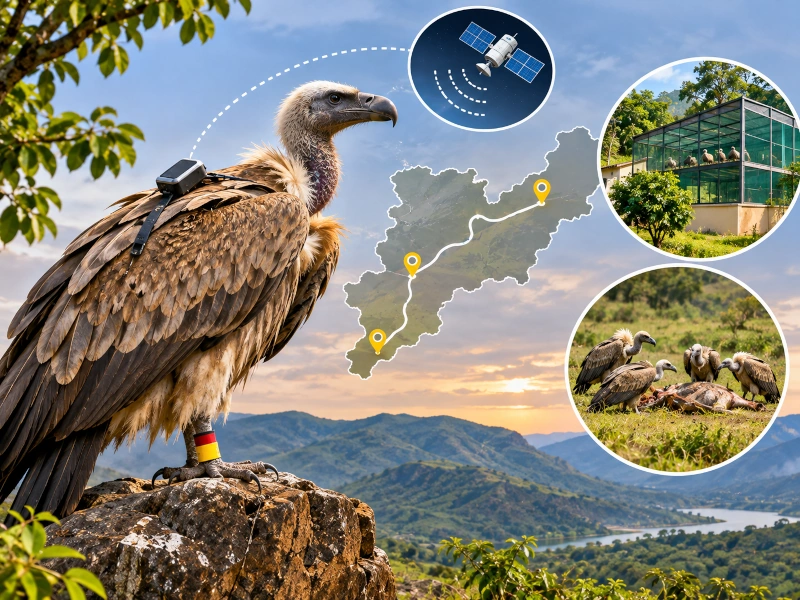
A captive-bred Indian vulture (Gyps indicus), one of the country’s most critically endangered birds, has been recorded for the first time in Maharashtra’s Latur district after travelling a cumulative distance of 10,767 kilometres across three states. The remarkable movement of the satellite-tagged bird highlights the importance of conservation breeding, scientific monitoring and habitat protection in restoring India’s severely depleted vulture populations.
The seven-year-old female vulture, identified by its satellite-tracking tag F14/M99, was sighted in Ausa tehsil on 18 November 2026. The bird was bred at the Bombay Natural History Society’s Vulture Conservation Breeding Centre in Pinjore, Haryana, before being released into the wild at Melghat Tiger Reserve earlier this year. According to tracking information reported by forest officials, the vulture travelled extensively across Maharashtra, Madhya Pradesh and Karnataka between 28 May and 20 November, covering approximately 10,767 kilometres through a series of movements rather than a single continuous flight.
The sighting provides valuable evidence of the bird’s ability to survive and move independently after being raised in captivity. Its extensive movements also demonstrate the importance of protecting suitable habitats and safe feeding areas across large geographical regions, as released vultures may travel far beyond the protected areas where they begin their return to the wild.
Wildlife Observers Confirm Rare Sighting in Latur
The vulture was first noticed in Ausa tehsil by wildlife enthusiast Abhijit Rasal on 18 November. Following the observation, a team comprising Deputy Conservator of Forests Amitraj Jadhav, Latur-based wildlife observer Dhananjay Gutte and Dr Datta Ambekar initiated a field verification exercise. The team began searching for the bird at approximately 5:30 AM the following morning and successfully located it perched on a tree.
Forest officials confirmed the bird’s identity using the coloured identification bands attached to its legs. These bands, together with the satellite transmitter, enabled the team to establish that the bird was F14/M99, a captive-bred Indian vulture released under the ongoing conservation programme. The observation was particularly significant because wildlife enthusiasts described it as the first recorded presence of this critically endangered species in Latur district.
The confirmation demonstrates how field observations and modern tracking technologies can complement one another in wildlife conservation. While satellite transmitters provide information about an animal’s movements, direct sightings allow researchers to assess its physical condition, behaviour and habitat use. Combining these methods can improve the monitoring of endangered birds released into natural environments.
Satellite Tracking Reveals an Extraordinary Journey Across Three States
Satellite tracking records indicate that the vulture began its extensive movements on 28 May 2026 and had accumulated approximately 10,767 kilometres of travel by 20 November. Its recorded route included several locations in Maharashtra, including Akot, Malkapur, Nashik, Thane and Pune, before the bird moved south towards Vijayapura in Karnataka. It subsequently travelled through other parts of the region and was recorded in Latur during its continuing movements.
The distance covered is notable because it demonstrates the extensive geographical range that individual vultures can occupy while searching for food and suitable resting habitats. Unlike migratory birds that follow relatively predictable seasonal routes, vultures often travel considerable distances in response to feeding opportunities and environmental conditions. Their movements can connect forests, agricultural landscapes, grasslands and other habitats across administrative boundaries.
The tracking results also provide useful information about the challenges associated with reintroducing captive-bred vultures into the wild. Released birds must independently locate food, navigate unfamiliar landscapes and avoid threats such as harmful veterinary drugs, unsafe power infrastructure and other environmental hazards. Continued monitoring of F14/M99 will help researchers understand its movements and survival, although the available information does not establish whether the bird has successfully integrated into a breeding population.
Bombay Natural History Society’s Conservation Breeding Programme
The vulture was bred at the Vulture Conservation Breeding Centre in Pinjore, Haryana, operated through a partnership involving the Bombay Natural History Society and the Haryana Forest Department. Established in September 2001, the centre initially focused on understanding the catastrophic decline of India’s vulture populations before developing conservation breeding programmes intended to protect threatened species from extinction.
Over the years, the centre has contributed to the breeding and conservation of several endangered vulture species, including the Indian vulture, white-rumped vulture and slender-billed vulture. Conservation breeding programmes maintain carefully managed populations under controlled conditions while supporting efforts to address the threats responsible for population declines in natural habitats. The eventual release of captive-bred birds is an important component of attempts to restore viable populations in the wild.
In January 2026, the Bombay Natural History Society released 15 captive-bred Indian vultures into the Somthana forest range of Melghat Tiger Reserve in Maharashtra. The release followed a period of acclimatisation during which the birds were maintained in a suitable enclosure and gradually prepared for independent survival. The soft-release process began on 2 January, with the enclosure gates opened remotely and food placed outside to encourage the vultures to explore their surroundings.
The programme was developed with support from the Maharashtra Forest Department and other conservation partners. Its implementation reflects the recognition that successful vulture recovery requires more than breeding additional birds in captivity. Conservationists must also ensure that released individuals encounter suitable habitats, reliable food sources and conditions that allow them to survive without continuous human assistance.
Indian Vultures Remain Critically Endangered
The Indian vulture, also known as the long-billed vulture, is classified as Critically Endangered on the International Union for Conservation of Nature Red List. The species was once widespread across large parts of the Indian subcontinent, where it played an important ecological role by consuming the carcasses of dead animals. Its populations declined dramatically during the late twentieth century, creating one of the most serious bird conservation crises recorded in the region.
A major cause of this decline was the veterinary use of diclofenac, a non-steroidal anti-inflammatory drug administered to livestock. Vultures feeding on the carcasses of animals treated with diclofenac can suffer severe kidney damage and fatal visceral gout. The widespread use of the drug contributed to devastating declines among several species of Gyps vultures in India and neighbouring countries.
Recognising the scale of the threat, the Government of India prohibited veterinary diclofenac use in 2006. Conservation organisations subsequently expanded efforts to promote safer veterinary alternatives, monitor vulture populations and establish conservation breeding facilities. Although these interventions have helped address important threats, the recovery of wild vulture populations remains a long-term challenge requiring sustained monitoring and protection.
The Indian vulture continues to face risks associated with contaminated carcasses, habitat disturbance and other human-related pressures. Protecting the species therefore requires coordinated action involving forest departments, veterinary authorities, livestock owners, conservation organisations and local communities.
Vultures Perform an Essential Ecological Function
Vultures play an important role in maintaining ecological balance by consuming animal carcasses and accelerating the natural decomposition process. Their ability to locate and consume carrion helps remove dead animals from the environment, reducing the availability of carcasses to other scavenging species and contributing to natural nutrient recycling.
The disappearance of vultures from large areas of India has demonstrated the ecological importance of these birds. When vulture populations decline, carcasses may remain available for longer periods, potentially altering scavenger communities and creating additional challenges for animal carcass management. Conservation researchers have consequently emphasised the relationship between healthy vulture populations, ecosystem functioning and public health.
The ecological role of vultures makes their conservation particularly important in landscapes where wildlife habitats overlap with agricultural and livestock-rearing communities. Maintaining safe food sources and preventing the use of harmful veterinary medicines are essential measures for protecting these scavengers. Restoring vulture populations could help strengthen the natural ecological processes upon which many rural and forest landscapes depend.
Satellite Tracking Strengthens India’s Wildlife Conservation Efforts
The movement of F14/M99 demonstrates the importance of satellite telemetry in studying the behaviour and survival of endangered wildlife. Satellite transmitters allow researchers to collect information about an individual bird’s movements over extended periods, helping identify frequently used habitats, important resting locations and areas where conservation risks may arise.
For captive-bred vultures, this information is especially valuable because researchers need to determine whether released birds can adapt to natural environments. Tracking data can indicate whether individuals remain near their release sites or disperse across wider landscapes. When combined with field observations, these records can help conservation teams investigate feeding behaviour, environmental hazards and potential interactions with wild vultures.
The extensive movements recorded for F14/M99 highlight the need for conservation planning beyond individual protected areas. Although Melghat Tiger Reserve served as the bird’s release location, its subsequent journey extended across several districts and states. Such movements demonstrate that the long-term survival of released vultures depends partly on conditions in landscapes located far beyond the boundaries of the original conservation site.
The experience also underscores the importance of cooperation between forest departments, research institutions and local wildlife observers. Information shared between these groups can help researchers respond to unexpected movements, investigate possible threats and improve the management of future releases.
A Promising Development for India’s Vulture Recovery Programme
The sighting in Latur represents an encouraging development for India’s efforts to restore critically endangered vulture populations. The bird’s continued survival and extensive movements following its release indicate that at least some captive-bred individuals can adapt to life outside conservation breeding facilities and travel independently across large landscapes.
However, long-distance movement alone does not establish the success of a reintroduction programme. Conservation outcomes also depend on long-term survival, access to safe food, successful interactions with wild populations and eventual breeding in natural habitats. Continued monitoring will therefore be essential for determining the long-term significance of this individual bird’s movements.
The work undertaken by the Bombay Natural History Society, forest departments and conservation researchers reflects the growing use of scientific methods in India’s endangered species recovery programmes. Conservation breeding, habitat management, satellite tracking and field verification are increasingly being combined to address the challenges associated with restoring wildlife populations.
The remarkable journey of F14/M99 provides a valuable example of how sustained conservation efforts can create opportunities for endangered birds to return to natural landscapes. As India continues its vulture recovery initiatives, the survival and movements of satellite-tracked individuals will provide important information for improving future releases and strengthening conservation strategies. The Latur sighting offers renewed encouragement for protecting a species whose ecological importance extends far beyond the forests in which it is released.
You may also like
-
The Sacred Groves of India: Traditional Protection and Modern Biodiversity Conservation
-
New Micro-Moth Species Discovered in Assam After Nearly a Century
-
Botswana-Born Cheetah Gives Birth to Four Cubs in Wild, India’s Cheetah Population Reaches 62
-
Gauhati University Scientists Rediscover Rare Flowering Shrub in Assam After 204 Years
-
Rare Striolated Bunting Spotted Near Mangaluru, Reported as Coastal Karnataka’s First Record
