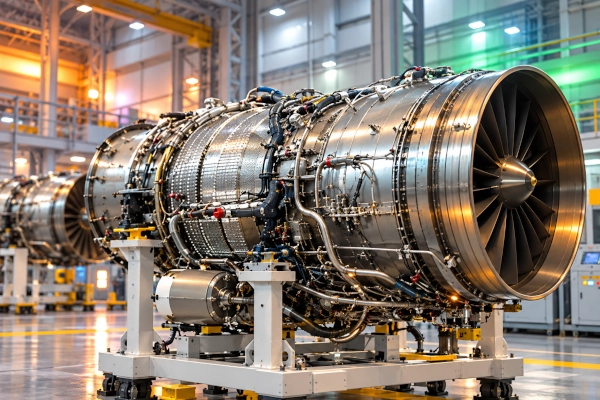
India’s Kaveri aero-engine programme has reached a stage where the question is no longer whether the country can design and fly-test a military gas-turbine engine. DRDO has already demonstrated that capability through the original Kaveri programme, while the present Kaveri Derivative Engine is being developed specifically for India’s remotely piloted strike aircraft programme.
The next technological challenge is substantially harder: converting the knowledge accumulated through Kaveri into an indigenous engine capable of powering a frontline Indian Air Force fighter.
The present Kaveri derivative is not intended for the Tejas Mk1A or another operational manned fighter. The Ministry of Defence has formally identified it as the power plant for India’s unmanned combat aircraft programme and has sanctioned dedicated projects for development of a flightworthy dry engine and its technology demonstration.
For Kaveri technology to eventually return to an IAF fighter, India must move beyond simply completing the present dry-engine programme. It must demonstrate reliability in an operational unmanned aircraft, improve thrust-to-weight performance, master higher-temperature turbine technology and develop a substantially more powerful fighter-class engine.
The Present Kaveri Is Being Developed for an Unmanned Strike Aircraft
The Ministry of Defence confirmed in July 2025 that the Kaveri Derivative Engine is intended to power India’s remotely piloted strike aircraft, or IUCAV programme.
Two separate development projects have been sanctioned. The Flightworthy Kaveri Dry Engine Development programme carries a sanctioned cost of ₹472.42 crore, while the Technology Demonstration of the Kaveri Derivative Dry Engine has received ₹251.17 crore.
This establishes a clear near-term role for Kaveri.
Instead of attempting immediately to return the engine to the Tejas programme, DRDO is using the dry derivative to create a flightworthy propulsion system for an unmanned combat aircraft. This provides a realistic pathway for proving the engine under operationally relevant conditions while continuing to mature India’s military aero-engine ecosystem.
Why the Present Kaveri Cannot Simply Be Installed in Tejas
The original Kaveri was developed with the Light Combat Aircraft programme in mind, but the engine could not meet the thrust requirement that emerged as the Tejas design matured.
The Ministry of Defence stated in 2012 that Tejas required an engine in approximately the 90 kN thrust class, while the Kaveri in its existing architecture did not fully meet that requirement.
The government reiterated in 2021 that the Flight Operational Clearance configuration of Tejas required higher thrust than the Kaveri architecture could provide. It therefore stated explicitly that a modified engine version would be necessary before Kaveri could be considered for integration with the fighter.
This remains the fundamental engineering issue.
An engine can be reliable, flightworthy and technologically sophisticated and still be unsuitable for a particular fighter if it cannot deliver sufficient thrust at an acceptable weight and fuel consumption.
Fighter Engines Are Judged by More Than Maximum Thrust
Increasing thrust alone would not be enough to turn the Kaveri derivative into an operational fighter engine.
Combat aircraft propulsion is dominated by thrust-to-weight ratio. An engine that produces greater thrust but becomes disproportionately larger or heavier can reduce aircraft performance rather than improve it.
A future Indian fighter engine must therefore produce significantly more thrust while simultaneously controlling engine mass, diameter, fuel consumption and thermal signature.
It must also fit within the aircraft’s existing or planned intake geometry and engine bay without requiring excessive redesign of the airframe.
This combination of high thrust, low weight, compact dimensions and long service life is one of the principal reasons fighter-engine development remains concentrated among a relatively small number of countries.
The Hot Section Is the Critical Technology
Among the most difficult technologies India must master is the engine hot section.
The turbine behind the combustion chamber operates under extreme temperatures while rotating at very high speed. Turbine blades must survive enormous centrifugal forces while remaining mechanically stable at temperatures that can approach or exceed the melting point of the underlying metallic material.
Modern fighter engines overcome this through advanced nickel-based superalloys, single-crystal turbine blades, internal cooling passages and sophisticated thermal-barrier coatings.
India has been progressively building these capabilities.
In October 2025, the Ministry of Defence announced that PTC Industries had received an order associated with post-cast manufacturing operations for single-crystal ready-to-fit turbine blades for the Kaveri Derivative Engine. The same programme also includes indigenous titanium castings for the KDE-2.
These developments are significant because the future of an indigenous fighter engine depends as much on materials science and precision manufacturing as on aerodynamic engine design.
A Fighter Version Would Need a High-Performance Afterburner
The present Kaveri derivative is a dry engine, meaning that it is being developed without relying on afterburning thrust for its intended unmanned-aircraft role.
A conventional high-performance fighter would normally require a substantially more powerful afterburning configuration.
An afterburner injects additional fuel into the exhaust stream behind the turbine, creating a large temporary increase in thrust. Fighters use this capability during take-off, rapid acceleration, interception and demanding combat manoeuvres.
Developing such a system involves far more than adding fuel injectors to the exhaust.
Flame stability, thermal management, nozzle control, fuel scheduling and engine airflow must all remain stable across changing altitude and speed conditions. Poor afterburner integration can cause compressor instability, excessive temperatures or inefficient fuel consumption.
A future fighter-class Kaveri successor would therefore require a modern afterburner designed as part of the complete engine rather than as an isolated subsystem.
Compressor Performance Must Rise
Another major challenge is the compressor.
The compressor determines how efficiently incoming air can be raised to the pressure required for efficient combustion. Higher compressor pressure ratios generally allow better engine performance, but they also make the engine more difficult to design.
Blade aerodynamics, compressor-stage matching, tip clearances and surge margins must remain stable across a fighter’s entire operating envelope.
Rapid throttle movement is especially demanding. A fighter pilot may move from relatively low thrust to maximum power within seconds, including during aggressive manoeuvres and rapidly changing airflow conditions.
The compressor must respond without entering surge or stall.
Further improvements in compressor aerodynamics will therefore be essential if Kaveri-derived technology is to support a higher-thrust fighter engine.
FADEC Must Control the Entire Engine Reliably
Kaveri development has already produced an indigenous Full Authority Digital Engine Control system.
FADEC continuously controls engine operation by managing fuel flow, compressor behaviour, temperature limits and other parameters according to pilot commands and flight conditions.
For a frontline fighter, the control system must operate reliably across thousands of combinations of altitude, speed, temperature and manoeuvre.
It must also communicate seamlessly with the aircraft’s flight-control system, mission computer and cockpit.
The earlier Kaveri programme therefore created an important technological foundation, but a future fighter engine would require further refinement and extensive qualification of its control architecture.
Flight Testing Must Go Far Beyond a Successful Engine Run
India has already demonstrated Kaveri in flight.
Official government records show that a Kaveri prototype was integrated with an Il-76 flying testbed at the Gromov Flight Research Institute in Russia. Twenty-seven flights covering about 55 hours were completed, with testing conducted up to approximately 12 kilometres altitude and Mach 0.7.
Those trials proved that India had reached an important level of military gas-turbine maturity.
A fighter engine programme, however, would require a much more extensive qualification campaign.
Testing would have to examine high-altitude relight, compressor surge margins, rapid throttle transients, vibration, fuel-system behaviour, engine response during high-angle manoeuvres, emergency conditions and sustained operation at maximum temperature.
Thousands of ground-test hours would normally accompany this work before production clearance.
Reliability Is More Important in a Manned Fighter
An unmanned aircraft and a piloted fighter impose different risk requirements.
A propulsion failure in an unmanned aircraft can result in the loss of the platform. In a fighter, it also places the pilot at risk.
A fighter engine therefore requires extremely mature reliability data before operational clearance.
Engine life must be established for major rotating assemblies, turbine blades, bearings, combustion components and accessories. Engineers must determine inspection intervals and identify how components degrade after repeated thermal and mechanical cycles.
Reliability therefore cannot be demonstrated by a few successful flights. It emerges from hundreds or thousands of hours of accumulated testing and continued operational experience.
This is why getting the dry Kaveri into an unmanned combat aircraft would itself be strategically valuable. It would allow GTRE to accumulate operating data from an indigenous military turbofan in a real aircraft environment.
Integration With a Fighter Would Become a Separate Programme
Even a fully developed fighter-class engine cannot simply be placed inside an aircraft.
The engine and airframe have to be designed around each other.
Air intake geometry determines the quality and quantity of airflow reaching the compressor. Engine dimensions affect fuselage shape, centre of gravity and internal fuel volume. Exhaust temperature influences rear-fuselage materials and infrared signature.
Engine mounts, electrical generation, lubrication, cooling, hydraulics, fire protection and fuel systems must all be integrated.
Software interfaces between the engine FADEC and the aircraft flight-control computer also require extensive testing.
This explains why replacing one fighter engine with another can become a major aircraft-development programme even when both engines provide similar thrust.
CEMILAC Certification Would Be Essential
Before an indigenous fighter engine could enter IAF service, it would require military airworthiness certification.
The Centre for Military Airworthiness and Certification would assess the engine and its integration with the aircraft across structural, mechanical, thermal, electronic and operational parameters.
Certification would involve progressively expanding the flight envelope and demonstrating that the propulsion system can safely perform under the full range of conditions expected in service.
Only after these requirements were completed could the engine move into regular fighter production and IAF operational use.
Kaveri Has Already Created Technologies for Future Engines
The original Kaveri programme did not achieve its initial objective of powering Tejas, but the technological investment was not lost.
The government stated in 2021 that nine full Kaveri prototypes and four core-engine prototypes had been built and that 3,217 hours of engine testing had been completed.
It also confirmed that technologies developed through Kaveri were being used in other Indian engine-development programmes and as test vehicles for next-generation technologies.
The same statement made another important point: India intended to use the capabilities created through Kaveri while developing future indigenous engines for LCA variants and the Advanced Medium Combat Aircraft.
This is the broader strategic value of the programme.
The Dry Kaveri Could Become India’s Most Important Intermediate Step
The present unmanned-aircraft application may ultimately prove more important to India’s fighter-engine ambitions than attempting another immediate Tejas integration.
If the Kaveri derivative is certified, manufactured in meaningful numbers and operated aboard an unmanned combat aircraft, India will gain something it has never previously possessed at scale: operational experience with an indigenous military turbofan.
Engineers would obtain real information about component wear, maintenance requirements, thermal behaviour, fuel consumption and long-duration reliability.
Manufacturers would also gain experience producing critical components repeatedly to aerospace tolerances rather than manufacturing small developmental batches.
This production knowledge is indispensable for a future fighter engine.
From Kaveri to a New Indigenous Fighter Engine
The most realistic path is therefore unlikely to involve installing the present dry Kaveri directly into a Tejas.
Instead, the Kaveri programme can serve as the technology bridge towards an entirely new generation of Indian fighter propulsion.
The compressor research, combustion technology, FADEC experience, high-temperature materials, single-crystal turbine manufacturing and flying-testbed knowledge accumulated through Kaveri can all feed into a higher-thrust engine designed from the beginning for future Indian fighters.
Such an engine would require substantially greater thrust than the present dry derivative while achieving a competitive thrust-to-weight ratio and service life.
It would effectively be a Kaveri successor rather than merely another modification of the original engine.
India’s Fighter-Engine Journey Is Now Building on a Real Technology Base
India began the Kaveri programme when much of the specialised knowledge, material technology and test infrastructure required for modern aero-engine development was unavailable domestically.
Official assessments of the original programme identified technological complexity, limited availability of critical materials, shortages of specialised test facilities and dependence on overseas testing as major constraints.
The situation today is different.
India now possesses decades of gas-turbine research experience, indigenous digital engine controls, growing single-crystal blade manufacturing capability, domestic titanium and superalloy production, specialised testing infrastructure and a wider aerospace industrial base.
The Kaveri Derivative Engine therefore represents more than the propulsion system for an unmanned combat aircraft. It is an opportunity to complete the full cycle of indigenous military engine development from design and ground testing to flight certification, production and operational deployment.
Once that cycle is established, India will be considerably better positioned to take the next and far more demanding step: developing an indigenous engine capable of powering a frontline Indian Air Force fighter.
References
Press Information Bureau, Ministry of Defence — Development of Indigenous Defence Technologies, 25 July 2025
https://www.pib.gov.in/PressReleasePage.aspx?PRID=2148337
Press Information Bureau, Ministry of Defence — Development of Kaveri Engine, 29 November 2021
https://www.pib.gov.in/PressReleasePage.aspx?PRID=1776092
Press Information Bureau, Ministry of Defence — Kaveri Engine, 14 May 2012
https://www.pib.gov.in/newsite/PrintRelease.aspx?lang=2®=3&relid=83706
Press Information Bureau, Ministry of Defence — Development of Indigenous Aero-Engine by DRDO, 21 December 2011
https://www.pib.gov.in/newsite/PrintRelease.aspx?lang=2®=48&relid=79102
Press Information Bureau, Ministry of Defence — Developments of Kaveri Fighter Engine, 30 July 2015
https://www.pib.gov.in/newsite/PrintRelease.aspx?relid=123940
Press Information Bureau, Ministry of Defence — Raksha Mantri Reviews Indigenous Military Gas Turbine Engine Development at GTRE, 16 February 2026
https://www.pib.gov.in/PressReleasePage.aspx?PRID=2228670
Press Information Bureau, Ministry of Defence — Strategic Materials Technology Complex and Indigenous Aerospace Components, 18 October 2025
https://www.pib.gov.in/PressReleasePage.aspx?PRID=2180722
You may also like
-
Bengaluru Startup Paar Autonomy Develops AI-Powered Drone Systems for GPS-Denied Environments
-
Sigma Advanced Systems Secures Fresh ₹973 Crore NATO Artillery Ammunition Order
-
India Advances Indigenous Defence and Space Technologies Through Naval Innovation, Drones and Advanced Electronics
-
Thales Seeks Indian Partnerships for Next-Generation Missiles, Radars and Electronic Warfare Systems
-
Indian and Australian Armies Conduct Jungle and Coastal Warfare Drills in AUSTRAHIND 2026
