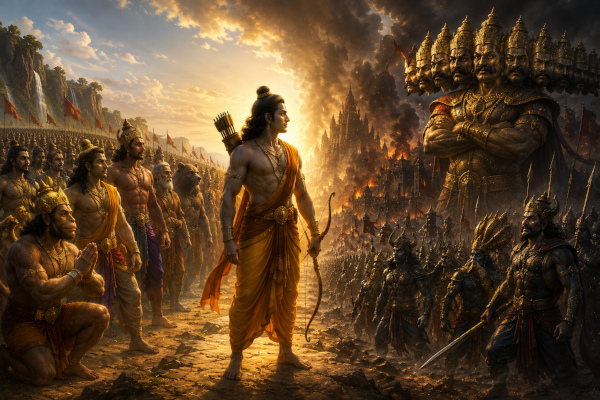
War is usually studied through weapons, formations, logistics, intelligence and leadership. The Ramayana adds another powerful dimension: ethical warfare. Rama’s campaign against Ravana is framed as a just war with a clear moral purpose. The objective is to rescue Sita, punish adharma and restore lawful order. This gives Rama’s side a strategic asset that weapons alone cannot provide. It gives legitimacy.
Ethical warfare means that a campaign carries a rightful cause, a disciplined method and a constructive end state. Rama’s war against Lanka follows this structure. The cause is clear. Sita has been abducted and held against her will. Ravana has violated dharma, honour and royal conduct. Rama’s response is built around justice. His purpose is focused. His army marches for rescue and restoration. This clarity gives the campaign moral force.
The first strength of ethical warfare is that it gives soldiers a reason to fight beyond survival and reward. Rama’s army knows why it is fighting. The Vanaras are not gathered for plunder or expansion. They are gathered for a mission that carries honour. Hanuman fights with devotion. Sugriva supports an ally. Jambavan guides with wisdom. Angada stands with courage. Vibhishana joins because dharma has greater value than family loyalty to a wrongful ruler. The army’s morale grows because its cause is clean.
A just cause also gives political strength. Rama’s campaign attracts allies because it is seen as righteous. Sugriva joins after Rama helps restore his lawful position. Vibhishana defects because Ravana’s rule has lost moral direction. Even before the final battle, the political balance begins to move toward Rama. Ethical warfare creates this effect. It draws support from those who value order, justice and lawful conduct.
Rama also follows the principle of giving warning before destruction. Angada’s mission to Ravana’s court is a major example. Rama sends an envoy with a clear message: return Sita and avoid war. This is not weakness. It is disciplined strength. It shows that Rama’s side has confidence and moral authority. The burden of war is placed openly on Ravana. Every witness in the court sees that Ravana has a path to peace and still chooses pride. This strengthens Rama’s legitimacy before the battle begins.
The treatment of Vibhishana also shows ethical warfare. When Vibhishana leaves Ravana and seeks refuge, Rama accepts him. Some warriors doubt him, but Rama stands by the principle of protection for one who seeks shelter. This is not only compassion. It is strategic wisdom. Rama shows that his campaign is against adharma, not against an entire people. A person from Lanka who chooses justice receives honour. This sends a powerful message to the enemy camp and to future generations.
Rama’s acceptance of Vibhishana also creates the political end state of the war. The goal is not endless destruction. The goal is lawful restoration. Vibhishana becomes the symbol of Lanka after Ravana. This gives the campaign a constructive purpose. Ethical warfare always needs such an end state. Victory must lead to order. Destruction must give way to governance. Rama understands this deeply.
The conduct of Hanuman in Lanka also carries ethical meaning. He enters as a scout, confirms Sita’s location and gives her Rama’s message. His mission is focused on intelligence, reassurance and proof. When he destroys Ashoka Vatika, the act becomes psychological warfare against Ravana’s pride. Even then, the deeper purpose remains connected to Sita’s rescue and Ravana’s accountability. Hanuman’s strength is guided by devotion and mission discipline.
The burning of Lanka is also symbolic within this ethical frame. Ravana’s court tries to humiliate Hanuman by setting fire to his tail. Hanuman turns that punishment into a message of resistance. The fire shows that Ravana’s capital can be reached and shaken. The act breaks the enemy’s confidence and lifts Rama’s side. It also announces that injustice has consequences. In ethical warfare, symbolic action becomes powerful when it serves a rightful cause.
Rama’s battlefield conduct further strengthens his moral position. He respects warriors, honours courage and fights openly. He does not present war as cruelty. He presents it as duty. This distinction matters. A warrior who fights for duty carries discipline. A ruler who fights from ego spreads ruin. Ravana’s side is driven by arrogance, possession and refusal to listen to counsel. Rama’s side is driven by justice, loyalty and restoration.
Ethical warfare also shapes command discipline. Rama’s army has emotional energy, but that energy is tied to purpose. The Vanaras are fierce, but the mission remains clear. The army moves toward Lanka to end Ravana’s wrongdoing. This prevents the campaign from becoming uncontrolled violence. A clear moral objective gives boundaries to military action. It tells commanders what victory means and where the campaign must end.
The final confrontation between Rama and Ravana is therefore more than a duel between two warriors. It is the clash between ethical authority and arrogant power. Ravana enters the field with immense strength, weapons and reputation. Rama enters with the legitimacy of a rightful cause. By the time Ravana falls, his moral defeat has already taken place. His ministers have warned him. His brother has left him. His city has been breached. His pride has isolated him. His battlefield defeat becomes the final expression of an earlier ethical collapse.
This is the central defence lesson of the Ramayana: moral legitimacy is a force multiplier. It strengthens morale, attracts allies, weakens the enemy’s internal confidence and gives the campaign a clear end state. An army with a just cause fights with steadier purpose. A commander with ethical authority can build trust across allies and soldiers. A campaign with moral clarity can survive hardship because its purpose remains strong.
Modern defence thinking also recognises this truth. Military action gains power when the objective is clear, the cause is legitimate and the use of force is disciplined. Nations that frame their operations around protection, deterrence, lawful response and restoration gain stronger domestic and international credibility. Soldiers fight with greater confidence when they know the mission has moral purpose. Citizens support action more firmly when they understand the justice behind it.
Ethical warfare does not reduce the need for strength. It gives strength direction. Rama still needs intelligence, engineering, logistics, alliances, formations and weapons. He still crosses the ocean, lays siege to Lanka and defeats Ravana in battle. The ethical frame does not replace military power. It gives military power legitimacy. This is why Rama’s victory becomes lasting. It is remembered as justice restored, not merely an enemy defeated.
The Ramayana teaches that war must be judged by cause, conduct and consequence. Rama’s cause is the rescue of Sita and punishment of adharma. His conduct shows restraint, warning, protection of those who seek refuge and respect for lawful order. His consequence is restoration through Vibhishana’s rule. These three elements make the campaign ethically powerful.
In the end, Rama wins because his arrows are strong and his cause is stronger. Ravana commands armies, weapons and wealth, but he loses the moral ground. Once a ruler loses moral ground, every battlefield success becomes temporary. Rama’s ethical warfare shows that legitimacy is one of the deepest foundations of victory. Weapons can win territory, but dharma wins history.
You may also like
-
Astra Microwave Expands Counter-Drone Capabilities with Layered Detection and Neutralisation Systems
-
MDL Begins Development of Indigenous Lithium-Ion Battery System for Project-75(I) Submarines
-
Tarang Shakti Delegates from 28 Countries Visit HAL and BEL to Explore India’s Defence Manufacturing Ecosystem
-
India’s 114 Rafale Fighter Jet Programme Moves Towards Final Decision with Focus on Indigenous Integration
-
Embraer and Mahindra Identify Nagpur as Potential C-390 Millennium Assembly Hub in India
