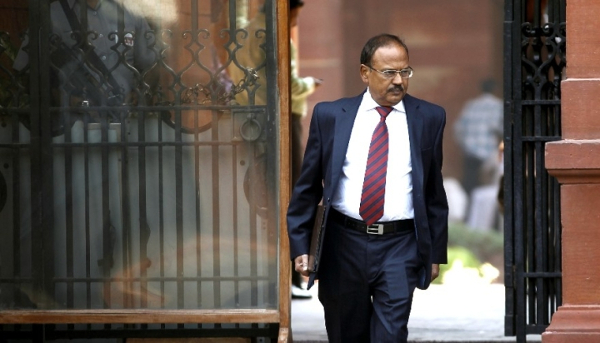
National Security Advisor Ajit Doval’s remarks at the Moscow Security Forum carried a clear strategic message: the global fight against terrorism cannot be selective, convenient or politically adjusted. Speaking at the first International Security Forum and the 14th Meeting of High Representatives for Security Matters in Moscow, Doval said responsible nations must decide whether they stand against sponsors of terrorism or enable them through hesitation and double standards. Coming in the larger shadow of the Pahalgam terror attack and India’s subsequent Operation Sindoor, the statement reflects New Delhi’s harder diplomatic line on cross-border terrorism and state-backed terror ecosystems.
The Moscow forum was hosted under the chairmanship of Sergei Shoigu, Secretary of the Security Council of the Russian Federation. The gathering focused on challenges and threats to international security in an emerging multipolar world. This setting gave Doval’s remarks wider meaning. India was speaking at a platform where security chiefs and senior representatives from several countries were discussing global instability, regional conflict, terrorism, maritime disruption, institutional reform and the changing balance of power. In that environment, India’s message was not framed as a narrow bilateral complaint. It was presented as a global security principle.
Doval’s central argument was direct: terrorism has to be confronted with consistency. Nations cannot condemn terrorism in one theatre and excuse it in another. They cannot mourn victims in one region and protect sponsors elsewhere. They cannot demand international action against extremist violence when their own interests are affected, while treating cross-border terrorism against another country as a manageable diplomatic inconvenience. India’s frustration with such selective responses has grown over decades, and the Pahalgam attack gave that frustration a sharper moral and strategic force.
The Pahalgam attack of April 2025 became a turning point because it targeted civilians in a brutal manner and struck at the heart of normal life in Jammu and Kashmir. The attack was not simply an incident of violence; it was designed to create fear, damage confidence in peace, hurt tourism, and send a message through innocent lives. India’s official position linked the attack to Pakistan-backed terrorism and Lashkar-e-Taiba-linked networks. The scale and nature of the attack pushed New Delhi to respond not only militarily, but also diplomatically.
That response came through Operation Sindoor, in which Indian Armed Forces targeted terrorist infrastructure in Pakistan and Pakistan-occupied Jammu & Kashmir. The operation marked a visible shift in India’s counter-terror posture. India presented it as a precise, calculated and legitimate act of self-defence aimed at terror infrastructure from where attacks against India had been planned and directed. The message was clear: terror attacks on Indian civilians would invite a response against the machinery that enabled them.
Doval’s Moscow remarks should be read in that continuum. India is no longer treating terrorism as a law-and-order issue alone. It is placing terrorism inside the wider architecture of national defence, diplomacy and global security. Terror groups are no longer being viewed only as violent organisations operating in isolation. India’s language increasingly identifies the ecosystem around them: sponsors, financiers, trainers, handlers, propaganda networks, safe havens, intelligence enablers and political protectors. This is why the phrase “double standards” matters so much. It targets not only the terrorist, but also the international hypocrisy that allows the terrorist system to survive.
The Moscow platform was also important because Russia has been a long-standing security partner for India. Doval met Sergei Shoigu on the sidelines of the forum, and both sides reviewed cooperation in defence, security, energy and economic ties. They also exchanged views on the upcoming BRICS NSA meeting in New Delhi. This shows that India-Russia security engagement is operating on several tracks at once: bilateral strategic coordination, counter-terror understanding, defence cooperation, energy security and multilateral consultation through formats such as BRICS.
India’s message on terrorism also fits naturally into the BRICS and Global South context. Doval highlighted the need for urgent reforms in global institutions created after the Second World War. His argument was that old structures must become more effective in dealing with contemporary threats and must provide greater representation to the Global South. This is a crucial point. India is connecting counter-terrorism with global governance reform. It is saying that the present international system often fails because it reflects old power equations while facing new threats.
For India, terrorism is one of those new-age threats that exposes the weakness of old institutions. Terror groups operate across borders. Their financing can move through informal channels, charities, narcotics routes, front businesses and digital networks. Their propaganda travels through encrypted platforms and social media. Their weapons can be supplied through state intelligence networks, smuggling routes or abandoned conflict zones. Their sponsors can hide behind deniability. A system built for conventional diplomacy often struggles to confront such hybrid threats unless countries develop the political will to act together.
Doval’s remarks also had a maritime dimension. He highlighted the need to ensure safe and uninterrupted movement of trade through international waterways such as the Strait of Hormuz and the Red Sea amid tensions in West Asia. This was not a separate issue from security. It was part of the same strategic canvas. Terrorism, regional instability, maritime disruption, energy security and trade routes are now connected. A crisis in West Asia can affect oil prices, shipping insurance, port operations, supply chains and the cost of goods across the world. For India, a major energy importer and trading power, the security of Hormuz and the Red Sea is directly linked to economic stability.
This is why Doval’s Moscow intervention had three layers. The first was counter-terrorism: no safe space for sponsors and no selective outrage. The second was global governance: institutions must reflect current realities and include the voice of the Global South. The third was strategic connectivity: critical waterways must remain secure because modern economies depend on uninterrupted trade movement. Together, these points show how India now frames security in a broad and integrated way.
The Pahalgam context gives the counter-terror message its emotional power. India has repeatedly argued that terrorism cannot be separated from the infrastructure that sustains it. The gunman at the attack site is only the final instrument. Behind him lies recruitment, training, ideological radicalisation, financing, safe houses, weapons movement, handlers, propaganda and protection. A genuine counter-terror doctrine must strike the full chain. Doval’s remark on responsible nations making clear choices goes directly to this point. Countries have to choose between confronting the chain or quietly tolerating parts of it.
India’s post-Pahalgam diplomacy has also tried to internationalise the principle without internationalising the dispute. This is an important distinction. New Delhi is not asking other countries to mediate India’s security decisions. It is asking them to recognise terrorism as terrorism, call out sponsors, and stop hiding behind diplomatic balancing when civilians are killed. In other words, India wants global clarity, not external arbitration.
The Moscow forum gave India a useful stage for that message because the theme itself was the emergence of a multipolar world. A multipolar world cannot function if terrorism becomes a bargaining chip among rival blocs. It cannot claim fairness if victims in one region receive solidarity while victims in another are pushed into silence. It cannot build trust if terror infrastructure is protected for geopolitical convenience. Doval’s intervention essentially argued that a multipolar world must also be a morally consistent world.
There is also a domestic strategic meaning to this message. Operation Sindoor has been presented in India as a new benchmark in the country’s counter-terror doctrine. Earlier Indian responses such as the surgical strikes and the Balakot air strike had already signalled willingness to cross old thresholds when terrorism crossed India’s tolerance limits. Operation Sindoor added another layer by targeting multiple terrorist sites with precision. Doval’s Moscow remarks reinforce the diplomatic side of that military doctrine: India will act, and it will also press the world to judge terror sponsors by conduct rather than convenience.
The speech also fits Doval’s long-standing security thinking. He has often emphasised the invisible nature of modern conflict, where civil society, information systems, morale, public fear and national will become targets. Terrorism is a classic example of such warfare. A terror attack seeks a physical casualty count, but it also seeks psychological shock, economic disruption, communal stress and international pressure. By raising terrorism at a global security forum, India is presenting it as hybrid warfare rather than isolated violence.
The reference to double standards also carries a pointed message for countries that maintain ties with terror-tolerant states while speaking the language of security cooperation. India’s position is that terror networks survive because they are useful to some states and ignored by others. A state may publicly condemn terrorism while privately using extremist groups as instruments of pressure. Another state may avoid naming the sponsor because of strategic, economic or diplomatic calculations. This pattern gives terrorism room to regenerate after every attack.
India’s demand is therefore simple and severe: terrorism must carry consequences for the ecosystem that supports it. Condemnation after an attack is insufficient. Accountability must reach the planner, the funder, the trainer, the handler and the protector. That is the doctrine behind India’s present language. It is also the reason Pahalgam continues to appear in India’s diplomatic messaging. The attack is treated not as a past tragedy alone, but as proof of the continuing danger posed by cross-border terror infrastructure.
Doval’s meeting with Shoigu also underlines the practical importance of security partnerships. Counter-terrorism is not built only through speeches. It requires intelligence exchange, defence cooperation, technology, border management, cyber monitoring, financial tracking and political coordination. India and Russia have long maintained cooperation in defence and security, and the Moscow forum allowed both sides to review this relationship in the middle of a volatile global environment.
The West Asia section of Doval’s intervention adds further seriousness. The Strait of Hormuz and the Red Sea are among the world’s most sensitive maritime arteries. Any disruption in these routes affects energy supplies, shipping lanes and global inflation. India’s concern is practical. Its economy depends on stable energy flows and secure sea lines of communication. By linking trade route security with international stability, Doval placed India’s national interest inside a wider global economic concern.
The larger message from Moscow is that India is now speaking as a security actor with a broad field of vision. It is raising terrorism because of Pahalgam. It is raising maritime security because of West Asia. It is raising institutional reform because of the Global South. It is engaging Russia because of strategic partnership. It is looking toward BRICS because future security conversations will increasingly involve non-Western platforms. This is a multi-layered foreign policy moment, not a single speech.
For India, the fight against terrorism has moved into a new phase. The old pattern of attack, outrage, dossier and diplomatic appeal is being replaced by a more assertive model: identify the ecosystem, respond with precision, build international pressure, and demand consistency from global partners. Doval’s Moscow statement captures that model in one line. There can be no double standards in the fight against terrorism because double standards are exactly what allow terror networks to survive.
The Pahalgam attack gave India a painful reminder of the human cost of cross-border terrorism. Operation Sindoor showed India’s willingness to respond against terror infrastructure. The Moscow Security Forum gave India a global platform to convert that experience into a wider principle. Doval’s message was meant for every capital that speaks against terrorism while measuring its words according to convenience. The choice before responsible nations is now sharper: confront terror sponsors with clarity, or become part of the ambiguity that protects them.
You may also like
-
Exercise Tarang Shakti 2026 Concludes in Jodhpur, Showcasing India’s Air Power, Indigenous Defence Technology
-
US Double Standards in Foreign Policy: 16 Recent Cases Involving India, Russia, China and Global Trade
-
Indian Navy Vice Chief Inspects Japan’s Mogami-Class Stealth Frigate as India-Japan Shipbuilding Cooperation Expands
-
Philippine Marine Wargames Reportedly Show BrahMos Can Penetrate Chinese Destroyer Air Defences
-
Safran Signs 18 Agreements with Indian Aerospace Suppliers, Expanding Make in India Manufacturing Partnerships
