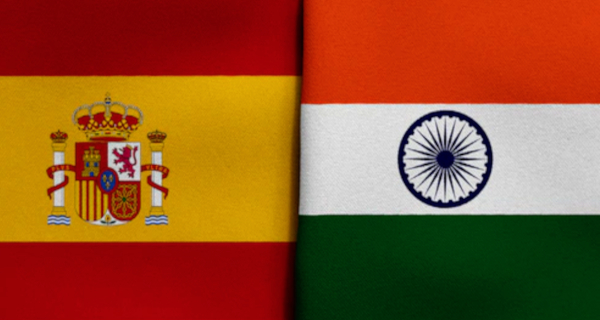
External Affairs Minister Dr. S. Jaishankar’s meeting with Spanish Foreign Minister José Manuel Albares on the sidelines of the Cyprus Gymnich meeting adds fresh momentum to India’s growing engagement with Spain and the wider European strategic space. The discussion focused on the next steps in trade, technology, defence and people-to-people ties, giving the bilateral relationship a practical roadmap at a time when India is expanding its diplomatic, economic and security footprint across Europe.
The meeting took place during the informal gathering of European Union Foreign Ministers in Cyprus, a platform designed for open political discussion on current and regional issues. India’s presence at such a forum reflects the changing character of India-Europe engagement. New Delhi is increasingly being seen as a major voice in global affairs, with stakes in Europe, the Mediterranean, West Asia, the Indo-Pacific and the global economy. For India, the Cyprus meeting offered a useful diplomatic space to engage European partners in a setting shaped by security concerns, regional instability, trade pressures and technology competition.
The Jaishankar-Albares conversation fits into a larger pattern of renewed India-Spain momentum. Spain’s Foreign Minister had visited India in January 2026, when both sides reviewed the full range of bilateral relations, including trade and investment, defence and security, culture, tourism and people-to-people ties. The year also marks the 70th anniversary of diplomatic relations between India and Spain, being observed through the India-Spain Dual Year of Culture, Tourism and Artificial Intelligence. That framing gives the partnership both historical depth and future direction.
Trade and investment remain central to the relationship. India’s expanding market, manufacturing push, infrastructure growth and digital economy create major opportunities for Spanish companies. Spain brings strengths in transport systems, renewable energy, urban infrastructure, railways, defence technology, tourism, design and advanced manufacturing. A deeper India-Spain commercial partnership can help both countries connect industrial capability with market scale, especially at a time when supply chains are being reworked across the world.
Defence cooperation gives the relationship a sharper strategic edge. The C-295 aircraft project, involving Airbus Spain and Tata Advanced Systems, has already become a major symbol of defence industrial cooperation. The project shows how India’s Make in India approach can work with European technology partners to build domestic aerospace capability. It also demonstrates that India-Spain defence ties can move beyond buyer-seller arrangements into manufacturing, supply-chain development, skill creation and long-term industrial collaboration.
Technology is another important pillar. The focus on artificial intelligence during the India-Spain Dual Year shows that both countries are looking at future-facing cooperation rather than only traditional diplomacy. AI, digital public infrastructure, cybersecurity, clean technologies, advanced mobility, research partnerships and innovation ecosystems can become strong areas of engagement. Spain’s European technology networks and India’s scale in digital adoption create a natural space for collaboration.
People-to-people ties add warmth to the strategic relationship. Education, tourism, culture, language, cinema, sports, academic exchanges and professional mobility can give India-Spain relations a wider social base. Strong diplomatic ties become more durable when students, artists, researchers, businesses and travellers create daily bridges between societies. The Dual Year of Culture, Tourism and Artificial Intelligence gives both countries an opportunity to bring these connections into public visibility.
The Cyprus meeting also had a wider geopolitical backdrop. Dr. Jaishankar appreciated Minister Albares’s views on global and regional developments, showing that India and Spain are engaging each other beyond bilateral issues. Europe’s security environment, the Indo-Pacific, West Asia, maritime stability, terrorism and multilateral reform all matter to both countries. India and Spain have already expressed shared concern over terrorism and support for stronger international cooperation against it.
For India, Spain occupies an important place inside a broader European strategy. New Delhi’s diplomacy with Europe is becoming more diversified, reaching beyond the traditional big powers and building deeper partnerships with countries that have industrial strength, maritime relevance, technological capability and political influence within the European Union. Spain fits that profile well. It is a major European economy, a Mediterranean power, a NATO member, and a country with strong links to Latin America, North Africa and the wider Atlantic space.
The Jaishankar-Albares meeting therefore carries significance beyond a routine bilateral interaction. It points to an India-Spain partnership that is moving across multiple tracks at once — trade, technology, defence, culture, education, tourism and regional diplomacy. As India expands its global role and Spain looks to strengthen ties with major Asian partners, the relationship has the potential to become a stronger bridge between India, Europe, the Mediterranean and the Atlantic world.
In that sense, the Cyprus meeting was a continuation of a larger diplomatic process. It kept political momentum alive, identified practical next steps and placed India-Spain relations inside the wider conversation on global change. The result is a partnership that looks increasingly modern, strategic and multidimensional.
You may also like
-
Exercise Tarang Shakti 2026 Concludes in Jodhpur, Showcasing India’s Air Power, Indigenous Defence Technology
-
US Double Standards in Foreign Policy: 16 Recent Cases Involving India, Russia, China and Global Trade
-
Indian Navy Vice Chief Inspects Japan’s Mogami-Class Stealth Frigate as India-Japan Shipbuilding Cooperation Expands
-
INS Trishul Arrives in UK for Exercise KONKAN 2026 as India and Royal Navy Expand Maritime Cooperation
-
INS Sahyadri Arrives in Russia for Exercise INDRA 2026 to Strengthen India-Russia Naval Cooperation
