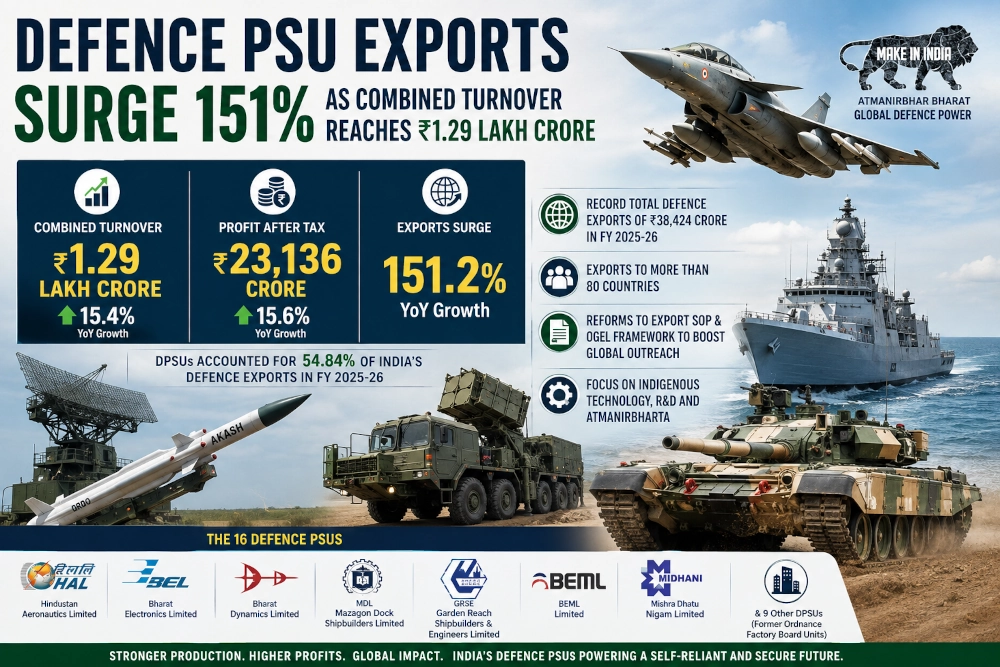
India’s Defence Public Sector Undertakings recorded a sharp expansion in production, profitability and overseas sales during FY 2025-26, with their combined turnover reaching ₹1.29 lakh crore and exports rising 151.2% over the previous financial year.
The latest figures released by the Ministry of Defence on 31 August 2026 show that the country’s 16 Defence Public Sector Undertakings recorded 15.4% growth in turnover, compared with approximately ₹1.12 lakh crore in FY 2024-25. Their combined profit after tax reached ₹23,136 crore, representing year-on-year growth of 15.6%.
The figures come ahead of Defence Minister Rajnath Singh’s annual performance review of the 16 DPSUs in New Delhi on 1 September, where indigenous technology development, modernisation and further expansion of defence exports will be among the principal areas of focus.
Defence PSU Exports More Than Double
The strongest improvement came from overseas sales. DPSU exports increased by 151.2% during FY 2025-26, considerably faster than the growth recorded in their domestic business.
Earlier Ministry of Defence figures showed that India’s total defence exports reached a record ₹38,424 crore in FY 2025-26, increasing 62.66% from ₹23,622 crore in the previous year. DPSUs accounted for 54.84% of the country’s defence exports, while private-sector companies contributed the remaining 45.16%.
The figures indicate an important change in the role of India’s state-owned defence manufacturers. Companies that were historically structured primarily around supplying the Indian Armed Forces are increasingly competing for overseas contracts involving aircraft, helicopters, missiles, naval platforms, radars, electronic systems, armoured-vehicle equipment and associated services.
Turnover Climbs to ₹1.29 Lakh Crore
The ₹1.29-lakh-crore combined DPSU turnover also represents a substantial component of India’s wider defence-industrial output.
India’s overall domestic defence production reached a record ₹1.78 lakh crore in FY 2025-26, reflecting the expansion of both public-sector and private defence manufacturing.
The 16-DPSU ecosystem includes major aerospace, shipbuilding, missile, electronics, armoured-vehicle and specialised-material companies such as Hindustan Aeronautics Limited, Bharat Electronics Limited, Bharat Dynamics Limited, Mazagon Dock Shipbuilders, Garden Reach Shipbuilders & Engineers, BEML and MIDHANI, alongside the defence companies created following the restructuring of the former Ordnance Factory Board.
Their growing turnover reflects sustained orders for military modernisation as well as India’s increasing emphasis on sourcing weapons and equipment from domestic manufacturers.
Profit After Tax Reaches ₹23,136 Crore
The companies also reported a combined ₹23,136 crore in profit after tax, an increase of 15.6% over the previous year.
The simultaneous increase in turnover, profitability and exports is significant because India’s defence-industrial strategy increasingly expects DPSUs to function not only as strategic manufacturing organisations but also as globally competitive aerospace and defence companies.
Seven major DPSUs — HAL, MDL, BEL, BDL, GRSE, BEML and MIDHANI — will present dividend cheques representing the government’s equity share for FY 2025-26 during the Defence Minister’s review on 1 September.
Export Reforms Aim to Accelerate Overseas Sales
The surge in exports comes as the government is further simplifying the regulatory framework governing overseas sales of Indian military equipment.
On 28 August, the Department of Defence Production announced reforms to the Defence Export Standard Operating Procedure and Open General Export Licence framework, reducing procedural requirements and widening access to international markets while retaining restrictions associated with national security and sanctioned destinations.
The reforms are intended to allow Indian companies to respond more quickly to overseas opportunities, particularly for components, subsystems and equipment where repeated export permissions can otherwise slow commercial activity.
India has set a target of reaching ₹50,000 crore in annual defence exports by FY 2028-29, while Indian defence products are already being supplied to more than 80 countries.
Focus Shifts Towards Indigenous Technology
The annual DPSU review will also place increased emphasis on moving companies further up the defence-technology value chain.
Rajnath Singh is scheduled to release publications covering the self-reliance journey of the DPSUs, defence technology awareness for students, HAL’s modernisation roadmap and HAL’s indigenisation roadmap.
The emphasis is important because increasing production alone does not necessarily create strategic technological independence. India’s longer-term objective is to develop more of the underlying intellectual property, components, sensors, electronics, propulsion technologies, materials and manufacturing processes domestically.
DPSUs are consequently being encouraged to expand indigenous R&D while working more extensively with private companies, MSMEs, startups, academia and DRDO laboratories.
From Domestic Suppliers to Global Defence Companies
The FY 2025-26 numbers show that India’s state-owned defence industry is increasingly moving beyond its traditional role as a supplier to the domestic military.
A 15.4% rise in turnover, 15.6% growth in profit after tax and particularly the 151.2% surge in exports point towards an industry whose international business is expanding considerably faster than its overall revenue base.
The next challenge will be sustaining that momentum through repeat international orders, greater indigenous content and exports of complete high-value defence platforms rather than predominantly components and subsystems.
For India’s broader defence-industrial strategy, the latest results represent another important milestone: its public-sector defence manufacturers are not only producing more equipment for the Indian Armed Forces, but are increasingly becoming a significant part of India’s emergence as a global defence exporter.
You may also like
-
India’s Economic Warfare Challenge: Strategic Autonomy, Energy Security and the Rise of a Global Power
-
India-US Trade Deal Stalemate: Why Washington’s Tariff Pressure Has Failed to Secure an Agreement
-
US Double Standards in Foreign Policy: 16 Recent Cases Involving India, Russia, China and Global Trade
-
India’s Arctic Energy Ambitions: Russian Oil, LNG and a New Sea Route to Indian Ports
-
Indian Navy Vice Chief Inspects Japan’s Mogami-Class Stealth Frigate as India-Japan Shipbuilding Cooperation Expands
