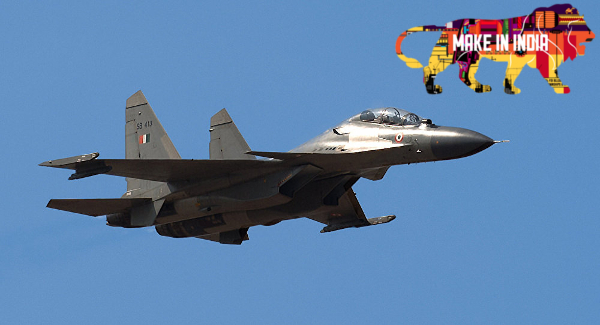
India’s effort to strengthen the Su-30MKI’s indigenous electronic-warfare capability has reached an important stage, with Chennai-based defence electronics company Data Patterns preparing its self-protection jammer pod for aircraft integration and flight trials.
Data Patterns Chairman and Managing Director S. Rangarajan said during the company’s Q1 FY 2026-27 earnings call that qualification work is underway and that the company expects the first aircraft trials to begin before December 2026, subject to completion of the required validation process. The customer has already reviewed the system and, according to the company, expressed satisfaction with its progress.
Designed to Protect the Su-30MKI
A self-protection jammer is an electronic-warfare system designed to improve a fighter aircraft’s survivability against hostile radars and radar-guided weapons. It works by transmitting carefully generated radio-frequency signals intended to disrupt or confuse enemy radar tracking and targeting.
Data Patterns has previously identified the system as a wingtip-mounted jammer developed for the Su-30MKI. The company has also stated that the design uses AESA technology, allowing electronically controlled transmission of jamming energy without mechanical beam steering.
The company has developed the jammer hardware in-house and has been working on associated cooling, aerodynamics, electronics and jamming algorithms. These are critical because an externally mounted jammer must remain structurally and electronically reliable during high-speed flight and aggressive manoeuvres.
Part of a Wider Indigenous EW Suite
The jammer is being developed as part of a broader Indian electronic-warfare capability rather than as an isolated pod. Data Patterns has also been working on Radar Warning Receiver technology and associated EW electronics, with the longer-term objective of supplying complete airborne electronic-warfare systems.
A Radar Warning Receiver detects and identifies hostile radar emissions, while the jammer provides the active electronic response. Together, such systems can significantly improve the survivability of combat aircraft operating in contested airspace.
This capability is particularly relevant to the Super Sukhoi upgrade programme, under which the Indian Air Force plans to modernise the Su-30MKI fleet with newer indigenous radar, avionics, electronic-warfare systems and weapons.
Reducing Dependency Through Indigenous Development
Electronic warfare is among the most sensitive technologies aboard a modern fighter because its effectiveness depends not only on hardware but also on software, threat libraries and continuously updated countermeasure techniques.
An indigenous jammer would give India greater control over future upgrades and allow systems to be adapted as new radar and missile threats emerge. It could also reduce dependence on foreign suppliers for one of the Su-30MKI’s most critical survivability systems.
You may also like
-
Indian Navy Vice Chief Inspects Japan’s Mogami-Class Stealth Frigate as India-Japan Shipbuilding Cooperation Expands
-
India and Russia Explore Joint Icebreaker Construction as Maritime Industrial Cooperation Expands
-
Philippine Marine Wargames Reportedly Show BrahMos Can Penetrate Chinese Destroyer Air Defences
-
Safran Signs 18 Agreements with Indian Aerospace Suppliers, Expanding Make in India Manufacturing Partnerships
-
Indian Army’s Vajra Corps Certifies First Batch of Drone Operators, Strengthens Battlefield Surveillance
