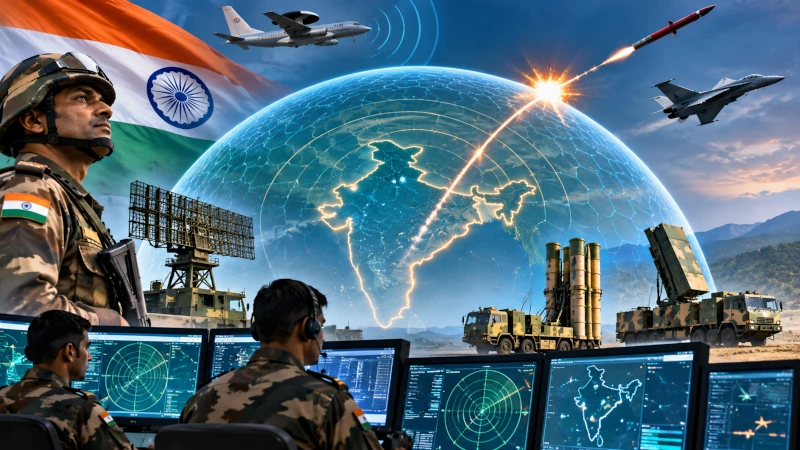
India’s ambitious Mission Sudarshan Chakra has reached an important planning milestone, with a formal report on the proposed integrated air and ballistic missile defence system prepared and undergoing further examination by Headquarters Integrated Defence Staff (HQ IDS).
Defence Secretary Rajesh Kumar Singh confirmed the development during a media summit in New Delhi on 16 November 2026. He stated that the report had been completed and was being examined by HQ IDS as part of the ongoing work to develop India’s proposed national air and missile defence architecture.
The development marks progress in the planning of Mission Sudarshan Chakra, although the preparation of the report does not constitute final approval or operational deployment of the proposed system.
Integrated Defence Staff Examines the Prepared Report
Speaking about the status of Mission Sudarshan Chakra, the Defence Secretary explained that the formal report was ready and that Headquarters Integrated Defence Staff was undertaking further examination of its contents.
Mission Sudarshan Chakra is envisaged as a multilayered defence architecture intended to strengthen India’s ability to detect, track and counter aerial threats. The broader initiative includes the development of coordinated defensive capabilities against different categories of airborne weapons, including missiles.
The involvement of Headquarters Integrated Defence Staff is significant because the proposed architecture requires coordination across the armed forces. Modern air defence depends upon the integration of surveillance assets, communication networks, command-and-control systems and weapons platforms operating across different military services.
An effective integrated air defence network requires more than individual missile systems. Its operational effectiveness depends upon the coordination of sensors, command structures and defensive weapons within a common operational framework.
The ongoing examination represents a planning milestone in the proposed programme, with the final configuration and implementation arrangements yet to be announced.
Procurement Initiated to Address Existing Air Defence Gaps
The Defence Secretary also clarified that the Ministry of Defence was not waiting for the formal acceptance of the Mission Sudarshan Chakra report before addressing existing operational requirements.
He indicated that procurement action had already been initiated in several areas, particularly those associated with strengthening India’s air defence capabilities. These acquisition activities are being pursued alongside the broader examination of the proposed Sudarshan Chakra architecture.
The approach reflects the distinction between immediate operational requirements and the longer-term development of an integrated defence system. Existing capability gaps can be addressed through procurement and modernisation programmes while the broader architecture continues to undergo examination.
The Defence Secretary’s remarks establish that air defence modernisation is proceeding through parallel efforts, with immediate capability requirements being addressed independently of the final approval of Mission Sudarshan Chakra.
However, the latest remarks did not identify the specific equipment being acquired, the value of the procurement proposals or the industrial organisations selected to execute them.
Mission Sudarshan Chakra and India’s Defence Modernisation
Mission Sudarshan Chakra was announced by Prime Minister Narendra Modi during his Independence Day address on 15 August 2025 as an initiative aimed at strengthening India’s national security architecture.
The programme draws its name from the Sudarshana Chakra associated with Lord Krishna and is intended to develop advanced capabilities for protecting the country against evolving security threats.
On 12 June 2026, Defence Minister Rajnath Singh described Mission Sudarshan Chakra as a proposed multilevel missile defence system during his visit to the Defence Research and Development Laboratory (DRDL) in Hyderabad.
The Defence Minister emphasised the importance of indigenous research and technological development in strengthening India’s defence capabilities. The initiative forms part of the government’s broader emphasis on developing advanced military technologies within the country.
During his Independence Day address on 15 August 2026, Prime Minister Narendra Modi also stated that work on Mission Sudarshan Chakra was progressing rapidly, reaffirming the government’s emphasis on the initiative.
The programme reflects India’s objective of developing a coordinated and increasingly indigenous air and missile defence capability rather than relying solely on individual defensive weapons operating independently.
Importance of Integrated Air and Missile Defence
The changing nature of modern warfare has increased the importance of multilayered air defence systems capable of responding to different categories of aerial threats. Ballistic missiles, cruise missiles, unmanned aircraft and precision-guided weapons present varying operational challenges that cannot necessarily be addressed through a single defensive platform.
An integrated air defence architecture seeks to improve coordination between surveillance systems, command networks and defensive weapons. Such coordination is particularly important when military forces must respond to multiple threats approaching from different directions or operating at different altitudes.
India already possesses indigenous capabilities in several areas relevant to air defence, including surface-to-air missile systems, surveillance radars, command-and-control technologies and associated electronic equipment. Research establishments under DRDO and domestic defence manufacturers have contributed to the development of these technologies.
Mission Sudarshan Chakra is relevant to the continued development of these capabilities, although the final selection of systems and the responsibilities of individual organisations have not been publicly established in the latest announcement.
The strategic significance of an integrated defence architecture lies in its ability to combine detection, decision-making and interception capabilities into a coordinated response against increasingly complex aerial threats.
Role of Indigenous Defence Research and Manufacturing
The proposed initiative is also relevant to India’s defence research and industrial ecosystem, particularly in the areas of missile technology, surveillance systems, electronic warfare, command-and-control equipment and systems integration.
DRDO has developed several indigenous air defence technologies, while defence public sector undertakings and private manufacturers contribute to the production of radar systems, electronics, communications equipment and other military technologies.
The continued development of such capabilities supports India’s policy of Aatmanirbhar Bharat in defence manufacturing. Indigenous research and manufacturing can strengthen domestic technological capabilities and provide greater control over the development, maintenance and modernisation of critical defence equipment.
However, no specific new manufacturing contracts or industrial partnerships for Mission Sudarshan Chakra were announced in the Defence Secretary’s remarks on 16 November 2026.
Strengthening India’s Future Air Defence Architecture
The completion of the formal Mission Sudarshan Chakra report and its examination by Headquarters Integrated Defence Staff represent a further stage in India’s efforts to develop a coordinated air and missile defence architecture.
The Defence Secretary’s confirmation that procurement action has already begun to address existing air defence gaps also demonstrates that the Ministry of Defence is pursuing immediate operational improvements alongside longer-term planning.
The development comes amid continued emphasis on technological modernisation, inter-service coordination and indigenous defence capabilities.
Mission Sudarshan Chakra represents an important direction in India’s defence planning, combining the objective of stronger national air defence with the development of advanced domestic military technologies.
The latest development establishes that the programme’s formal planning has progressed while the defence establishment continues to examine the proposed architecture and address existing capability requirements.
The parallel emphasis on operational preparedness, integrated military planning and indigenous technological development provides a foundation for India’s continuing efforts to strengthen its national air defence capabilities.
You may also like
-
Cochin Shipyard Signs MoU with Netherlands’ Damen Shipyards for Future Shipbuilding Projects
-
Russian University and Drone Manufacturer Plan UAV Technology Transfer and Production in India
-
India’s AMCA Stealth Fighter Programme Enters Bid Evaluation Stage as Three Industry Groups Compete
-
Bharat Forge Dispatches First Consignment of Indigenous 5.56 mm Rifles for Uttar Pradesh STF
-
India’s PLI Schemes Achieve 76% of Investment Target and 64% of Production Goal
