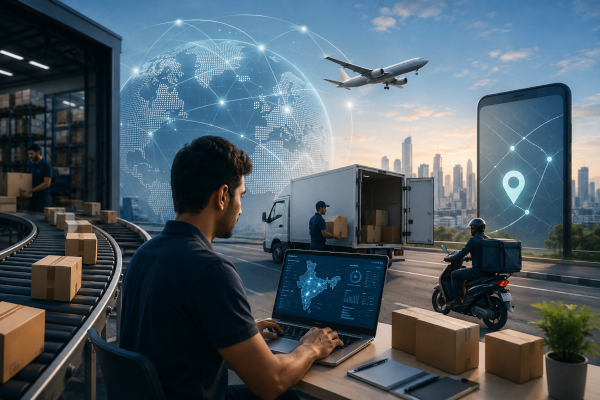
India’s direct-to-consumer market is entering a new phase where logistics is no longer just a back-end delivery function, but a core operating system for digital-first brands. As online-first businesses expand beyond metro cities and sell directly through their own websites, marketplaces and social commerce channels, courier aggregators are quietly becoming one of the most important enablers of India’s next decade of e-commerce growth.
According to an IBEF report, courier aggregation platforms are helping smaller merchants and emerging D2C brands access enterprise-grade logistics without having to build expensive warehousing, shipping or delivery networks of their own. These platforms bring multiple courier companies into a single technology interface, allowing brands to compare shipping options, automate order allocation, track deliveries, manage returns and reduce logistics friction.
This shift is significant because India’s D2C ecosystem is no longer limited to a few urban lifestyle brands. New businesses in fashion, beauty, wellness, electronics accessories, home products, food, personal care and niche consumer categories are trying to reach buyers across the country. For many of them, logistics can decide whether the business scales profitably or collapses under the pressure of high shipping costs, failed deliveries and returns.
Courier aggregators solve this problem by giving brands a plug-and-play logistics layer. Instead of negotiating separately with multiple courier companies, a small brand can use one dashboard to ship orders across India. The IBEF report notes that logistics technology platforms now connect merchants with more than 40 courier partners, cover over 19,000 PIN codes in India and also support deliveries to more than 220 countries.
For a young D2C brand, this is a major advantage. A company selling from Jaipur, Surat, Kochi, Indore or Guwahati can reach a customer in Delhi, Bengaluru, Patna or even overseas without building its own physical distribution network. This has democratised online selling by giving smaller businesses access to logistics capabilities that were earlier available mainly to large e-commerce companies.
The real value of courier aggregators lies in optimisation. These platforms do not simply assign a parcel to any courier partner. They use data to select the most suitable delivery partner based on location, cost, serviceability, past performance, delivery speed and return probability. This allows brands to reduce failed deliveries, improve customer satisfaction and control shipping expenses.
Returns are one of the biggest challenges in India’s online commerce market, especially in cash-on-delivery orders. Failed deliveries and return-to-origin shipments can seriously hurt margins for small brands. Courier aggregators help reduce this burden through automated non-delivery reports, customer communication tools, address verification, shipment tracking and return management systems. Some reports say brands using multi-courier allocation and non-delivery management workflows have seen return-to-origin reductions of around 15–25%.
This is why logistics is now becoming a strategic function for D2C brands. Delivery speed, tracking transparency, return handling and post-purchase experience influence whether a customer buys again. In a crowded market where many brands sell similar products, the delivery experience can become a major differentiator.
The rise of courier aggregators also comes at a time when India’s digital commerce market is expanding rapidly. A recent Google-Deloitte report cited by Economic Times projected that India’s digital commerce market could grow to around US$250 billion by 2030, from about US$90 billion at present. This expansion is being driven by quick commerce, AI-enabled customer experiences, Gen Z consumers and the spread of digital buying beyond large cities.
As more consumers shop online, the pressure on logistics will only increase. Buyers now expect fast delivery, real-time tracking, easier returns and predictable service. For D2C brands, meeting these expectations requires technology-led logistics rather than manual shipment handling. Courier aggregators are filling this gap by turning logistics into a software-driven layer.
Artificial intelligence and analytics are also becoming central to this model. Modern courier aggregation platforms can analyse delivery routes, courier performance, customer behaviour, return patterns and cost structures. This helps brands make better decisions about where to stock products, which courier partner to use and how to reduce delivery failures.
The model is especially useful for India’s small businesses and MSMEs. Many micro and small enterprises have strong products but limited access to national distribution. Courier aggregators allow such businesses to go beyond their local markets and sell across the country. This supports a more decentralised e-commerce economy where smaller towns and regional entrepreneurs can participate in national digital commerce.
The sector also has an export angle. With cross-border shipping support to more than 220 countries, Indian D2C brands can test international demand without setting up global warehouses. This can help Indian brands in categories such as Ayurveda, beauty, handicrafts, apparel, organic products, speciality foods and lifestyle goods reach overseas customers more easily.
However, the growth of courier aggregators will also depend on execution. India remains a complex logistics market because of varied geography, address inconsistencies, regional demand patterns, cash-on-delivery dependence and last-mile challenges in smaller towns. Technology can reduce many of these problems, but service quality, courier reliability and cost discipline will remain critical.
Despite these challenges, courier aggregators are becoming one of the strongest foundations of India’s D2C story. They are not merely transporting parcels; they are giving brands the logistics intelligence needed to scale. For the next generation of Indian consumer companies, the ability to deliver reliably across 19,000 PIN codes may be as important as product design, marketing or pricing.
India’s D2C boom will therefore not be powered only by websites, influencers and digital payments. It will also be powered by the invisible logistics networks that make every online order possible. Courier aggregators are turning this network into a smarter, more accessible and more scalable system — one that could define the next decade of India’s digital commerce growth.
You may also like
-
LC3: The Indian-Backed Cement Technology That Could Change How India Builds
-
India’s Quantum-Secure Network Reaches 1,000 km as National Quantum Mission Advances Towards 2,000-km Goal
-
EON Space Labs and Dhruva Space Advance Indian Space Hardware on Transporter-18 Mission
-
SatLeo Labs’ TAPAS-1 Reaches Orbit, Advancing India’s Private Thermal-Imaging Capability
-
TakeMe2Space’s MOI-1A Reaches Space on Falcon 9 Transporter-18 Mission
