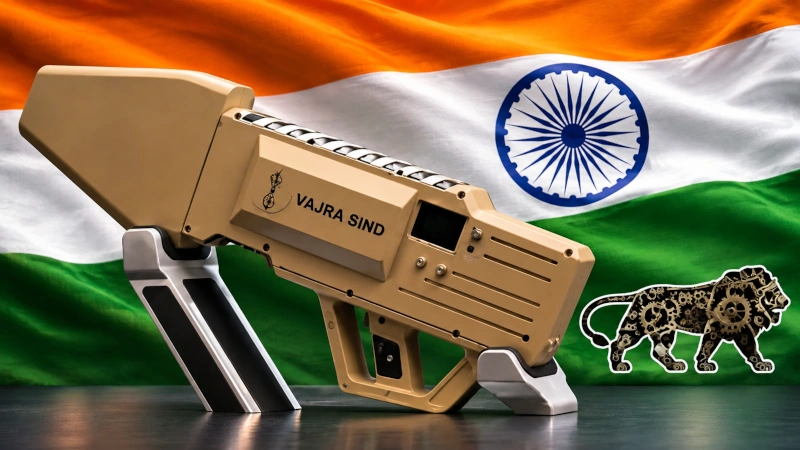
Chennai-based defence technology company Big Bang Boom Solutions Private Limited (BBBS) has unveiled Vajra Sind, an indigenously developed handheld radio-frequency (RF) jammer designed to counter hostile drones at short range. The system offers wideband jamming capabilities across frequencies ranging from 400 MHz to 6 GHz, providing a portable electronic warfare solution intended for frontline military personnel.
The Vajra Sind was unveiled on November 17, 2026, at the company’s headquarters in Chennai by Major General Roopesh Mehta, Additional Director, Capability Development (B), Integrated Headquarters of the Ministry of Defence (Army). The development represents another addition to India’s indigenous counter-drone technology ecosystem as the Armed Forces increasingly focus on addressing threats from small unmanned aerial vehicles.
Designed, developed and manufactured in India, Vajra Sind forms part of BBBS’s expanding portfolio of counter-unmanned aerial systems. The company has positioned the equipment as a lightweight and rapidly deployable solution for military personnel operating in environments where conventional drone detection and neutralisation systems may not always be readily available.
Wideband RF Jamming Across 400 MHz to 6 GHz
The principal technological feature of Vajra Sind is its claimed ability to conduct wideband radio-frequency jamming across the 400 MHz to 6 GHz spectrum. This frequency coverage encompasses several communication bands used by commercially available and specialised unmanned aerial vehicles.
Many drones depend on radio-frequency communication links for receiving control instructions, transmitting telemetry and maintaining connections with their operators. Disrupting these communication links can interfere with the operation of susceptible drones, potentially triggering programmed responses such as hovering, landing or returning to a designated location.
Unlike systems restricted to a limited selection of frequency bands, Vajra Sind has been designed to provide broader RF coverage. According to BBBS, the equipment supports multiple configurable frequency bands that can be adjusted according to operational requirements and the characteristics of the detected threat.
The company describes Vajra Sind as a true wideband handheld jammer capable of addressing a wider variety of drone communication frequencies than conventional narrowband systems.
However, the effectiveness of RF jamming depends on several factors, including the target drone’s communication architecture, operating frequency, distance, signal strength and resistance to electronic interference. Drones operating autonomously or using alternative communication arrangements may not respond to jamming in the same manner.
Lightweight Design for Frontline Military Personnel
Vajra Sind has been developed with portability as a major design consideration. According to the manufacturer, the handheld system weighs less than five kilograms, allowing military personnel to carry and operate it without depending on vehicle-mounted electronic warfare equipment.
The device incorporates a simplified operating interface intended to support rapid activation during counter-drone operations. BBBS has stated that the system includes a single-button activation feature and a self-check status display to help operators monitor its readiness.
The jammer also supports configurable operating bands, allowing its electronic countermeasure functions to be adjusted according to the frequencies associated with a particular threat.
Another feature highlighted by the company is the provision for integrating a handheld drone detector. Such integration could provide operators with detection information alongside the jammer’s electronic countermeasure capability, although the manufacturer has presented this as an upgrade option rather than a confirmed standard feature of every unit.
The emphasis on portability reflects the growing importance of equipping individual military units with counter-drone technologies that can complement larger air defence and electronic warfare systems.
Development Influenced by Operational Lessons from Operation Sindoor
According to BBBS, the development of Vajra Sind was influenced by operational lessons associated with Operation Sindoor, particularly the challenges posed by evolving drone communication technologies.
The company stated that its experience highlighted the limitations of electronic countermeasures restricted to conventional industrial, scientific and medical (ISM) frequency bands.
As unmanned aircraft increasingly employ different frequencies and communication technologies, effective counter-drone equipment must be capable of responding to a broader range of electronic signals.
BBBS developed Vajra Sind as a soldier-centric system intended to address these challenges through wideband jamming capabilities within a compact handheld configuration.
The company has also described the system as a tribute to Indian military personnel who participated in Operation Sindoor.
The development illustrates how operational experience can inform domestic defence technology programmes, particularly in areas where equipment must adapt rapidly to changing battlefield requirements.
Understanding the Role of Handheld Counter-Drone Jammers
Handheld counter-drone jammers are a category of electronic warfare equipment designed to interfere with the wireless communication links used by unmanned aerial vehicles.
Unlike kinetic counter-drone systems, which physically intercept or destroy airborne targets, RF jammers attempt to disrupt the electronic signals supporting drone operation.
This approach can provide military personnel with an additional means of responding to certain drone threats without necessarily employing missiles, guns or interceptor drones.
However, electronic jamming does not guarantee the destruction or capture of a hostile unmanned aircraft. The result depends on the drone’s design and its programmed behaviour when communication links are interrupted.
A drone may lose operator control, enter a predefined safety mode or continue its mission autonomously, depending on its technical configuration.
Consequently, handheld RF jammers are most appropriately understood as one component of a broader counter-drone defence system that may also include radar, radio-frequency detection, electro-optical sensors and physical interception capabilities.
Vajra Sind is intended to occupy this portable electronic countermeasure segment within India’s growing counter-unmanned aerial systems ecosystem.
Expanding BBBS’s Vajra Counter-Drone Technology Portfolio
Vajra Sind forms part of the Vajra family of counter-drone technologies developed by Big Bang Boom Solutions.
The company’s wider portfolio includes systems intended for drone detection, tracking and electronic neutralisation across different operational ranges.
Among these is Vajra Sentinel, a counter-unmanned aerial system that BBBS says has been supplied to the Indian Army, Indian Air Force and Indian Navy, as well as exported to friendly foreign countries.
The company has also developed technologies involving radar systems, interceptor drones and other electronic warfare capabilities.
According to BBBS, the initial development of its Vajra Sentinel counter-drone system received support through the Innovations for Defence Excellence (iDEX) initiative of the Ministry of Defence.
The addition of Vajra Sind broadens the company’s product portfolio by introducing a compact handheld system alongside its larger counter-drone solutions.
This approach reflects the growing need for layered counter-drone protection, with different systems designed for individual soldiers, military installations and wider operational areas.
Indigenous Research and Development in Chennai
Big Bang Boom Solutions is an Indian deep-technology company established in 2018, with activities spanning defence electronics, artificial intelligence, autonomous systems, advanced materials, robotics and electronic warfare.
The company undertakes research, engineering, prototyping, systems integration and manufacturing activities in India, with Chennai serving as an important centre for its technological development.
BBBS operates the SHAKTI Research and Development Hub in Chennai, a facility covering approximately 20,000 square feet.
According to the company’s announcement, it has secured eight projects under the Ministry of Defence’s iDEX programme, which supports the development of innovative defence technologies by Indian companies and startups.
The development of Vajra Sind reflects the increasing participation of Indian private-sector enterprises in specialised defence technologies that were previously associated primarily with established defence manufacturers and government research institutions.
The company has stated that Vajra Sind was developed by its in-house research and engineering team, with an emphasis on indigenous intellectual property and domestic technological capabilities.
Army Official Highlights Importance of Emerging Defence Technologies
Major General Roopesh Mehta, who unveiled Vajra Sind, highlighted the changing technological character of modern military operations and the growing importance of drones and counter-drone systems.
He emphasised that military responses to emerging unmanned aerial threats must be adaptable, technologically advanced and suitable for rapidly changing operational conditions.
The senior Army officer also recognised the contribution of young Indian engineers and defence technology developers in creating solutions relevant to modern warfare.
Dr Shivaraman Ramaswamy, Founder and Chief Technology Officer of Big Bang Boom Solutions, described Vajra Sind as the result of the company’s efforts to develop practical counter-drone technology informed by operational requirements.
He highlighted the company’s focus on indigenous intellectual property, lightweight design and the development of electronic warfare systems suited to the needs of military personnel.
The unveiling in the presence of a senior Army officer demonstrates institutional interest in emerging counter-drone technologies. However, it should not be interpreted as confirmation of an Army procurement order or operational induction of Vajra Sind.
India’s Growing Requirement for Counter-Drone Systems
The expanding use of small unmanned aerial vehicles has introduced new challenges for military forces across the world.
Drones can be employed for surveillance, reconnaissance, battlefield observation and attacks against military equipment and infrastructure. Their relatively small size, mobility and diverse operating characteristics can make them difficult to counter using conventional air defence systems alone.
The increasing availability of commercially derived drones has also created demand for countermeasures that can be deployed at the level of individual military units.
Electronic warfare systems capable of disrupting drone communication links have consequently become an important component of counter-unmanned aerial vehicle technology.
Handheld systems such as Vajra Sind are intended to provide portable countermeasure capabilities, while larger systems can support the protection of military bases, critical infrastructure and wider operational areas.
The development of indigenous counter-drone equipment is particularly relevant to India because it supports domestic expertise in radio-frequency engineering, electronic warfare and defence systems integration.
Development Confirmed, Operational Induction Not Announced
The November 17 announcement confirms the unveiling of Vajra Sind as an indigenous handheld wideband counter-drone jammer.
The manufacturer has disclosed its frequency coverage, approximate weight, configurable operating bands and selected operating features.
However, the company has not publicly provided independently verified operational performance data establishing the system’s effective jamming distance, success rate against different drone types or performance under contested electronic warfare conditions.
The announcement also does not confirm a procurement order, acceptance by the Indian Army or operational deployment of Vajra Sind.
The system’s introduction should therefore be understood as a product development and unveiling milestone, rather than a confirmed induction into military service.
Strengthening India’s Indigenous Counter-Drone Ecosystem
The unveiling of Vajra Sind represents another development in India’s efforts to expand domestic capabilities in defence electronics and counter-unmanned aerial systems.
By developing a handheld jammer with manufacturer-reported frequency coverage extending from 400 MHz to 6 GHz, Big Bang Boom Solutions has introduced a portable electronic countermeasure designed to address the evolving requirements of drone defence.
The project also demonstrates the role of India’s private defence technology sector in translating operational requirements into indigenous equipment through domestic research and engineering.
As unmanned aerial technologies continue to evolve, the development of complementary systems for detection, electronic interference and interception will remain important to strengthening military preparedness.
Vajra Sind adds to India’s growing portfolio of domestically developed counter-drone technologies and highlights the increasing contribution of Indian defence startups to technological self-reliance and innovation.
You may also like
-
Apollo Micro Systems Partners with Redon Systems to Develop Indigenous Tethered Drones and Loitering Munitions
-
Indian Navy’s Barak Missile Defence Systems to Receive ₹1,976 Crore Upgrade Under India–Israel Agreement
-
ICAR Develops India’s First Indigenous H5N1 Chicken Vaccine to Strengthen Poultry Disease Control
-
Tata Steel Plans India’s First Hydrogen Production Facility Using Steel Plant Off-Gases in Odisha
-
India’s Memory Chip Exports Surge 2,333% to $562.4 Million as Semiconductor Trade Expands
