Akhanda Bharath

The vastness of the Bharath, the land rich in heritage and cultural diversity

Prambanan Temple: India and Indonesia Reconnect Through a 1,000-Year-Old Shiva Shrine

The Prambanan complex was built during the reign of the Mataram kingdom, especially under rulers such as Rakai Pikatan and Rakai Balitung. Unlike a single temple structure, Prambanan is a large sacred complex consisting of hundreds of shrines. Traditionally, the site is associated with 240 temples, arranged in a carefully planned layout. At its heart are the main temples dedicated to the Hindu trinity: Shiva, Vishnu and Brahma.

India and Kyrgyzstan Launch Civilizational Research Centre to Deepen Cultural and Academic Ties

The centre was inaugurated during the visit of an Indian academic delegation to Kyrgyzstan from July 4 to 7, in collaboration with the Manas National Academy and the Centre for Studies of International Relations (CSIR), New Delhi. The event also marked the release of the first Hindi translation of the Kyrgyz national epic, Manas, making one of Central Asia’s most celebrated literary works accessible to millions of Hindi readers.

Thekkumkur Rajas: The Royal House that Shaped Kottayam’s Medieval Identity

The name Thekkumkur is commonly understood as the “southern regent” or southern division, often remembered in relation to Vadakkumkur, the northern counterpart. These two political houses emerged after the older regional order of Vempolinad weakened and split into smaller principalities. Local historical accounts connect the Kottayam region with the older Kulasekhara and Vempolinad background before the rise of Thekkumkur and Vadakkumkur as separate powers.

India–Norway Sanskrit Culture: The Ancient Linguistic Bridge between the Vedic and Norse Worlds

These similarities are powerful because they show a shared ancestral layer beneath two distant cultures. A Norwegian child saying mor and an Indian tradition preserving mātṛ are separated by geography and centuries, yet they echo an older linguistic inheritance. The same pattern appears in bror and bhrātṛ, where the sound has changed but the ancestral relationship remains visible.

Ramayana in Singapore: A Living Bridge of Indian and Southeast Asian Civilisation

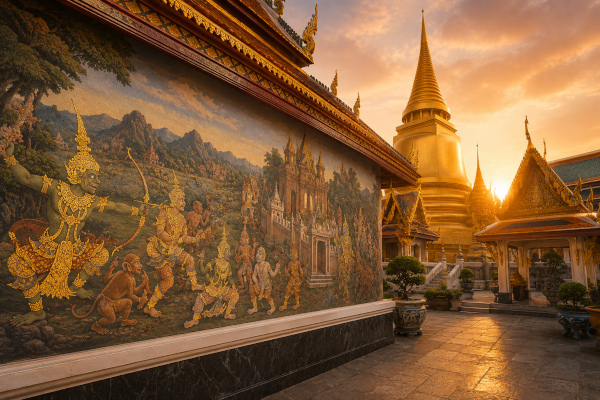
This makes Singapore special in the Ramayana map. It is both Indian and Southeast Asian in its cultural inheritance. The epic is preserved through Indian classical forms such as Bharatanatyam, Odissi and storytelling, while also being understood as part of the wider Southeast Asian cultural family. In Singapore, the Ramayana is not only remembered as scripture or literature; it becomes performance, education, community identity and shared heritage.

Mammiyur Mahadeva Temple: The Sacred Shiva Shrine Beside Guruvayur

For generations, devotees visiting Guruvayur have also offered prayers at Mammiyur Mahadeva Temple. This tradition gives the temple a special place in the religious life of Kerala. While Guruvayur is celebrated as the abode of Lord Krishna, Mammiyur is cherished as the seat of Lord Shiva, who is worshipped here in the form of Uma Maheswara, along with Goddess Parvathy.

Ramayana in Vietnam: Champa, Hindu Deities and the Sacred Cultural Bridge With Bharat

The ancient Champa kingdom flourished along the coast of present-day central and southern Vietnam for many centuries. Located on important maritime routes between India, China and Southeast Asia, Champa became a powerful cultural meeting ground. Indian merchants, priests, scholars and maritime networks carried Sanskrit, Hinduism, Buddhism, temple architecture, royal rituals and epic traditions into the Cham world. Over time, the Cham people created their own refined civilisation, blending Indic religious ideas with local Austronesian culture.