Economy

News on Indian Economy

India’s Chip-Design Pipeline Accelerates as C2S Trains 68,000 and Enables 254 Semiconductor Tape-Outs

Of the 254 designs taped out so far, 175 have been processed at the 180-nanometre technology node at Semiconductor Laboratory, Mohali, while another 79 have gone to overseas foundries. Tape-out represents a crucial stage in semiconductor development because it marks the point at which a completed circuit design is sent for physical fabrication.

Indian Navy Receives Mangrol, Third Anti-Submarine Warfare Shallow Water Craft Built by Cochin Shipyard

With more than 80 percent indigenous content, Mangrol reflects the increasing participation of Indian industry in the development and construction of specialised naval platforms. The vessel has been designed primarily for operations in India’s coastal waters, where shallow-water environments present unique challenges for detecting and tracking underwater threats.

29 FDI Investments Worth ₹4,895.65 Crore Reported Under Revised Framework

The investments span sectors including Information Technology, Artificial Intelligence, Information and Communication, manufacturing, pharmaceuticals, data centres and transport services. Investors and entities involved are based in jurisdictions such as Mauritius, the United States, South Korea, Japan, Singapore, Luxembourg and the Cayman Islands.

HAL Moves Indigenous Head-Mounted Display Generator Into Endurance Testing for Fighter Avionics

Hindustan Aeronautics Limited has reportedly moved an indigenous Head-Mounted Display Generator into endurance testing, marking an important step towards qualification of a domestically developed cockpit avionics subsystem. The programme could strengthen India’s ability to develop advanced helmet-mounted display technology for present and future combat aircraft while reducing dependence on imported avionics.

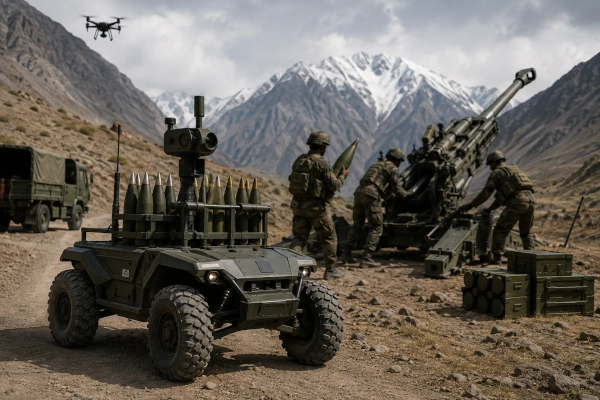
Indian Army Moves to Introduce 4×4 UGVs for Artillery Logistics and Battlefield Mobility

Field artillery formations depend on a continuous supply of shells, propellant charges, fuzes, fuel and other stores. In modern combat, these logistics movements are increasingly vulnerable to reconnaissance drones, loitering munitions and counter-battery fire. A UGV could help carry ammunition and equipment through the final and most dangerous part of the supply route without placing soldiers inside a vehicle.