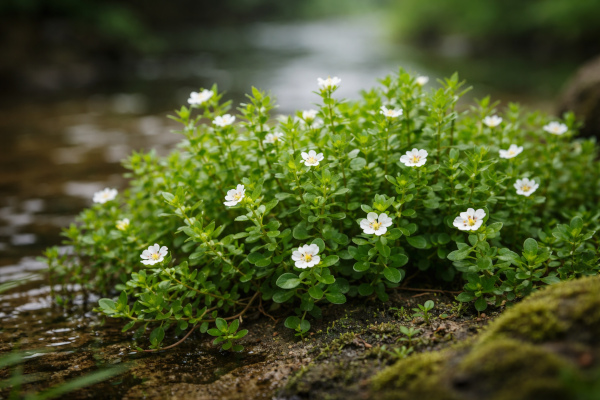
In Indian herbal medicine, few plants are spoken of with as much quiet respect as Brahmi. For generations, it has been associated with sharper memory, steadier nerves, better concentration, and a calmer mind. In modern botanical and medical writing, Brahmi usually refers to Bacopa monnieri, a small creeping marsh herb that has become one of the best-known traditional brain-support plants from India. Its reputation is old, but interest in it is not merely traditional anymore. Over the past few decades, Brahmi has also drawn the attention of pharmacologists, neuroscientists, and clinicians studying cognition, stress, and neuroprotection.
Brahmi does not look dramatic. It is a low-growing, succulent herb with small fleshy leaves and delicate flowers, usually found in damp soil and watery habitats. Yet behind that modest appearance lies a chemically active plant. Modern reviews identify bacosides, a group of triterpenoid saponins, as its best-known active compounds. These are thought to be among the main constituents linked to Brahmi’s traditional and researched effects on memory, learning, and nervous-system support. The plant also contains other phytochemicals, including flavonoids and alkaloids, which may contribute to its broader biological activity.
Brahmi in Ayurveda
In Ayurveda, Brahmi is valued as a medhya rasayana—a rejuvenative herb traditionally associated with the mind and intellect. That phrase matters because it tells us how the herb was understood long before modern supplements existed. Brahmi was not seen merely as a memory trick or an exam herb. It was used to support smriti (memory), medha (intellect), mental clarity, emotional steadiness, and restful sleep. Traditional uses have included support in anxiety, insomnia, mental fatigue, and certain nervous-system conditions. In Ayurvedic thinking, Brahmi is often viewed as cooling, calming, and clarifying rather than stimulating.
That Ayurvedic view is one reason Brahmi has remained culturally important. It is associated not just with “remembering more,” but with a more settled mind. In practical terms, that means the herb has traditionally been used for people who feel mentally overworked, distracted, restless, or emotionally agitated. This older interpretation is interesting because it overlaps, at least partially, with modern research that explores Brahmi’s possible roles in cognition and stress response.
Nutritional Value of Brahmi
Brahmi is better known as a medicinal herb than as a bulk food, but it does have measurable nutritional value. One commonly cited fresh-leaf profile reports that per 100 grams of fresh Brahmi leaves, the plant contains approximately 88.4 g moisture, 2.1 g protein, 0.6 g fat, 5.9 g carbohydrates, 1.05 g fibre, 1.9 g ash, about 38 kcal, 202 mg calcium, and 7.8 mg iron. These values should be treated as approximate rather than universal, because herbal plants can vary with soil, climate, season, and cultivation method.
This nutritional profile shows that Brahmi is not a calorie-dense food, nor is it eaten in large quantities like common leafy vegetables. Its importance lies more in its phytochemical richness and medicinal use than in macronutrient contribution. Even so, the presence of calcium, iron, fibre, and bioactive compounds helps explain why Brahmi has sometimes been discussed as an edible medicinal green in addition to being a classical herb.
What Modern Science Says About Brahmi
Modern scientific interest in Brahmi centers mainly on the brain. A number of reviews and controlled human studies suggest that standardized Bacopa monnieri extracts may help with aspects of memory, learning, information processing, and cognitive performance, especially when taken regularly over several weeks. This point is important: Brahmi is not usually presented in research as a quick stimulant that works instantly. Its reported benefits, when observed, tend to emerge gradually with continued use.
Some human trials have reported improvements in areas such as delayed recall, verbal learning, memory acquisition, and processing speed, particularly in older adults or in people taking standardized extracts in structured study settings. This has helped Brahmi earn a reputation as a possible calming nootropic—a substance that may support mental performance without acting like a harsh stimulant.
Laboratory and animal studies have also made Brahmi scientifically interesting for other reasons. Researchers have explored its possible antioxidant, anti-inflammatory, neuroprotective, and cholinergic effects. Some papers suggest it may help protect nerve cells against oxidative stress and may influence pathways relevant to learning, memory, and neuronal survival. These mechanisms are part of why Brahmi continues to attract attention in research on aging and neurodegeneration.
Can Brahmi Treat Alzheimer’s or Major Brain Disorders?
This is where caution is essential. Although Brahmi has shown promise in preclinical studies and some small clinical work, modern medicine does not consider it a proven treatment for Alzheimer’s disease, dementia, ADHD, depression, or other major neurological disorders. Reviews of the evidence note that while the findings are encouraging, the human data are still limited, and many studies are too small or too variable to support strong disease-treatment claims.
So the fairest medical position is this: Brahmi may be a supportive herb for cognition and mental calmness, but it should not be marketed as a cure. A plant can be genuinely promising without being a miracle. That is probably the most honest place to put Brahmi today.
Brahmi and Mental Well-Being
One reason Brahmi remains attractive in modern wellness discussions is that it sits at the intersection of brain health and stress regulation. Traditional use linked it to calmness, and some modern studies and reviews suggest possible anxiolytic or stress-modulating effects. This does not mean it replaces therapy, psychiatric care, sleep, or medical treatment. But it may help explain why Brahmi has long been used not just for memory, but also for people whose minds feel overdriven and overstimulated.
That older Ayurvedic intuition now feels surprisingly modern. Cognitive health is not just about memory in isolation. It is also shaped by stress, sleep, inflammation, emotional balance, and long-term brain resilience. Brahmi’s appeal lies partly in the fact that it has traditionally been used with that broader mind-body view in mind.
Safety, Side Effects, and Medical Caution
Brahmi is generally considered well tolerated in the amounts used in many studies, but it is not completely side-effect free. Reported adverse effects include nausea, abdominal cramping, diarrhea, increased bowel movements, flatulence, dry mouth, headache, dizziness, and fatigue. In some people, digestive upset appears to be the most common issue.
There is some reassuring safety data as well. The NIH’s LiverTox resource notes that Bacopa monnieri has not been linked to clinically apparent acute liver injury and is considered an unlikely cause of hepatotoxicity based on current evidence. Still, that should not be taken as a license for careless use. Herbal products vary widely in quality, concentration, contamination risk, and standardization. A standardized extract used in a clinical trial is not the same thing as an unknown market powder sold without quality assurance.
People who are pregnant, breastfeeding, taking prescription medicines, managing chronic illness, or considering Brahmi for children or older adults should discuss it with a qualified physician or Ayurvedic practitioner first. That is especially important in health matters involving memory decline, anxiety, seizures, or neurological symptoms, where self-treatment can delay proper diagnosis.
Brahmi in Today’s Health World
What makes Brahmi so enduring is that it has managed to remain relevant in two very different languages. In Ayurveda, it is a mind-supporting rasayana. In modern science, it is a phytochemically active herb with emerging evidence in cognition and neuroprotection. Those are not identical frameworks, but they overlap enough to keep Brahmi firmly in conversation.
A sensible modern view of Brahmi is neither blind faith nor dismissal. It is not magic, and it is not a substitute for medical care. But it is also not just folklore. Brahmi appears to be a meaningful traditional herb with modest nutritional value, biologically active compounds, a long Ayurvedic reputation, and a body of modern research that justifies continued interest. In a world obsessed with instant performance fixes, Brahmi represents something slower and more interesting: the idea that brain health may be supported not by force, but by steady nourishment.
Reference:
NCBI StatPearls on Bacopa monnieri; NCBI LiverTox on Bacopa monnieri; Calabrese et al. on standardized Bacopa extract and cognition; Peth-Nui et al. on 12-week Bacopa use in healthy elderly volunteers; Aguiar and Borowski’s neuropharmacological review; Fatima et al. on pharmacological attributes of Bacopa monnieri; Nemetchek et al. on inflammatory pathways; and The Pharma Innovation Journal on Brahmi’s phytochemicals and nutritional composition.
You may also like
-
Ayurveda on Cold Foods and Iced Drinks: Why Food Temperature Matters for Digestion
-
Serum Institute of India-Manufactured Ebola Vaccine Enters Clinical Trial in Uganda
-
Ayurveda and Hydration: How Much Water Should We Really Drink?
-
Warm Water in Ayurveda: When and Why It Is Recommended
-
Women Make Up 43% of India’s Ayush Workforce as Sector Supports 17.6 Lakh Livelihoods
