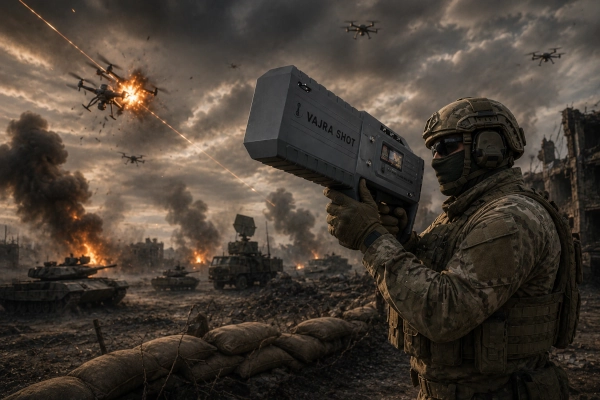
The rapid spread of unmanned aerial systems has changed the economics of modern warfare. Small commercial drones that cost a fraction of a conventional missile can now be used for battlefield reconnaissance, artillery correction, precision attack, weapons delivery, surveillance of military positions and attacks on critical infrastructure. Larger one-way attack drones have added another layer to the problem by allowing an adversary to launch relatively inexpensive aerial threats in numbers large enough to strain conventional air-defence systems. This has created an urgent requirement for counter-drone technologies that can detect, identify, track and neutralise hostile UAVs without forcing armed forces to expend disproportionately expensive interceptors against relatively cheap targets.
Chennai-based Big Bang Boom Solutions, or BBBS, has emerged as one of the Indian companies developing systems for this new category of warfare. Its principal counter-UAS programme, Vajra Sentinel, has been conceived not as a single jammer or radar but as an integrated defensive architecture that combines passive radio-frequency detection, radar surveillance, electro-optical and infrared tracking, artificial-intelligence-assisted classification, electronic countermeasures, command-and-control software and, where required, hard-kill effectors.
The company’s development is particularly relevant to the Make in India programme because Vajra Sentinel progressed through the Indian defence innovation ecosystem from an indigenous prototype into a system ordered for the Indian Army and Indian Air Force. The programme therefore demonstrates how Indian start-ups are beginning to move beyond laboratory demonstrations and defence exhibitions into serial military procurement.
Vajra Sentinel and the Counter-Drone Kill Chain
Countering a hostile drone is considerably more complicated than simply detecting an object in the sky. A modern counter-UAS network must first establish that an aerial object is present, determine whether it is a drone, distinguish it from friendly aircraft or civilian activity, continuously track it and assess whether it represents a threat. Only after these stages can the system decide whether electronic disruption, kinetic interception or another countermeasure represents the most appropriate response.
Vajra Sentinel has therefore been designed around a complete counter-drone engagement chain covering detection, classification, tracking, threat assessment and neutralisation. This approach reflects the larger transformation occurring in air defence, where different sensors and weapons are increasingly integrated through software rather than operating as independent systems.
A passive RF detector may provide the first indication that a drone is operating in the area. Radar can then confirm that a physical aerial object exists at the suspected location. Electro-optical and infrared sensors can provide visual identification and continuous tracking, while the command-and-control system fuses these separate streams of information into a common operational picture. Once the UAV has been classified as hostile, an electronic or kinetic countermeasure can be assigned.
The strength of such an architecture lies in redundancy. No individual sensor is required to solve the entire problem, and the weaknesses of one technology can be compensated for by another.
Passive RF Detection and Electronic Fingerprinting
One of the principal components of Vajra Sentinel is passive radio-frequency detection. Most commercial and tactical drones communicate with their controllers through radio links that carry command signals, telemetry and, in many cases, video. These transmissions create electronic signatures that can potentially be detected before the aircraft itself becomes visually apparent.
A passive RF system does not need to continuously transmit high-power energy in the manner of a conventional radar. It can instead monitor the electromagnetic environment and attempt to identify radio emissions associated with unmanned aircraft. This makes passive sensing particularly useful for installations that wish to maintain a lower electromagnetic signature while still maintaining surveillance.
BBBS has developed AI-assisted RF fingerprinting techniques intended to distinguish drone communications from the large volume of other radio-frequency traffic present in a modern operating environment. This is an important requirement because military bases, urban areas and border regions are saturated with wireless communications. A counter-drone system must therefore do more than detect a radio signal; it must determine whether that signal belongs to a UAV and, where possible, identify the type of aircraft or control link involved.
This capability has become increasingly important because the threat is no longer limited to purpose-built military drones. Commercial UAVs originally designed for photography, mapping or recreation can be adapted for reconnaissance or weapons delivery with relatively minor modifications. Counter-UAS systems must therefore maintain libraries of electronic signatures and be capable of adapting as commercial drone technologies evolve.
Radar as the Second Detection Layer
Passive RF detection alone cannot provide complete protection. Some drones may operate autonomously, limit their transmissions or use communication methods that are difficult to detect. Others may continue toward a target after losing their command link. For this reason, Vajra Sentinel can incorporate radar systems as a complementary sensor layer.
Radar detects the physical presence and movement of an object rather than depending upon the target to transmit radio energy. In a layered architecture, radar can therefore identify UAVs that may not be visible to passive RF sensors. Small drones present a difficult radar target because of their limited radar cross-section, relatively low speed and tendency to operate close to buildings, vegetation or terrain. Counter-UAS radars must consequently be optimised to distinguish them from birds and other clutter.
BBBS has integrated X-band and Ku-band radar options within the broader Vajra architecture. When radar information is fused with passive RF data, the system gains both an electronic and physical indication of the threat, improving the probability of correct identification.
Electro-Optical and Infrared Confirmation
After initial detection, visual and thermal sensors provide an additional layer of confirmation. BBBS has developed Vajra Sight, an electro-optical and infrared surveillance system intended to identify and track UAVs at tactically useful ranges.
Electro-optical cameras provide high-resolution daylight imagery, while thermal sensors allow the system to detect heat emitted by drone motors, batteries and electronics during low-light or night operations. The ability to transition automatically from RF or radar detection to optical tracking is particularly important because it gives the operator a visual means of confirming what the electronic sensors have detected.
The process effectively converts an anonymous radar return or radio transmission into a positively tracked aerial object. This reduces the risk of inappropriate engagement and allows the command system to maintain a more accurate track as the drone moves through the defended airspace.
Sensor Fusion and Artificial Intelligence
A modern counter-drone system may receive information simultaneously from several radars, RF receivers, thermal cameras and daylight sensors. Without automation, this volume of information could overwhelm the human operator, particularly during an attack involving multiple UAVs.
BBBS has therefore placed considerable emphasis on sensor fusion and artificial intelligence within Vajra Sentinel. The command-and-control system combines data from different sensors and attempts to correlate them into individual tracks. AI-based classification can assist in distinguishing drones from birds or other airborne objects and can help identify patterns that indicate a probable hostile threat.
The importance of this capability increases significantly during a swarm or saturation attack. A human operator may be capable of manually following one or two drones, but dozens of simultaneous tracks require machine assistance. Software must prioritise threats, determine which sensors are best positioned to follow each target and allocate appropriate countermeasures.
This transformation is making software increasingly central to air defence. The effectiveness of a counter-drone network is no longer determined only by the range of its radar or the power of its jammer; it also depends on how efficiently the system combines information and makes engagement decisions.
Electronic Warfare as the First Line of Neutralisation
Once a hostile drone has been positively identified, electronic warfare frequently provides the most economical means of neutralising it. BBBS has developed the Vajra Shield family of electronic countermeasures for this purpose.
Many drones depend upon radio links for navigation updates, control instructions or telemetry. They may also rely heavily upon satellite navigation systems such as GPS. Electronic jamming attempts to interfere with these links or navigation signals, potentially causing the UAV to lose control, abandon its mission, return to its launch location or land.
The economic logic behind this approach is important. Conventional surface-to-air missiles can be disproportionately expensive when used against inexpensive quadcopters. A counter-drone system that can electronically disrupt several UAVs without expending a missile offers a much more sustainable defensive option.
However, electronic warfare is not a universal solution. More sophisticated drones may be programmed to continue toward their target after losing communications. Others may use inertial navigation, optical navigation or hardened communications links. For this reason, BBBS has increasingly developed Vajra Sentinel as a layered system capable of integrating both electronic and physical countermeasures.
Hard-Kill Options for Resistant Threats
A complete counter-UAS architecture must be capable of defeating drones that remain functional after electronic attack. BBBS has consequently developed hard-kill elements within the Vajra family, including systems referred to as Vajra Strike and Vajra Slayer.
The purpose of these technologies is not to replace jamming but to complement it. The command-and-control system can select the most appropriate response according to the target. A low-cost commercial drone that depends heavily upon its control link may be defeated electronically, while a larger autonomous attack UAV may require physical destruction.
This layered philosophy mirrors the development of integrated air defence more broadly. Different weapons are used against different classes of threat, allowing the defender to preserve expensive interceptors for targets that genuinely require them.
For India, the ability to integrate soft-kill and hard-kill technologies within a common indigenous command architecture is particularly important because it reduces dependence on imported solutions and allows the system to be continuously modified according to emerging operational requirements.
The ₹200-Crore Indian Army and Air Force Order
The most important milestone in BBBS’s development came when Vajra Sentinel moved from prototype development into large-scale procurement. In 2024, the company secured contracts valued at more than ₹200 crore for the supply of counter-UAS systems to the Indian Army and Indian Air Force.
The procurement represented one of the most significant orders awarded to an Indian defence start-up through the Innovations for Defence Excellence ecosystem. Public reporting indicated that the Army and Air Force were together procuring approximately 50 long-range Vajra Sentinel systems.
This order marked an important transition in Indian defence innovation. BBBS was no longer merely demonstrating an indigenous counter-drone concept; it was being required to manufacture, deliver and support operational systems for the Armed Forces.
Military procurement imposes standards significantly more demanding than those encountered during a technology demonstration. Equipment must function reliably in heat, dust, vibration, electromagnetic interference and prolonged field deployment. It must also be maintainable by military personnel and capable of being transported and repeatedly deployed without loss of performance.
The move from prototype to production therefore represented a major industrial milestone for the company.
Deliveries to the Indian Air Force
By 2025, BBBS announced that it had begun delivering Vajra Sentinel systems to the Indian Air Force following user-acceptance and quality-assurance procedures. The company also expanded its Chennai manufacturing infrastructure to support serial production.
This stage is particularly important because it represents the point at which the Indian defence-start-up model begins to generate actual operational capability. Many companies are capable of producing prototypes, but relatively few succeed in converting a laboratory system into equipment that can be manufactured repeatedly and meet military acceptance requirements.
The Vajra programme demonstrates that domestic counter-UAS technology has begun to cross this threshold.
BBBS has also stated that Vajra Sentinel was operationally deployed during Operation Sindoor in 2025. Detailed public information regarding individual engagements and the precise systems employed remains limited, and the claim should therefore be understood primarily as a company disclosure rather than a comprehensive official Ministry of Defence account. Nevertheless, the programme had already reached Indian Air Force induction by that period, demonstrating that it had advanced well beyond the experimental stage.
The iDEX Pathway
The rise of Big Bang Boom Solutions is closely associated with India’s Innovations for Defence Excellence, or iDEX, initiative. The programme was established to connect the Armed Forces with Indian start-ups, MSMEs and research teams capable of developing technologies for specific military challenges.
Instead of requiring a young company to independently identify a defence market and navigate the entire procurement structure, iDEX allows the Services to define operational problems and invite Indian innovators to propose solutions. Selected companies receive development support and access to military users, trials and testing.
BBBS was among the beneficiaries of this ecosystem and received early grant support while developing its counter-drone technologies. The company has subsequently participated in multiple iDEX challenges across different technological fields.
The value of this model becomes particularly clear in the Vajra Sentinel programme. An operational requirement generated an indigenous development effort; the technology was subsequently tested, refined and ruggedised before receiving a military order. The resulting intellectual property, engineering knowledge and manufacturing capability remain largely within the Indian defence ecosystem.
This represents a deeper form of indigenisation than simply producing a foreign-designed counter-drone system under licence.
Relevance to Border Security
The counter-drone requirement is not confined to conventional military operations. India’s borders are increasingly vulnerable to small UAVs used for surveillance, smuggling and delivery of weapons or contraband.
BBBS has therefore also participated in government programmes addressing counter-drone requirements for border security. The company was shortlisted under the BHUMI challenge, which sought technologies capable of addressing operational problems faced by the Border Security Force.
The importance of such systems is particularly evident along borders where commercial drones can cross terrain that would otherwise be difficult to penetrate. A UAV requires neither a road nor an established infiltration route, and a small aircraft can carry cameras, communications equipment or payloads over physical barriers.
Counter-UAS technology is therefore becoming an integral component of modern border surveillance alongside fences, ground sensors, cameras and patrol forces.
Beyond Counter-Drone Systems
Although Vajra Sentinel has become the company’s most prominent defence programme, BBBS has developed a broader portfolio of technologies spanning autonomous systems, artificial intelligence, electronic warfare and material science.
One such programme is Yudhikshana, a situational-awareness system intended for armoured fighting vehicles. Multiple electro-optical and infrared cameras are positioned around the vehicle to provide a continuous external view, which can then be presented through wearable or mixed-reality displays. The system is intended to improve crew awareness without requiring personnel to expose themselves through hatches or rely exclusively upon traditional observation ports.
Artificial intelligence can also assist in identifying potential threats within the camera feeds. The underlying concept closely parallels the architecture employed in Vajra Sentinel: multiple sensors generate information, software fuses the data and the crew receives a simplified operational picture.
The company has also developed the Thermal Intervention Caged Drone, intended for operation in confined or GPS-denied environments. A protective cage allows the aircraft to operate close to walls, obstacles or structures while thermal imaging provides visibility in smoke or darkness. Such a platform has potential military, firefighting and disaster-response applications.
Another BBBS technology, Cnidaria Aqua Tether, explores a different area of maritime security by using specialised materials to interfere with the propulsion systems of vessels. The company has also worked on Agni Quell, a firefighting material system, and PRAVICI, an artificial-intelligence-driven open-source intelligence platform.
These programmes show that the company is evolving beyond a narrow counter-drone specialisation toward a broader deep-tech defence portfolio.
Why Counter-Drone Warfare Has Become Strategically Important
The rapid expansion of drone warfare has exposed a structural weakness in conventional air defence. Traditional systems were designed primarily to defeat aircraft, helicopters and missiles whose cost and performance justified the use of sophisticated interceptors.
Small drones have disrupted this calculation.
An adversary can launch dozens of inexpensive UAVs and force the defender either to expend expensive missiles or accept the possibility that some drones will penetrate the defensive screen. The attacker may therefore achieve a strategic effect even when many drones are destroyed.
The answer is a layered counter-UAS architecture with different defensive mechanisms for different types of threat. Passive sensors provide low-cost surveillance. Electronic warfare can defeat drones that remain dependent upon control or navigation links. Guns, specialised interceptors and other hard-kill systems can deal with targets that survive jamming. Conventional air-defence missiles remain available for larger or faster aerial threats.
The decisive factor is integration. A radar, jammer and camera operating separately create several disconnected systems. When they are linked through a common command-and-control architecture, they become an integrated defensive network capable of responding according to the nature of the threat.
The Strategic Importance of Indigenous Software
Indigenous ownership of the software and signal-processing architecture may ultimately be as important as manufacturing the physical counter-drone hardware in India.
Drone technology evolves extraordinarily quickly. Commercial manufacturers introduce new communication protocols, frequencies, navigation techniques and levels of autonomy every year. Military users modify commercially available systems, while more sophisticated adversaries deliberately attempt to defeat known jamming and detection methods.
A counter-drone system must therefore evolve continuously.
If the core technology is foreign, India may remain dependent on an overseas supplier for software updates and modifications. If the algorithms, signal libraries, command software and electronic-warfare architecture are controlled domestically, Indian engineers can respond more rapidly to new threats encountered by the Armed Forces.
This makes counter-UAS indigenisation fundamentally different from simply replacing an imported airframe with an Indian-manufactured equivalent. The critical capability lies in controlling the knowledge required to modify the system when the threat itself changes.
Chennai and the Growth of an Indian Defence-Technology Cluster
BBBS operates from Chennai, placing it within the broader defence and aerospace ecosystem developing in Tamil Nadu. The state forms part of India’s Defence Industrial Corridor initiative and is increasingly home to companies working in unmanned systems, electronic warfare, electro-optics, aerospace manufacturing and defence electronics.
The development of specialised testing infrastructure in the region is equally important. India has been expanding facilities for unmanned aircraft, electronic warfare and electro-optical systems, allowing indigenous companies to test increasingly complex defence technologies within the country.
A sustainable defence-industrial ecosystem requires more than individual manufacturers. It needs testing facilities, specialist suppliers, engineers, research institutions, military users and a procurement system capable of converting successful technology into orders. The growth of such clusters can reduce development time and help Indian companies move more quickly from prototypes to operational products.
From Start-Up Innovation to Military Capability
Big Bang Boom Solutions represents the larger transformation now taking place within India’s defence sector. The country’s indigenisation programme is no longer limited to large public-sector projects involving aircraft, warships, missiles and armoured vehicles. A growing portion of future military capability will be determined by smaller companies specialising in sensors, algorithms, autonomous systems, communications and electronic warfare.
Vajra Sentinel is particularly significant because it addresses a threat that has become central to contemporary warfare. Small drones are proliferating far more quickly than traditional air-defence systems can economically counter them, creating an urgent requirement for scalable defensive technologies.
BBBS has responded by building an architecture that attempts to combine the complete counter-UAS chain within an Indian-developed system. Passive radio-frequency sensors search the electromagnetic spectrum, radar detects the physical aircraft, electro-optical and infrared systems provide identification and tracking, artificial intelligence assists classification and command software coordinates electronic or physical neutralisation.
This represents a transition from manufacturing isolated defence products to creating integrated battlefield systems.
The importance of the company to Make in India therefore lies not merely in the fact that Vajra Sentinel is produced domestically. It lies in the accumulation within India of the engineering expertise required to detect, classify and defeat rapidly evolving unmanned threats.
As drone warfare becomes increasingly dominant, the countries that succeed will not simply be those capable of building drones in large numbers. They will also be those capable of defending their forces, installations and infrastructure against them at sustainable cost.
With Vajra Sentinel and its expanding portfolio of autonomous, electronic-warfare and sensor technologies, Big Bang Boom Solutions is contributing to the emergence of an indigenous Indian counter-drone ecosystem capable of addressing one of the defining defence challenges of the coming decade.
You may also like
-
GeM’s AABHAR Collection Showcases 294 Indigenous Products, Strengthens Market Access for Indian Artisans
-
Balaghat Chinnor Rice of Madhya Pradesh: The Fragrant Heritage Grain with GI Recognition
-
Indian Semiconductor Companies Propose New Manufacturing and Chip Design Investments in Madhya Pradesh
-
CSIR-CRRI Partners with Industry to Develop Advanced Indigenous Airport Runway and Pavement Materials
-
Paras Semiconductors Secures 43 Acres in Madhya Pradesh for Proposed ₹6,200 Crore Advanced Chip Packaging Facility
