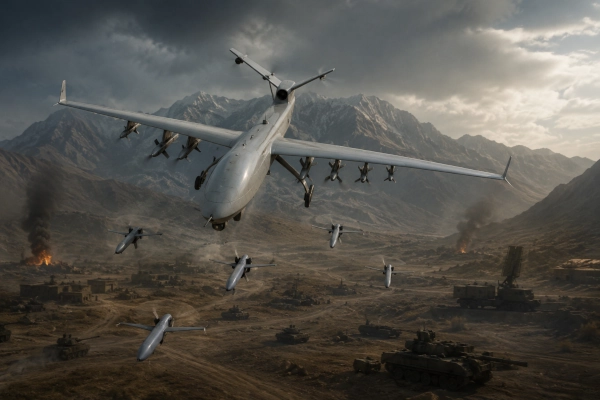
Indian unmanned-systems developer EndureAir Systems has revealed VAHAK-6, a new multi-UAV mothership concept intended to take multiple smaller drones forward aboard a larger unmanned aerial platform before deploying them closer to the mission area. The development represents an important step in India’s emerging approach to collaborative drone warfare, where different classes of unmanned aircraft operate together rather than functioning as independent platforms.
EndureAir began publicly teasing VAHAK-6 on August 21, 2026, before confirming that the new system was on its way. The company has not yet released a complete technical specification for VAHAK-6, including its operational radius, deployment altitude, communications architecture or the exact configuration of the six carried UAVs. However, the concept points toward a carrier-and-deployed-drone architecture in which a larger UAV provides transport, reach and potentially communications support for a group of smaller aircraft.
The timing of the reveal is significant because EndureAir has simultaneously been highlighting the evolution of its ALAKH family into a kamikaze or loitering-munition system. In a company update immediately preceding the VAHAK-6 announcement, EndureAir showed rows of ALAKH systems in production and described the platform as a loitering munition capable of travelling to a designated area, remaining airborne while identifying an intended target and carrying out a precision strike when commanded. The company also emphasised coordinated formations and operation at scale, indicating that ALAKH is being developed with multi-drone employment firmly in mind.
That makes a mothership architecture particularly relevant. Small strike drones offer advantages in cost, numbers and their ability to approach targets from multiple directions, but their compact size inevitably limits the amount of energy they can carry for propulsion, sensors and communications. A larger carrier UAV can potentially overcome part of this limitation by transporting several smaller systems through the initial portion of a mission before releasing them. In military terms, this could allow the smaller aircraft to preserve their own endurance for the terminal phase of an operation.
Such an arrangement could also greatly increase the area from which small unmanned systems can be employed. Instead of requiring individual launch teams to move close to the forward edge, a larger UAV could carry multiple deployable drones across difficult terrain or toward a designated release point. Once separated from the carrier, the smaller systems could disperse toward different objectives, conduct reconnaissance, observe a target area or, where configured as loitering munitions, prosecute individual targets.
EndureAir already possesses platforms suitable for building such a layered unmanned ecosystem. Its SABAL family uses a tandem-rotor unmanned-helicopter configuration designed primarily for logistics and demanding high-altitude missions. EndureAir says the design uses variable-pitch electric propulsion, can operate beyond visual line of sight and supports automated cargo delivery as well as surveillance and reconnaissance payloads. The company previously supplied the SABAL-20 to the Indian Army’s Eastern Command.
The smaller ALAKH platform occupies the opposite end of the company’s UAV portfolio. EndureAir describes its standard ALAKH as a compact FPV UAV intended for short-range surveillance, operations inside confined spaces and missions where larger aircraft cannot safely enter. The platform is lightweight, backpackable and capable of autonomous flight, while variants are now being developed for more specialised military roles. The recent disclosure of an ALAKH kamikaze version demonstrates how the same compact-UAV family is expanding beyond reconnaissance into offensive missions.
VAHAK-6 therefore appears to bring together two strands of EndureAir’s development work: larger high-altitude aerial platforms capable of transporting useful payloads and smaller UAVs designed to operate near the objective. Instead of viewing the carrier UAV simply as a logistics vehicle carrying ammunition or supplies, the mothership concept treats the smaller unmanned aircraft themselves as the payload.
The approach is increasingly relevant to modern warfare. Battlefield experience around the world has demonstrated the value of deploying large numbers of comparatively inexpensive unmanned systems against dispersed targets. A mothership can potentially extend that concept by moving multiple drones together over significant distances and releasing them only when necessary. This reduces dependence on numerous forward launch positions while allowing operators to generate several airborne systems from a single carrier mission.
A six-UAV load also opens the possibility of missions involving cooperative behaviour. The released aircraft could theoretically divide an area for reconnaissance, approach a defended position from different directions or assign individual drones to separate targets. More sophisticated versions could eventually use onboard autonomy to redistribute tasks if one aircraft is lost or communications are interrupted. EndureAir has itself recently been highlighting swarm operations and cooperative unmanned systems as an important area in the future of military drone technology.
The concept could be especially valuable in mountainous environments, where India faces unusually demanding operational conditions. Moving personnel and equipment across high-altitude terrain is difficult, and line-of-sight communications can be obstructed by ridgelines and valleys. EndureAir’s existing emphasis on high-altitude UAVs gives the company a relevant technological foundation for developing carrier systems intended for such regions. Its SABAL platforms use rotorcraft-derived technology specifically designed to retain useful lifting performance in thin air and difficult terrain.
The VAHAK-6 announcement also comes against the backdrop of EndureAir’s established relationship with Bharat Electronics Limited (BEL). A September 2025 investment announcement from IAN Alpha Fund stated that EndureAir was co-developing high-altitude logistics drones with BEL. EndureAir’s own website also lists BEL among organisations using or working with its UAV platforms. This cooperation gives the company access to an important Indian defence-electronics ecosystem covering communications, electro-optical systems, sensors and command-and-control technologies.
It is important, however, to distinguish the confirmed BEL-EndureAir cooperation from details that have not yet been formally disclosed for VAHAK-6. Neither company has so far published a full statement identifying BEL’s exact workshare on the newly revealed mothership system. Claims regarding specific BEL communications equipment, sensors, electronic-warfare payloads or command networks aboard VAHAK-6 should therefore await an official technical disclosure.
EndureAir itself has grown from UAV research originating at IIT Kanpur into one of India’s increasingly visible indigenous unmanned-aircraft developers. The company was founded in 2018 and says its aircraft, flight-control software and associated technologies are developed in-house. Its systems have been used by the Indian Army and government agencies, while its portfolio now stretches from micro UAVs such as ALAKH to the SABAL logistics family and much larger heavy-lift concepts.
The company is also scaling upward. In June 2026, EndureAir announced ₹30 crore in Research, Development and Innovation funding for its SABAL-200 heavy-lift UAV, a planned platform designed to carry more than 200 kg across difficult and high-altitude terrain. EndureAir has stated a target endurance of around 2.5 hours and an operational range of about 200 km for that system, illustrating how rapidly its unmanned-helicopter technology is moving into larger payload classes.
VAHAK-6 may consequently be more important than the appearance of another individual drone. It represents movement toward an unmanned system-of-systems, in which large and small UAVs cooperate across different phases of the same mission. A carrier can provide reach and payload capacity, while smaller expendable or recoverable aircraft provide distributed sensing, reconnaissance or strike capability near the objective.
For the Indian Armed Forces, systems of this kind could eventually offer new options for operations along mountainous borders, against dispersed tactical targets and in areas where sending manned aircraft or ground teams would carry greater risk. They could also support reconnaissance and electronic-surveillance missions if small specialised payload UAVs are integrated alongside strike variants.
Much will depend on the technical architecture eventually disclosed by EndureAir, particularly the method used to carry and release the six UAVs, the degree of autonomy available after deployment, communications between the carrier and daughter aircraft, resistance to electronic warfare and whether the mothership remains airborne as a relay or command node after launch.
Even at this early stage, however, VAHAK-6 signals a clear shift in India’s indigenous drone industry from building individual UAV platforms toward developing coordinated families of unmanned systems. With EndureAir simultaneously expanding its high-altitude logistics aircraft, ALAKH loitering-munition family and cooperation with BEL, the company is assembling many of the technologies required for more complex collaborative unmanned operations.
You may also like
-
Defence Acquisition Council Clears ₹2.12 Lakh Crore Proposals, 82% Earmarked for Indian Industry
-
Manastu Space Secures ₹116 Crore Government Support to Develop Indigenous Green Propulsion Systems
-
GeM’s AABHAR Collection Showcases 294 Indigenous Products, Strengthens Market Access for Indian Artisans
-
Indian Semiconductor Companies Propose New Manufacturing and Chip Design Investments in Madhya Pradesh
-
CSIR-CRRI Partners with Industry to Develop Advanced Indigenous Airport Runway and Pavement Materials
