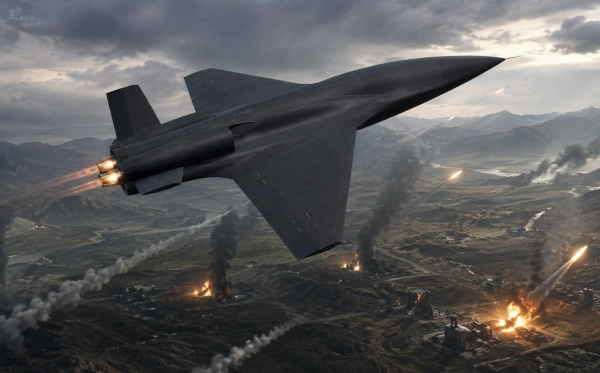
Bengaluru-based defence technology company Flying Wedge Defence & Aerospace (FWDA) has unveiled the FWD Supreme, an indigenous artificial intelligence-driven combat aircraft prototype, marking an important development in India’s emerging autonomous military aviation industry. The company presented the aircraft in New Delhi on October 13, 2026, as part of its programme to develop a family of AI-piloted combat aircraft for future military applications.
The FWD Supreme programme aims to develop unmanned combat aircraft capable of conducting missions through advanced artificial intelligence, autonomous navigation and coordinated operations. Its proposed capabilities include intelligence gathering, surveillance, reconnaissance, strike missions and collaborative combat operations involving multiple aircraft.
The October 13 unveiling represents progress in the company’s transition from aircraft design and digital engineering to physical prototype development. FWDA is also developing a smaller technology demonstrator, FWD Supreme Lite, which the company says has completed taxi trials and is preparing for its maiden flight.
Founded by Suhas Tejaskanda, Flying Wedge Defence is pursuing an indigenous approach to autonomous combat aviation. The programme combines advanced aircraft engineering, artificial intelligence and networked operations with the objective of developing technologically capable and economically sustainable unmanned military platforms.
FWD Supreme Introduces Indigenous AI-Piloted Combat Aircraft Development
Flying Wedge Defence’s FWD Supreme programme represents the company’s efforts to develop a new generation of combat aircraft capable of operating without an onboard pilot.
Unlike conventional remotely piloted drones, which depend extensively on operators controlling their movements and missions, AI-piloted aircraft are designed to perform greater portions of their operations autonomously. Advanced onboard computing systems can process information from sensors, assist with navigation and support mission execution within defined operational parameters.
The development of such systems requires the integration of aircraft engineering, propulsion, flight-control technologies, sensors, computing hardware and sophisticated software.
FWDA’s programme seeks to bring these capabilities together within an indigenous aircraft development platform. The company envisages a family of unmanned combat aircraft capable of undertaking different missions while sharing common technological foundations.
The unveiling of the FWD Supreme prototype demonstrates the company’s progress in developing the physical aircraft configuration associated with its autonomous aviation programme.
FWD Supreme Features Flying-Wing Aircraft Design
The FWD Supreme is being developed around a flying-wing configuration, an aircraft design in which the wings and central body form a largely continuous aerodynamic structure.
Flying-wing designs can offer aerodynamic advantages by reducing drag and improving efficiency. They can also support low-observable aircraft configurations when combined with suitable materials, structural design and other technologies.
According to the technical specifications presented by Flying Wedge Defence, the initial FWD Supreme configuration measures approximately 10 metres in length and 10 metres in wingspan.
The proposed aircraft has a maximum take-off weight exceeding 1,500 kilograms and a payload capacity of approximately 350 kilograms.
The design incorporates an internal weapons bay, reflecting its intended role as an unmanned combat aircraft rather than a conventional surveillance drone.
The company is developing the aircraft for autonomous missions involving surveillance, reconnaissance and strike capabilities. Its flying-wing configuration provides a foundation for integrating the aerodynamic, structural and mission systems required for these applications.
Aircraft Designed for Speeds Approaching Mach 0.85
Flying Wedge Defence has outlined ambitious performance objectives for the initial phase of the FWD Supreme programme.
According to the company’s stated design specifications, the aircraft is intended to achieve a maximum speed between Mach 0.8 and Mach 0.85, placing it in the high-subsonic flight category.
Its planned cruising speed is approximately 500–600 kilometres per hour, while the proposed operational range exceeds 1,500 kilometres.
The aircraft is designed for an endurance of more than two hours, depending on its mission configuration and operating conditions.
FWDA has identified a propulsion requirement of approximately 5 kilonewtons of thrust for the proposed aircraft.
These specifications describe the performance objectives of the development programme. The October 13 unveiling involved a static prototype, with flight testing and performance validation forming subsequent stages of development.
The proposed combination of speed, range and payload capacity reflects the company’s intention to develop an unmanned aircraft capable of carrying out more demanding missions than smaller conventional drones.
FWD Supreme Lite Advances Towards Maiden Flight
An important part of the development programme is the FWD Supreme Lite, a smaller aircraft intended to serve as a technology demonstrator.
Flying Wedge Defence is using the lighter platform to advance the development of technologies required for its larger autonomous combat aircraft.
The company reported on October 13 that FWD Supreme Lite had completed taxi trials and was being prepared for its first flight.
Taxi trials are an important stage of aircraft development because they allow engineers to evaluate systems while the aircraft moves on the ground. These activities can help assess propulsion integration, steering, braking, ground handling and other functions before flight testing.
FWD Supreme Lite is intended to help validate technologies associated with autonomous flight, aircraft control and onboard systems.
Experience gained from the demonstrator can contribute to the engineering development of larger aircraft in the FWD Supreme family.
The programme therefore follows a progressive approach in which smaller experimental platforms support the development of more advanced unmanned aircraft.
Artificial Intelligence Forms the Core of the Programme
Artificial intelligence is central to Flying Wedge Defence’s proposed approach to combat aircraft development.
The company aims to develop aircraft capable of using onboard computing systems to process sensor information, navigate autonomously and coordinate mission-related activities.
Such capabilities differ from conventional drone operations, where human operators may need to provide continuous control inputs.
AI-enabled flight systems can potentially manage selected navigation and flight-control functions while responding to changing environmental and operational conditions.
Developing reliable autonomous aircraft requires sophisticated software engineering, sensor integration and extensive testing. Aircraft must interpret information accurately while maintaining stable and predictable flight characteristics.
Flying Wedge Defence’s programme is intended to advance these capabilities through the development of indigenous aircraft platforms and associated software systems.
The company’s work reflects the increasing importance of artificial intelligence in aviation research, particularly in areas involving autonomous navigation and collaboration between multiple unmanned platforms.
Flying Wedge Develops Its Mobbing Doctrine for Coordinated AI Aircraft
A distinctive feature of the FWD Supreme programme is Flying Wedge Defence’s proposed Mobbing Doctrine, which involves the coordinated operation of multiple AI-piloted aircraft.
The concept envisages autonomous aircraft working together as a networked force rather than operating exclusively as individual platforms.
Under the proposed approach, aircraft would exchange information and coordinate their activities to support common mission objectives.
This concept is intended to make use of distributed sensing, networked computing and coordinated autonomous operations.
Founder and Chief Executive Officer Suhas Tejaskanda has described the programme as an effort to develop a family of indigenous aircraft that balances technological capability with affordability.
The company’s approach places emphasis on the development of multiple autonomous platforms that can operate collectively while reducing reliance on a small number of expensive aircraft.
Such concepts are attracting increasing attention within the international aerospace industry as defence manufacturers explore the potential of collaborative combat aircraft and unmanned systems operating alongside conventional military aviation platforms.
Autonomous Aircraft Could Complement Manned Combat Platforms
The development of AI-enabled combat aircraft is part of a wider technological shift towards combining conventional military aircraft with autonomous and remotely operated systems.
Unmanned aircraft can potentially support missions involving reconnaissance, surveillance, electronic sensing and other specialised operations.
Their capabilities may allow military forces to deploy additional platforms while reducing the requirement for onboard aircrew during selected missions.
Future collaborative aircraft concepts also involve coordination between manned and unmanned platforms, allowing different aircraft to contribute complementary capabilities.
Achieving these objectives requires reliable communications, navigation systems, sensor integration and software capable of operating under demanding conditions.
FWD Supreme is being developed within this emerging category of autonomous aviation.
The programme contributes to India’s private-sector research into technologies that could support future military aircraft development and advanced aerospace manufacturing.
Flying Wedge Plans Indigenous Aerospace Development Through Operation Triple Seven
Alongside the unveiling of FWD Supreme, Flying Wedge Defence outlined plans for an international development and manufacturing initiative called Operation Triple Seven.
The company intends to involve foreign partners in an India-led programme supporting the development of advanced autonomous combat aircraft.
The initiative reflects FWDA’s objective of combining domestic aerospace capabilities with international technological cooperation.
Advanced aircraft development requires expertise in several demanding engineering fields, including aerodynamics, propulsion, structural design, avionics and flight-control systems.
Collaboration between specialised technology companies can support the integration of these capabilities into a common aircraft development programme.
Flying Wedge Defence’s proposed approach places Indian technological development and manufacturing at the centre of its long-term aerospace plans.
The initiative also reflects the growing ambitions of Indian private-sector companies to participate in advanced military aviation programmes.
Ministry of Defence Official Attends FWD Supreme Unveiling
The October 13 unveiling in New Delhi was attended by A. Anbarasu, Additional Secretary and Director General (Acquisition) in the Ministry of Defence.
During the event, Anbarasu congratulated Flying Wedge Defence on its aircraft development initiative and highlighted the growing capabilities of India’s domestic defence manufacturing ecosystem.
He emphasised the importance of strengthening indigenous technological development and innovation in response to changing defence requirements.
The Ministry of Defence official also referred to the importance of jointness, Aatmanirbharta and innovation in India’s defence development strategy.
The event reflected the increasing visibility of Indian private-sector companies developing advanced aerospace technologies.
The participation of a senior defence acquisition official highlighted the broader importance attached to indigenous innovation and the expansion of India’s defence industrial capabilities.
Flying Wedge Builds on Its Experience in Indigenous Unmanned Aircraft
Flying Wedge Defence has been developing unmanned aircraft and associated technologies from its Bengaluru operations.
Its product portfolio includes the Kaal Bhairav family of autonomous aircraft, compact loitering munitions and unmanned aerial interceptors.
The company’s Kaal Bhairav platforms are designed for missions involving reconnaissance, surveillance and other unmanned aviation applications.
FWDA has also developed Yama, an unmanned interceptor intended for counter-drone operations.
These projects provide a technological background for the company’s expansion into larger autonomous aircraft.
Experience in flight-control systems, navigation, aircraft structures and unmanned operations can support the development of more complex aerospace platforms.
The FWD Supreme programme represents an important expansion of the company’s ambitions, moving from conventional unmanned systems towards high-performance AI-piloted combat aircraft.
Indigenous AI Combat Aircraft Development Supports Aatmanirbhar Bharat
The development of FWD Supreme reflects growing private-sector participation in India’s advanced defence technology ecosystem.
India has been encouraging indigenous research, manufacturing and technological innovation in defence through initiatives aimed at expanding domestic industrial capabilities.
Autonomous aircraft development is particularly relevant because it combines several high-technology disciplines, including artificial intelligence, aerodynamics, propulsion, sensors and aerospace electronics.
The development of indigenous expertise in these areas can support a wider industrial ecosystem involving engineering companies, research institutions, component manufacturers and specialised software developers.
Flying Wedge Defence’s programme also demonstrates the increasing ambitions of Indian defence startups seeking to develop advanced technologies rather than relying exclusively on licensed manufacturing or component production.
By pursuing indigenous aircraft development, the company is contributing to the expansion of India’s private aerospace research and manufacturing capabilities.
FWD Supreme Marks Progress in India’s Autonomous Military Aviation Development
The unveiling of FWD Supreme on October 13, 2026, marks a significant development in Flying Wedge Defence & Aerospace’s efforts to build an indigenous AI-piloted combat aircraft family.
The programme combines a flying-wing aircraft configuration with planned autonomous navigation, advanced flight control and coordinated multi-aircraft operations.
Its proposed technical specifications include a high-subsonic speed capability, a payload capacity of approximately 350 kilograms and a range exceeding 1,500 kilometres.
The parallel development of FWD Supreme Lite provides a practical platform for evaluating technologies required for the larger aircraft. The company’s announcement that the lighter demonstrator has completed taxi trials represents progress towards its planned maiden flight.
Through FWD Supreme and Operation Triple Seven, Flying Wedge Defence is pursuing a larger role for Indian engineering and manufacturing in the development of next-generation autonomous aircraft.
The FWD Supreme prototype highlights the increasing capabilities and ambitions of India’s private defence technology sector. As the programme progresses through flight testing and further engineering development, it will contribute to the country’s growing expertise in artificial intelligence, autonomous aviation and advanced indigenous aerospace manufacturing.
References
1. Flying Wedge Defence & Aerospace — Official Company Website
Company information on indigenous autonomous aircraft, defence technologies and aerospace development.
https://www.fwdefence.com/
2. Flying Wedge Defence & Aerospace — Official Company Announcement
FWD Supreme AI-Piloted Fighter Jet Programme: Physical Technology Demonstrator and Mobbing Doctrine
Official company LinkedIn publication.
https://www.linkedin.com/posts/flying-wedge-defence-aerospace_fwdsupreme-flyingwedge-aipilotedfighterjet-activity-7496218768399011840-rt6v/
3. India Sentinels
Flying Wedge Defence Unveils FWD Supreme, Outlines Plans for AI-Piloted Aircraft Family
Published: October 13, 2026.
https://www.indiasentinels.com/defence-industry/private/flying-wedge-defence-unveils-fwd-supreme-outlines-plans-for-ai-piloted-aircraft-family-7645
4. Outlook India
India Enters the AI Fighter Race with Flying Wedge’s FWD Supreme Programme
Published: October 13, 2026.
https://www.outlookindia.com/national/india-enters-the-ai-fighter-race-with-flying-wedges-fwd-supreme-programme
You may also like
-
Indian Army’s Assam Regiment Wins Gold at Cambrian Patrol 2026 in UK, Excelling Among 140 International Entries
-
GE Aerospace to Double India Supply Chain Spending to $400 Million by 2030, Strengthening Indigenous Manufacturing
-
India Emerges as a Global Hub for Multinational Military Exercises, Bridging Diverse Defence Partnerships
-
India, Brazil and South Africa Strengthen Maritime Security Cooperation Through IBSAMAR IX Naval Exercise
-
India Establishes First High-Altitude Health Research Centre in Himachal Pradesh
