Kautilya

Antelopus Selan Energy Wins Two Onshore Oil and Gas Blocks in KG and Cambay Basins

The two contract areas are located in the Krishna-Godavari Basin in Andhra Pradesh and the Cambay Basin in Gujarat. The Directorate General of Hydrocarbons (DGH), operating under the Ministry of Petroleum and Natural Gas, communicated the award to the company through a letter dated August 31, 2026, according to Antelopus Selan Energy’s September 1 stock-exchange disclosure.

Indian Navy Seeks Indigenous C- and Ku-Band SATCOM Terminals for GSAT-7R-Enabled Network-Centric Warfare

The Navy has floated an Expression of Interest under the Make-II procurement framework for the development of indigenous C-band and Ku-band SATCOM terminals for warships. The programme is intended to reduce dependence on imported communication hardware while providing Indian naval platforms with more secure and resilient long-range connectivity.

Hical Delivers Indigenous Coreless BLDC Motor for Precision Satellite Attitude-Control Systems

At the heart of such a system is a highly precise electric motor. Hical’s new design employs a coreless BLDC architecture, eliminating the iron core normally found in many conventional motors. One of its most important advantages is the elimination of magnetic cogging, the small variations in torque that occur as magnetic components inside a conventional motor interact during rotation.

India’s izmo Microsystems Develops Indigenous 40-GHz RF Semiconductor Package for Defence Systems

The company announced on September 1, 2026 that the new Quad Flat No-Lead, or QFN, package was designed, developed and manufactured in India for a customer producing high-frequency RF modules for defence and secure wireless communication applications. Assembly and electrical validation have been completed, while production shipments have already begun.

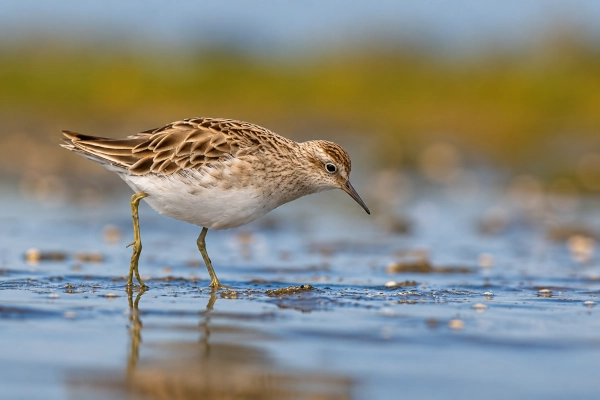
Rare Siberian Sharp-Tailed Sandpiper Recorded at Najafgarh

The bird was photographed on August 30, 2026, by NCR-based conservationist and birder Akshit Dua, who observed it actively feeding in shallow wetland habitat alongside Common Sandpipers and Wood Sandpipers. The identification was based on a combination of features including its prominent pale supercilium, rufous-streaked crown, eye-ring, rusty-brown scalloped upperparts and diffuse breast markings.