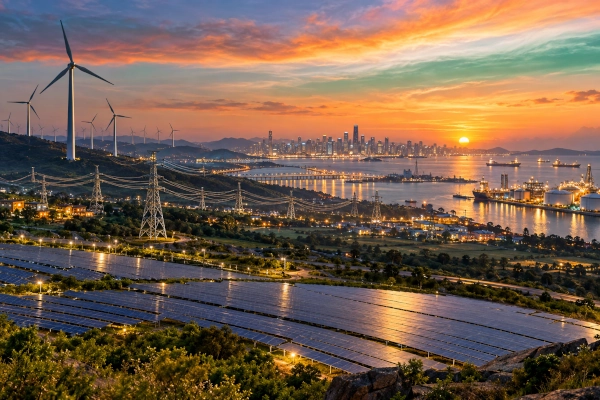
Australian Prime Minister Anthony Albanese has drawn international attention to the scale of India’s expansion of energy access, crediting Prime Minister Narendra Modi for extending energy availability to a vast section of the Indian population over the past decade.
Speaking at an Asia Society Policy Institute event on September 26, 2026, Albanese described the expansion in unusually strong terms, saying that more people had been given access to energy in India under Modi than in any decade, region or country “in all of human history.”
The statement was Albanese’s assessment of the scale of India’s transformation rather than an independently established historical ranking. Official Indian data, however, shows that the country has undertaken one of the world’s largest programmes of household electrification while simultaneously expanding electricity generation, renewable energy, cooking-fuel access and the geographical diversity of its energy imports.
India Connected 2.86 Crore Households Under Saubhagya
A central element of India’s household electrification drive was the Pradhan Mantri Sahaj Bijli Har Ghar Yojana — Saubhagya, launched in October 2017 to provide electricity connections to willing un-electrified households in rural India and willing poor households in urban areas.
The Ministry of Power records that approximately 2.86 crore households were electrified nationally during the Saubhagya period. The scale of the programme involved extending electricity connections across cities, villages and remote areas where conventional grid connectivity had previously been unavailable or difficult to provide.
By March 2021, participating states had reported electrification of all willing households identified under the programme, while additional households were subsequently connected under associated electrification initiatives. The original Saubhagya programme has since closed, while the government continues to support connections for eligible left-out and newly identified households through the Revamped Distribution Sector Scheme.
The figures provide important context to Albanese’s remarks. Rather than representing only an increase in electricity generation, India’s energy-access programme involved physically extending connections to tens of millions of individual households.
Energy Access Expanded Alongside a Much Larger Power System
Household electrification has taken place alongside a major expansion of India’s electricity system.
By September 2026, the Ministry of Power reported that India’s installed electricity generation capacity had reached approximately 552 GW, with more than half of the country’s installed capacity coming from non-fossil-fuel sources.
India has simultaneously been expanding solar power, wind energy, hydroelectric generation, nuclear energy and transmission infrastructure as electricity demand rises across residential, industrial, agricultural and transportation sectors.
This expansion is increasingly important because India’s next phase of energy growth is not simply about connecting households. Rising incomes, urbanisation, industrialisation, data centres, electric mobility, manufacturing and digital infrastructure are steadily increasing the amount of electricity consumed by connected households and businesses.
India’s Energy Security Strategy Has Also Changed
Albanese’s remarks come at a time when global energy security has again become a major international concern following disruptions affecting West Asian energy markets and maritime trade routes.
India remains dependent on international markets for a significant proportion of its crude oil and natural gas requirements. The government has therefore increasingly focused on diversifying the countries from which it purchases energy.
In remarks to Parliament on March 24, 2026, Prime Minister Narendra Modi stated that India had previously imported crude oil, LNG and LPG from 27 countries, compared with 41 countries after the government’s diversification efforts. The Prime Minister’s Office said reducing excessive dependence on any single energy source had become an important component of India’s energy-security strategy.
The diversification gives Indian refiners and energy companies access to a broader network of suppliers at a time when geopolitical conflicts, sanctions, shipping disruptions and changes in international energy prices can rapidly affect individual supply routes.
Strategic Petroleum Reserves Add Another Layer of Security
India has also expanded its ability to hold crude oil for emergencies.
According to the Prime Minister’s March 2026 statement to Parliament, India had developed more than 5.3 million metric tonnes of strategic petroleum reserve capacity, with further arrangements being pursued to increase the country’s emergency storage capability beyond 6.5 million metric tonnes.
These strategic stocks operate alongside commercial inventories maintained by Indian oil companies. Refining capacity has also expanded, strengthening India’s ability to process imported crude oil and supply petroleum products to the domestic market.
Diversification of suppliers, strategic reserves, domestic refining and the expansion of renewable energy consequently form different parts of the same broader Indian energy-security strategy.
From Electricity Connections to Clean Cooking and Gas Networks
India’s expansion of energy access extends beyond conventional household electricity.
The country has also expanded access to LPG cooking fuel, city gas distribution and natural gas infrastructure while pursuing a larger transition towards cleaner energy sources. The development of electricity transmission and distribution networks has brought millions of previously unconnected households into the formal electricity system.
At the same time, new energy infrastructure is increasingly being designed around future demand. At India Energy Week 2026, Prime Minister Modi highlighted India’s growing LNG requirements and the expansion of city gas distribution networks, alongside opportunities in LNG transportation, terminals, pipelines and domestic shipbuilding.
India’s energy transformation is therefore moving from the first challenge of providing basic access towards the more complex task of ensuring that energy remains affordable, reliable, secure and increasingly sustainable as consumption rises.
Renewable Energy Becomes Central to India’s Growth Model
The country’s renewable-energy expansion has become another major element of this transition.
India has built large solar parks, expanded rooftop solar, increased wind-generation capacity and developed new programmes around green hydrogen, battery storage, biofuels and renewable-energy manufacturing.
The Indian government has also linked this expansion with the country’s climate commitments. India’s long-term target remains Net Zero by 2070, while the government has repeatedly stated that economic development and environmental sustainability must progress together.
Prime Minister Modi said in September 2026 that renewable energy had played a major role in India’s environmental strategy over the preceding 12 years and that India had achieved important commitments made under the Paris climate framework ahead of schedule.
India’s Energy Challenge Is Now Entering a New Phase
The expansion highlighted by Anthony Albanese represents one phase of a much larger transformation.
Connecting millions of homes was essential, but India’s future energy challenge will increasingly revolve around supplying much larger quantities of dependable electricity to those same households while meeting rapidly growing industrial and infrastructure demand.
A household that receives its first electricity connection initially represents relatively modest consumption. As incomes rise, that same household may begin operating refrigerators, air conditioners, computers, electric vehicles and other appliances. Similar changes across hundreds of millions of consumers can produce enormous increases in national electricity demand.
India therefore needs to expand generation, transmission, storage, fuel security and distribution capacity simultaneously while keeping energy affordable for households and competitive for industry.
Albanese’s Remarks Reflect the International Scale of India’s Energy Transformation
Albanese’s comments are significant because they place India’s energy-access transformation within a wider international discussion about development and energy security.
His “all of human history” comparison should be understood as a political characterisation made by the Australian Prime Minister rather than as a statistical finding establishing a global historical ranking. The underlying Indian electrification programme, however, is measurable: official Ministry of Power data records approximately 2.86 crore households electrified under Saubhagya and associated connections.
India’s next test will be different from the one it faced a decade ago. The country must now provide increasingly large quantities of energy to a population of more than a billion people while protecting itself against international supply disruptions and steadily reducing the carbon intensity of economic growth.
That transition—from energy access to energy abundance, resilience and cleaner generation—is increasingly becoming one of the defining infrastructure challenges of India’s development.
References
Ministry of Power, Government of India — Lok Sabha reply on household electrification under Saubhagya; official figure of 2.86 crore households electrified nationally.
Press Information Bureau, Government of India — Status of implementation and coverage of the Saubhagya programme and national household electrification figures.
Prime Minister’s Office / Press Information Bureau — Prime Minister’s remarks in Rajya Sabha on the West Asia conflict, March 24, 2026; energy imports diversified from 27 to 41 countries and strategic petroleum reserve figures.
Prime Minister of India — Address at India Energy Week 2026 covering India’s energy demand, LNG infrastructure, city gas distribution and energy-sector expansion.
Ministry of Power / Press Information Bureau — September 2026 official statement on India’s 552 GW installed electricity capacity and non-fossil-fuel share.
Prime Minister’s Office / Press Information Bureau — September 19, 2026 statement on renewable-energy expansion, environmental sustainability and India’s climate commitments.
You may also like
-
India Strengthens Trade Ties with Netherlands as Piyush Goyal Visits Port of Rotterdam
-
India to Train 600 Nigerian Army Soldiers in Specialised Jungle and Mountain Warfare
-
India and Russia Strengthen Parliamentary Diplomacy as Om Birla Meets State Duma Chairman Vyacheslav Volodin
-
India Seeks South Korean Shipbuilding Partnerships as Sarbananda Sonowal Begins Four-Day Visit to Busan
-
India and Italy Hold First Maritime Security Dialogue in Rome, Strengthen Strategic Maritime Cooperation
