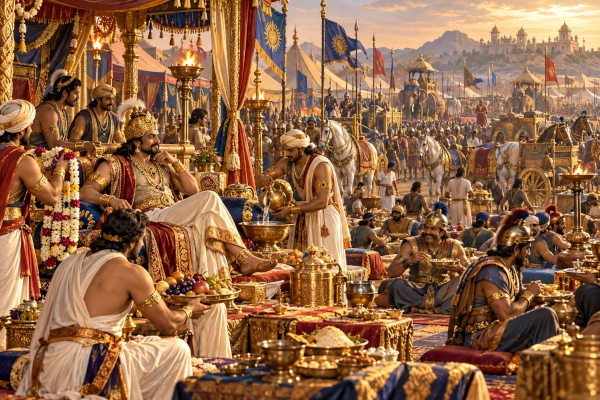
The Mahabharata’s account of Duryodhana winning King Shalya through hospitality is one of its clearest examples of diplomacy conducted through generosity, obligation and timing rather than through formal negotiation. Shalya had already set out with the intention of supporting the Pandavas, but Duryodhana intervened before that alliance was formally completed and turned hospitality into a political instrument.
The episode is important because Shalya was not an undecided ruler looking for the best offer. He was already inclined towards the Pandavas through family ties and political sympathy. Duryodhana therefore did not try to defeat that preference through argument. He created a different kind of leverage, one based on gratitude and the binding force of a promise. The result was that a king travelling to strengthen the Pandavas entered the Kaurava camp instead.
Shalya Set Out to Join the Pandavas
King Shalya of Madra had a natural connection with the Pandavas because his sister Madri was the mother of Nakula and Sahadeva. When the political situation moved towards war, Shalya set out with his army intending to support them. His military strength and royal standing made him an important ally, and his arrival would have added both soldiers and prestige to the Pandava coalition.
Duryodhana understood this before Shalya reached the Pandavas. Rather than wait for Shalya to join their camp and then attempt to persuade him to change sides, he acted while the alliance was still in transit. That timing was essential. Once Shalya had publicly joined Yudhishthira and accepted his hospitality, reversing the decision would have been far more difficult.
Duryodhana Turns Hospitality Into Political Leverage
Duryodhana arranged lavish hospitality for Shalya and his large army along the route. Food, rest, accommodation and other comforts were provided on such a scale that Shalya was deeply impressed. Crucially, Shalya believed that Yudhishthira had arranged everything for him.
That mistaken assumption shaped the entire diplomatic outcome. Shalya accepted the hospitality believing it came from the very side he intended to support, and his gratitude grew before he knew who had actually provided the benefits. By the time the truth emerged, his response had already created an obligation.
Duryodhana’s move was therefore more sophisticated than a simple gift. He created the conditions in which Shalya would voluntarily bind himself before the political request was revealed.
A Boon Was Offered Before the Benefactor Was Known
Pleased by the hospitality, Shalya declared that he wished to reward the person responsible and offered a boon. Only after that promise had been made did Duryodhana reveal himself as the true benefactor and ask Shalya to support the Kauravas.
The sequence matters. Shalya was not first asked to change sides and then offered rewards. The obligation came first, while the political request came later. This changed the character of the decision because Shalya no longer considered himself completely free to refuse without dishonouring his own word.
Duryodhana had therefore achieved something that direct persuasion might not have accomplished. He used Shalya’s own sense of honour as the mechanism through which political support was secured.
Why Shalya Felt Bound to Honour His Word
Shalya’s agreement did not come from a sudden change in his affection for the Pandavas. His family relationship with Nakula and Sahadeva remained unchanged, and his political sympathies did not disappear. What changed was the existence of a promise that he believed he could not withdraw.
This distinction between formal obligation and genuine loyalty is central to the episode. Duryodhana obtained Shalya’s participation, but he did not completely win his allegiance in the emotional or political sense. Shalya joined the Kaurava side because he considered his word binding, not because Duryodhana had persuaded him that the Kaurava cause was more just.
The alliance was therefore useful but internally fragile. It rested on honour and obligation rather than shared political purpose.
Yudhishthira Responds With Counter-Diplomacy
When Shalya later met the Pandavas and explained what had happened, Yudhishthira did not demand that he break his promise. Instead, he accepted that Shalya regarded himself as bound to Duryodhana and looked for another way to influence events.
Yudhishthira asked Shalya to act in a manner that would weaken Karna when Shalya later served as his charioteer. The request added a second layer of diplomacy to the same relationship. Duryodhana had secured Shalya’s formal allegiance through hospitality, while Yudhishthira relied on family ties and personal trust to shape Shalya’s conduct from within the Kaurava coalition.
The episode therefore becomes more than a story of one ruler changing sides. It becomes a contest over how far each side could influence the same man under different forms of obligation.
Gifts, Hospitality and Political Debt
The deeper principle behind Duryodhana’s strategy was reciprocity. Generosity often creates an expectation that the recipient will respond in some way, and diplomacy can use that expectation deliberately. A gift, favour or act of hospitality may appear personal, but it can become politically important when it creates access or obligation.
Duryodhana’s hospitality was effective because it did not initially look like a negotiation. Shalya experienced the benefit before he knew what might later be asked of him. By the time the request came, the relationship had already been altered.
The Mahabharata therefore presents hospitality not merely as courtesy, but as something that can acquire strategic meaning when its purpose is political.
The Importance of Knowing Who Is Giving and Why
Shalya’s error was not simply that he accepted generous treatment. The more important problem was that he accepted it without knowing its true source. He assumed that Yudhishthira had arranged the hospitality and allowed that belief to shape his promise.
That makes the episode a useful warning about attribution in diplomacy. A benefit cannot be properly understood without knowing who provides it, why it is being provided and what expectations may follow from accepting it.
In modern diplomacy, the same principle can apply to aid, investment, military assistance, infrastructure financing, political hospitality and other forms of support. These arrangements may be entirely legitimate, but they are rarely politically meaningless when they create dependence, gratitude or expectations of reciprocity.
Duryodhana’s Success Was Real but Incomplete
Duryodhana’s strategy was undoubtedly successful in its immediate objective. He prevented Shalya from joining the Pandavas and secured his support for the Kaurava side. The operation also showed considerable political intelligence because it required timing, organisation and a clear understanding of Shalya’s character.
Yet the method also contained a weakness. Duryodhana won Shalya’s promise, but he did not erase Shalya’s deeper loyalties. The difference became important later because Yudhishthira was still able to influence him.
The episode therefore distinguishes between compliance and conviction. Diplomacy can secure the first without necessarily achieving the second, and coalitions built on obligation may remain vulnerable to competing loyalties.
The Diplomatic Lesson
The story of Duryodhana and Shalya is one of the Mahabharata’s strongest examples of diplomacy through gifts, hospitality and obligation. Duryodhana did not defeat Shalya in debate and did not force him through coercion. He created a sense of indebtedness before revealing the political request, allowing Shalya’s own code of honour to do the rest.
The episode also shows why generosity in politics must be examined carefully. Gifts and hospitality can create goodwill, but they can also create expectations. Their real significance often becomes visible only when the benefactor asks for something in return.
At the same time, Shalya’s divided loyalties show the limits of such diplomacy. An obligation can change behaviour without changing conviction. Duryodhana won Shalya’s formal support, but Yudhishthira retained enough personal influence to shape how that support would later be expressed.
The larger lesson is therefore not that gifts simply buy loyalty. It is that political generosity can create leverage, but lasting alliances require more than obligation alone.
References
Mahabharata, Udyoga Parva — passages describing Shalya’s journey, Duryodhana’s hospitality, the boon and Shalya’s commitment to the Kaurava side.
Mahabharata, Critical Edition — Bhandarkar Oriental Research Institute, Pune; Udyoga Parva.
Kisari Mohan Ganguli, The Mahabharata — Udyoga Parva sections concerning Shalya, Duryodhana and Yudhishthira.
Bibek Debroy, The Mahabharata — Udyoga Parva translation based on the Critical Edition.
You may also like
-
India Strengthens Trade Ties with Netherlands as Piyush Goyal Visits Port of Rotterdam
-
India to Train 600 Nigerian Army Soldiers in Specialised Jungle and Mountain Warfare
-
India and Russia Strengthen Parliamentary Diplomacy as Om Birla Meets State Duma Chairman Vyacheslav Volodin
-
India Seeks South Korean Shipbuilding Partnerships as Sarbananda Sonowal Begins Four-Day Visit to Busan
-
India and Italy Hold First Maritime Security Dialogue in Rome, Strengthen Strategic Maritime Cooperation
