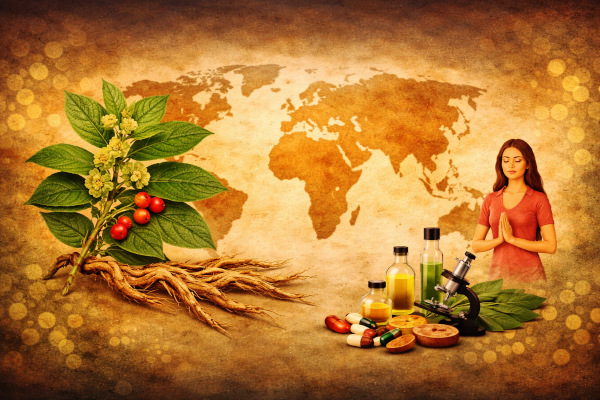
There was a time when Ashwagandha lived mostly in the pages of Ayurveda, in village medicine chests, and in the quiet advice of vaidyas who prescribed it for weakness, poor sleep, nervous exhaustion, and slow recovery. Today, that same herb has stepped onto the global stage. In December 2025, Ashwagandha was the focus of a dedicated side event at the 2nd WHO Global Summit on Traditional Medicine in New Delhi, reflecting how seriously the world is now taking evidence-based traditional medicine. India’s Ministry of Ayush described Ashwagandha as one of Ayurveda’s most revered Rasayana herbs, while WHO’s 2025 summit framed traditional medicine as an area where research, regulation, biodiversity, and public health now intersect.
Ashwagandha’s scientific name is Withania somnifera. It is also commonly called Indian ginseng or winter cherry, though it is not a true ginseng. In simple terms, Ashwagandha is best understood as a medicinal herb rather than a food crop. People do not usually take it because it is rich in calories or protein. They take it because the plant contains natural compounds that may affect stress response, sleep, inflammation, and resilience. The U.S. National Institutes of Health notes that Ashwagandha is rich in phytochemicals, especially with anolides and alkaloids, and that these are thought to be responsible for many of its studied effects.
The name itself tells a story. “Ashwa” means horse and “gandha” means smell in Sanskrit. Traditionally, the root was said to have a horse-like odor, and the plant was also associated with the idea of imparting horse-like stamina and vigor. The species name somnifera means “sleep-inducing,” which aligns with the herb’s long traditional reputation as a calming, restorative plant. This is one reason Ashwagandha has remained central to Ayurveda for centuries: it was never seen as a flashy quick-fix herb, but as a steady, rebuilding one.
Botanically, Ashwagandha is a small shrub belonging to the Solanaceae family, the same broad family that includes tomato, potato, and brinjal. It is usually described as a branched shrub around 35 to 90 cm tall, though size can vary with growing conditions. It has dull green leaves, small greenish bell-shaped flowers, and bright orange-red berries enclosed in a papery covering. Botanical references describe it as a hardy plant suited to warm, dry, and semi-arid environments.
As for where it is found, Ashwagandha is widely associated with India, but its range is broader. Botanical databases list it across parts of Africa, the Middle East, and South Asia, and Indian flora records also show it across dry regions of the Indian subcontinent. In India, it is especially linked with drier states and semi-arid belts where medicinal-plant cultivation is feasible. This ability to grow in relatively harsh conditions is one reason it has long been valued not only medically, but also agriculturally.
In Ayurveda, the most important medicinal part is the root. The Ministry of Ayush’s advisory makes this especially clear: the Ayurvedic Pharmacopoeia recognizes Ashwagandha as the dried mature roots of Withania somnifera. While leaves and other parts of the plant are studied in modern research, classical Ayurvedic usage is rooted mainly in the mature root. That distinction matters, because many commercial products sold under the same name may not contain the same plant part or the same chemistry.
From the Ayurvedic point of view, Ashwagandha is traditionally classified as a Rasayana, a category associated with rejuvenation, nourishment, vitality, and long-term strengthening of the body. In everyday language, that means it has historically been used when a person feels depleted rather than overstimulated: tired after illness, physically weak, mentally overworked, emotionally frayed, or slow to recover. Ayurveda has long placed it in the category of herbs that help the body regain steadiness. Modern government publications from CCRAS and the Ministry of Ayush continue to describe it in this rejuvenative and restorative framework.
Modern science, however, asks a different question: not “what is its traditional category?” but “what exactly does it do, and how strong is the evidence?” Here the answer is promising but not magical. The NIH Office of Dietary Supplements says the strongest modern evidence is for stress, anxiety, and sleep, where several clinical trials suggest Ashwagandha extracts may help reduce perceived stress and anxiety and may improve sleep in some adults. But the same NIH source also emphasizes that more research is needed, especially because studies use different doses, different extracts, and even different plant parts.
That is an important reality check. Online discussions often portray Ashwagandha as if it can cure everything from burnout to infertility to thyroid problems to depression. The evidence does not justify that kind of exaggeration. Scientific interest is real, and the results in stress-related research are encouraging, but good medicine requires caution. Ashwagandha may be useful for some people in some situations; it is not a miracle herb that replaces diagnosis, medical care, sleep, nutrition, or mental health support.
Nutritional information
Because Ashwagandha is usually taken in small medicinal amounts, its nutrition is not as practically important as its phytochemistry. Still, one published analysis of dehydrated Ashwagandha root powder reported the following approximate values per 100 g:
- Moisture: 7.45%
- Ash: 4.41 g
- Protein: 3.9 g
- Fat: 0.3 g
- Crude fibre: 32.3 g
- Carbohydrate: 49.9 g
- Energy: 245 kcal
- Iron: 3.3 mg
- Calcium: 23 mg
- Total carotene: 75.7 µg
- Vitamin C: 5.8 mg
These numbers should be read with caution. They refer to root powder, not necessarily to branded extracts or capsules, and the exact nutrient values can vary with soil, climate, processing, and plant variety. In real life, most people consume only a few grams a day, so the herb’s value usually lies more in its therapeutic constituents than in calorie or mineral contribution.
So what exactly is inside Ashwagandha?
Its best-known compounds are withanolides, a group of naturally occurring steroidal lactones. Researchers also study its alkaloids and other secondary metabolites. These compounds are thought to contribute to Ashwagandha’s adaptogenic, anti-inflammatory, antioxidant, and possibly neurobiological effects. But the chemistry is not identical across the whole plant. Roots, leaves, and extracts can differ substantially. That is one reason two products that both say “Ashwagandha” on the label may not behave the same way in the body.
Because many readers ask about nutrition, it is worth being very clear: Ashwagandha is not primarily used as a nutrient food. Its importance lies mainly in phytochemicals, not in macronutrients. Still, one published analysis of dehydrated Ashwagandha root powder reported approximate values per 100 grams of powder as follows: moisture 7.45%, ash 4.41 g, protein 3.9 g, fat 0.3 g, crude fibre 32.3 g, carbohydrate 49.9 g, energy 245 kcal, iron 3.3 mg, calcium 23 mg, total carotene 75.7 µg, and vitamin C 5.8 mg. These numbers are useful as a rough guide, but they should not be overinterpreted because they refer to analyzed root powder, not all branded extracts or capsules, and most people consume Ashwagandha in much smaller amounts than 100 grams.
That last point matters a lot in practical use. A medicinal herb can have a measurable nutrient profile on paper and still not function in the body like a food. For example, even though Ashwagandha root powder contains fibre and some minerals, people generally take a few grams, not a bowlful. So its real value is not that it feeds the body like spinach or lentils. Its value lies in the bioactive compounds that may influence stress biology, sleep quality, and overall resilience.
Ashwagandha’s “going global” story is not just marketing.
It is now being discussed in forums that focus on quality, safety, standardization, and public health. At the 2025 WHO Global Summit on Traditional Medicine, the herb was highlighted in a dedicated international discussion. India’s Ministry of Ayush explicitly framed Ashwagandha as a bridge between traditional wisdom and modern evidence. That does not mean the herb has been universally validated for every claimed benefit. It means the conversation has matured: the world is no longer dismissing such plants as folklore alone, but is also not accepting them blindly. The current mood is one of careful global scrutiny.
Safety is part of that scrutiny. NCCIH says Ashwagandha is not right for everyone and can cause side effects. Caution is especially advised during pregnancy, and it may not be suitable for people with certain autoimmune disorders or those taking sedatives or medicines that interact with the immune, endocrine, or nervous systems. NCCIH also notes there have been concerns about possible liver injury in some cases. The Ministry of Ayush’s safety report likewise stresses that Ashwagandha should be used responsibly and with attention to dosage, plant part, formulation quality, and patient context. Natural does not automatically mean risk-free.
This is where Ayurveda and modern science can actually complement each other. Ayurveda contributes the long civilizational memory: how the herb has been used, for whom, in what form, and in what health context. Modern science contributes controlled trials, toxicology, chemistry, standardization, and pharmacovigilance. When both are taken seriously, the result is neither blind faith nor cynical dismissal. It is a more mature understanding of a medicinal plant that has traveled from classical texts to modern laboratories and now to international health summits.
The best way to understand Ashwagandha is this: it is a traditional restorative herb that modern science finds genuinely interesting, especially for stress and sleep, but it is not a shortcut to health. It works best in a larger context that includes good sleep, proper food, physical activity, and medical guidance where needed. That balanced view is probably why Ashwagandha has endured for so long. It speaks both to an ancient human need for recovery and to a modern scientific desire to understand how plants influence the body.
Reference:
NIH Office of Dietary Supplements – Ashwagandha Fact Sheet for Health Professionals
https://ods.od.nih.gov/factsheets/Ashwagandha-HealthProfessional/
NCCIH – Ashwagandha: Usefulness and Safety
https://www.nccih.nih.gov/health/ashwagandha
Ministry of Ayush – Advisory on Ashwagandha
https://ayush.gov.in/resources/pdf/quality_standards/advisory-on-aswagandha.pdf
Ministry of Ayush – Report on Safety of Ashwagandha
https://ayush.gov.in/images/domains/quality_standards/safetyReportAshwagandha.pdf
CCRAS – Ashwagandha Booklet
https://ccras.nic.in/wp-content/uploads/2024/09/Revised-Ashwagandha-Booklet-9.8.2024-final.pdf
WHO – Second Global Summit on Traditional Medicine
https://www.who.int/teams/who-global-traditional-medicine-centre/global-summit-and-collaborations/second-traditional-medicine-global-summit
PIB – Global Experts Chart the Future of Ashwagandha at WHO Global Traditional Medicine Summit
https://www.pib.gov.in/PressReleasePage.aspx?PRID=2205492
World Flora Online – Withania somnifera
https://www.worldfloraonline.org/taxon/wfo-0001032779
India Flora Online – Withania somnifera
https://indiaflora-ces.iisc.ac.in/herbsheet.php?cat=13&id=12485
Nutritional composition of dehydrated ashwagandha root powder
https://www.homesciencejournal.com/archives/2016/vol2issue3/PartB/2-2-77.pdf
You may also like
-
Ayurveda on Cold Foods and Iced Drinks: Why Food Temperature Matters for Digestion
-
Serum Institute of India-Manufactured Ebola Vaccine Enters Clinical Trial in Uganda
-
Ayurveda and Hydration: How Much Water Should We Really Drink?
-
Warm Water in Ayurveda: When and Why It Is Recommended
-
Women Make Up 43% of India’s Ayush Workforce as Sector Supports 17.6 Lakh Livelihoods
