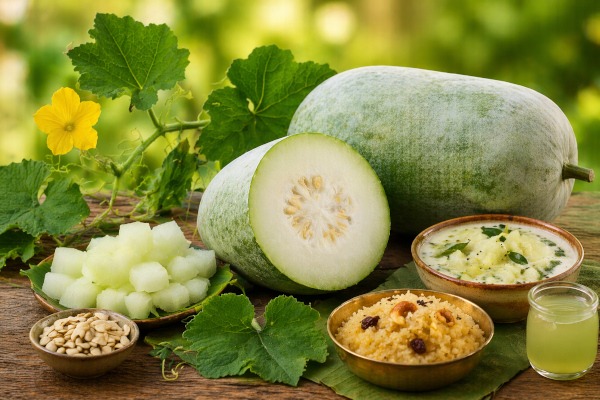
Ash gourd, botanically Benincasa hispida, is one of the most graceful vegetables in the Indian tradition because it sits at the meeting point of food, medicine, and seasonal wisdom. In Sanskrit it is widely known as Kushmanda, and official medicinal-plant records in India list the fruit, leaves, and seeds as used parts. Kerala’s State Medicinal Plants Board describes it as a cultivated climber of the Cucurbitaceae family, with large leaves, yellow flowers, and big succulent fruits, while classical Ayurveda-based food compendia continue to preserve Kushmanda in several nourishing formulations.
To identify the plant properly, look first at the vine. Ash gourd is a monoecious, hispid climber, which means the plant carries both male and female flowers and has a slightly rough or bristly habit. Its leaves are large, orbicular-cordate, and 5–7 lobed; the flowers are solitary, axillary, and yellow; and the fruit is large, juicy, and seed-filled, with yellowish-white seeds inside. In the field and in markets, one of its most recognizable signs is the pale waxy or ash-like bloom that develops on the mature fruit, which is why one common English name is “ash gourd” and another is “wax gourd.”
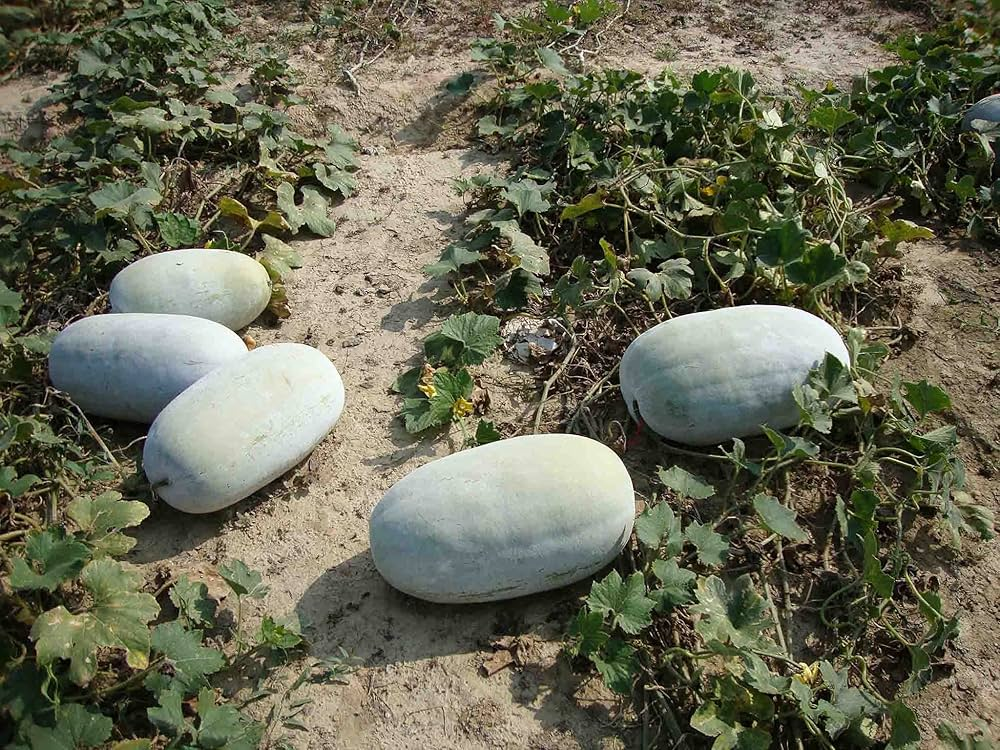
India’s own plant-variety system shows that ash gourd has meaningful natural and cultivated variation. The PPV&FRA guideline for ash gourd recognizes fruits that may be short, medium, or long, and cylindrical, round, oblong, or pear-shaped. It also records that some forms show prominent waxiness while others show little or none. In the officially listed vegetable varieties document, examples include Kashi Surabhi, whose fruits are oblong with a white wax coating and anthracnose resistance, Pusa Urmi, with oblong-ellipsoid fruits and white flesh, and Pusa Shreyali, with cylindrical fruits and white rind and flesh. So when Indian cooks say one kumbalanga is not quite like another, agriculture agrees with them.
In the Ayurvedic view, Kushmanda is cherished above all for its soothing and nourishing temperament. The FSSAI Ayurveda Aahara Compendium, which compiles classical food formulations, describes Kushmanda swarasa in one preparation as madhura (sweet), laghu (easy to digest), and sheeta (cool in potency). In other Kushmanda-based formulations, the compendium attributes qualities such as brimhana (nourishing the tissues), balya (strength promoting), and rasayana-type rejuvenative value. That is why ash gourd has such a respected place in Ayurvedic food culture: it is seen not merely as filling, but as calming, cooling, and quietly restorative.
Its nutritional profile supports that gentle reputation. In the Indian Food Composition Tables 2017, ash gourd is listed with about 92.17 g moisture, 0.79 g protein, 0.14 g fat, 3.37 g total dietary fibre, 2.84 g available carbohydrate, and 73 kJ of energy per 100 g edible portion, which works out to roughly 17 kcal per 100 g. India’s National Institute of Nutrition also places ash gourd among the country’s low-calorie vegetables in its dietary guidelines. In simple terms, it is light, hydrating, and easy to include generously in meals without heaviness.
Ayurveda also preserves ash gourd in a number of medicinal-food formulations, which is one of the strongest signs of its traditional esteem. The FSSAI compendium lists Kushmanda Avaleha, Kushmanda Rasayana, Kushmand Khanda, Kushmand Vati, Yavakshara Pana made with Kushmanda swarasa, and Nispavkushmanda Phala Paka. These are not random recipes. They show that classical Indian knowledge repeatedly chose ash gourd as a base for lickables, restorative preparations, and drinkable formulations, especially when a cooling, nourishing food vehicle was desired.
This is also where Indian cooking becomes especially beautiful. The vegetable is mild enough to receive spices without fighting them, and soft enough to combine with lentils, coconut, milk, or jaggery depending on the need of the meal. An official Indian nutrition-training manual from IGNOU lists olan as a curry made from ash gourd, red gram, and coconut milk. That one example alone explains a lot: the vegetable is paired with protein, softened by coconut, and kept relatively gentle in spice, creating a dish that is both satisfying and kind to the body. Classical Ayurvedic food literature goes further and shows Kushmanda entering confectionery-style preparations and therapeutic drinks as well.
In practical Indian kitchens, this opens many wholesome possibilities. A light ash gourd-lentil stew or olan-style preparation works beautifully when the weather is hot, when the appetite wants something soothing, or when one wants a meal that nourishes without burden. A mildly spiced kootu-style dish with moong or red gram keeps the vegetable grounded and digestible. A carefully made ash gourd juice or soft cooked ash gourd with cumin and ginger fits the same logic of lightness and ease. And sweet classical preparations such as Kushmanda Avaleha remind us that in India, even sweetness was often designed with purpose, structure, and balance rather than mere indulgence.
The plant itself is generous. The fruit is the star, but official medicinal-plant records also note the leaves and seeds in traditional systems. The seeds and fruit are both remembered in traditional usage, and that broad usefulness adds to ash gourd’s image as a complete household plant rather than a single-use vegetable. It is one of those crops that Indian civilization never treated casually: farmers selected different fruit forms, physicians preserved it in formulations, and home cooks gave it a place in daily meals.
So ash gourd deserves to be seen in the positive light that Ayurveda has long given it: as a cooling, nourishing, low-calorie, kitchen-friendly, and formulation-worthy vegetable. It is easy to identify, rich in culinary adaptability, and respected enough to appear both in official food-composition tables and in classical Ayurvedic preparations. And that leads to the deeper truth your article wants to end on: in India, the best recipes were never created merely to fill the stomach. They were designed to steady the body, support the mind, respect the season, and quietly act as medicine through food.
You may also like
-
Ayurveda on Fresh Food Versus Reheated Food: Why Freshly Prepared Meals Are Preferred for Healthy Digestion
-
Ayurveda on Cold Foods and Iced Drinks: Why Food Temperature Matters for Digestion
-
Serum Institute of India-Manufactured Ebola Vaccine Enters Clinical Trial in Uganda
-
Ayurveda and Hydration: How Much Water Should We Really Drink?
-
Warm Water in Ayurveda: When and Why It Is Recommended
